
Light Tower Overhead Power Line Clearance: Plan the Whole Mast Envelope
Plan light tower clearance around overhead lines using utility confirmation, the complete mast envelope, controlled travel routes and documented stop conditions.
Light tower overhead power line clearance must cover every part of the machine throughout arrival, mast raising, operation and removal. Check the lamp frame and the moving mast, not only the base position. Confirm line identity and voltage with the line owner, establish the required exclusion zone under the applicable rules, and choose a different setup location whenever the proposed movement cannot stay outside it. A drawing of the tower beneath a wire is not evidence that deployment is safe.
This guide is for planners, rental coordinators and site supervisors preparing temporary lighting. It does not authorize work near energized conductors, supply a universal clearance table or replace a utility-approved method. The purpose is to make the location decision complete before equipment arrives, while keeping the actual distance and protective measures tied to the site, voltage, activity and jurisdiction.
Identify the overhead service before choosing a lighting position
Start with a daylight survey of the arrival route and the operating area. Mark poles, crossing spans, service drops and routes that pass under wires. Do not decide that a line is harmless because it looks low, thin, covered or similar to a communications cable. The information needed is the line owner’s identification, its electrical status and the restrictions that apply to the planned activity.
Give the utility or site electrical coordinator a usable request: site address, proposed tower position, access route, machine dimensions, intended mast movements and work dates. A vague question about whether a location is safe invites a vague answer. Ask who confirms the information, what assumptions it depends on, and what happens if another contractor changes the route or work boundary.
Record uncertainty explicitly. If line voltage or status is unknown, the planning sheet should say that deployment in the affected area remains on hold. An unreturned email is not approval. Where power shutdown or other utility measures are proposed, keep confirmation of those measures with the job documentation instead of relying on a verbal message passed through several crews.
Treat clearance as a three-dimensional movement envelope
The closest point to a conductor may be the edge of a lamp frame, not the top of the mast tube. Include lamp orientation, any permitted mast rotation and every intermediate position during raising or lowering. Ground slope, settling and the machine’s permitted movements affect the envelope too. Use the manufacturer’s instructions to establish what movements are possible and which are prohibited.
A horizontal distance measured from the tracks alone can therefore be misleading. A tower can sit outside a marked line while an upper component enters the restricted space. Conversely, drawing a circle around the mast without considering conductor sag and movement may miss the limiting condition. Have a competent planner evaluate the relationship between the complete machine and the overhead service.
Do not use a generated photograph, a satellite screenshot or a perspective view to measure clearance. These can explain context, but they do not establish surveyed positions or vertical distances. Never raise a conductive tape or pole toward a line to discover its height. Arrange the assessment through the line owner and appropriately qualified people using suitable methods.
Apply the correct rules instead of treating one number as universal
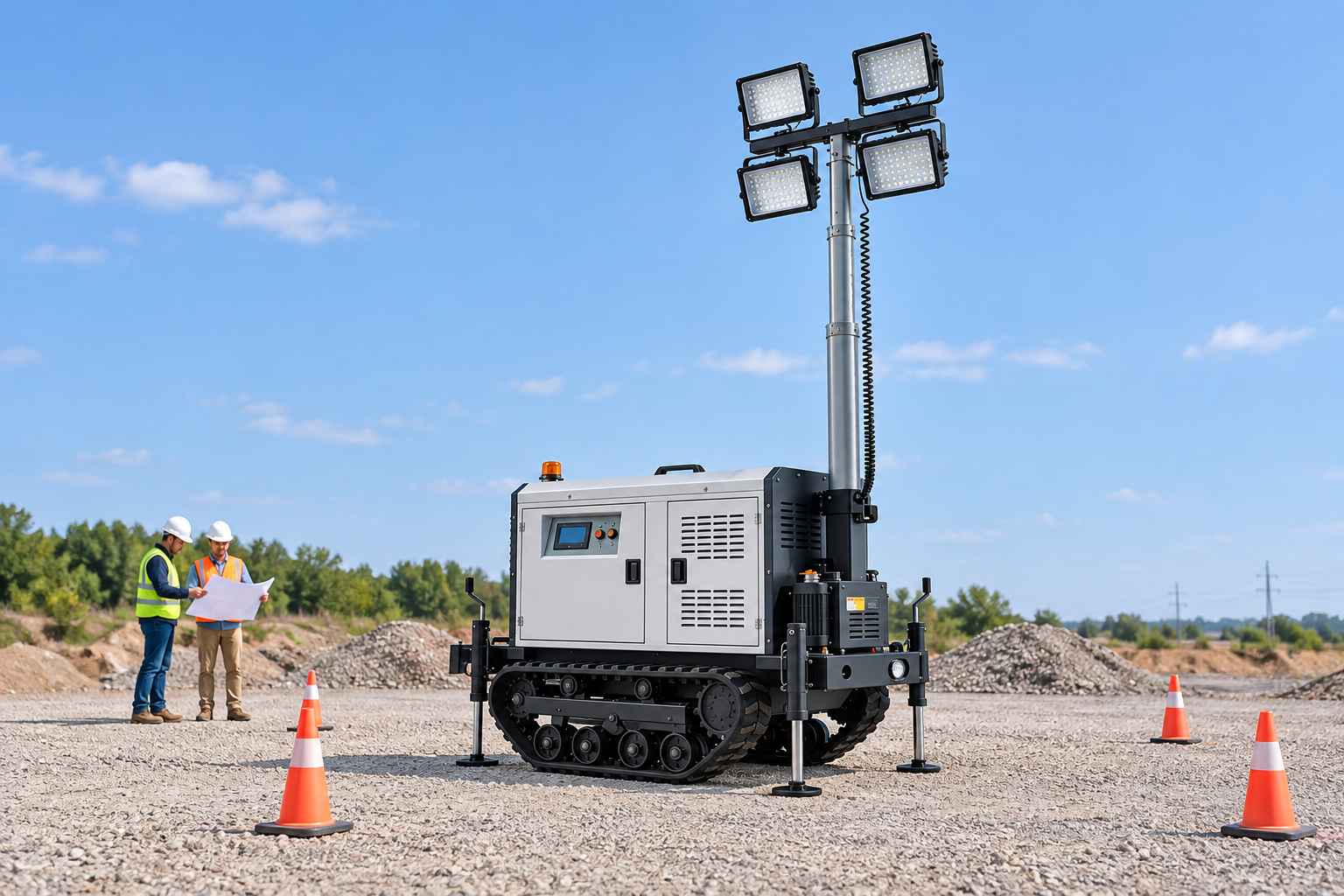
The Texas guidance linked below describes a minimum ten-foot separation and greater separation for higher voltages in its stated context. HSE GS6 describes planning and control measures for work near overhead lines in the United Kingdom. These references help explain why line identification and a controlled method matter; neither creates a universal approval for every light tower deployment.
Different activities can bring different rules into scope. Do not copy a crane clearance table and assume that it resolves all requirements for a stationary lighting unit, its delivery vehicle or nearby lifting work. Equally, do not use a general electrical-awareness distance to overrule a more restrictive site or utility requirement. Ask the responsible safety and electrical personnel to identify the applicable basis.
Keep units visible when a plan contains distances. If information arrives in feet but the drawing is in metres, have the conversion and the original requirement checked before marking the ground. Avoid rounding that reduces separation. The approved plan should identify what the dimension is measured from and what changes would require reassessment.
Use a deployment hold-point table
The following qualitative table is a planning aid, not a clearance schedule. Its basis is the utility coordination and work-control approach described in the linked Texas and HSE guidance. Complete the evidence column with the project’s actual records. A blank record means the associated decision has not been demonstrated, even if the equipment has already been delivered.
| Decision stage | Required action or information | Evidence or stop condition |
|---|---|---|
| Unconfirmed line identity or voltage | Keep the tower outside the uncertain area; ask the line owner to identify the service. | Written line-owner information and approved route |
| Proposed mast position near a corridor | Evaluate the lamp head, moving mast and possible line movement together. | Site drawing showing assessed limits and excluded ground |
| Arrival or relocation | Use the manufacturer’s transport configuration and an approved path. | Route briefing and transport-lock check |
| Conditions change after setup | Stop the affected operation and reassess rather than moving the barrier informally. | Updated plan and responsible person’s release |
Source basis: Texas Department of Insurance: power line safety; HSE GS6: avoiding danger from overhead power lines. Apply each source only within its stated scope.
A hold point needs an owner and a release condition. For example, the delivery coordinator can confirm the approved access route, while the designated site authority releases the operating location after the line information and machine envelope have been reviewed. The operator should know which document to follow and whom to call if the position on the ground differs from the drawing.
Separate travel controls from operating controls
Plan delivery with the manufacturer’s transport configuration established. Check the mast restraints and permitted travel arrangement before entering the route. A route that accommodates a lowered mast may not accommodate a raised one, and a successful arrival does not prove that the operating position is acceptable. Treat those as separate decisions with separate checks.
Look beyond the first parking location. The crew may later want to move the tower to remove a shadow, avoid a truck queue or reach another workface. Reserve any alternative location in advance or require a new review. Do not allow a small informal move to become the step that invalidates the original clearance assessment.
Protect the route against foreseeable changes such as stored materials, new fencing and vehicles that force a detour. A spotter should have an agreed position, reliable communication and authority to stop movement. The spotter’s role is to help maintain the approved method, not to grant permission to approach closer than the established boundary.
Keep the exclusion zone useful throughout the shift
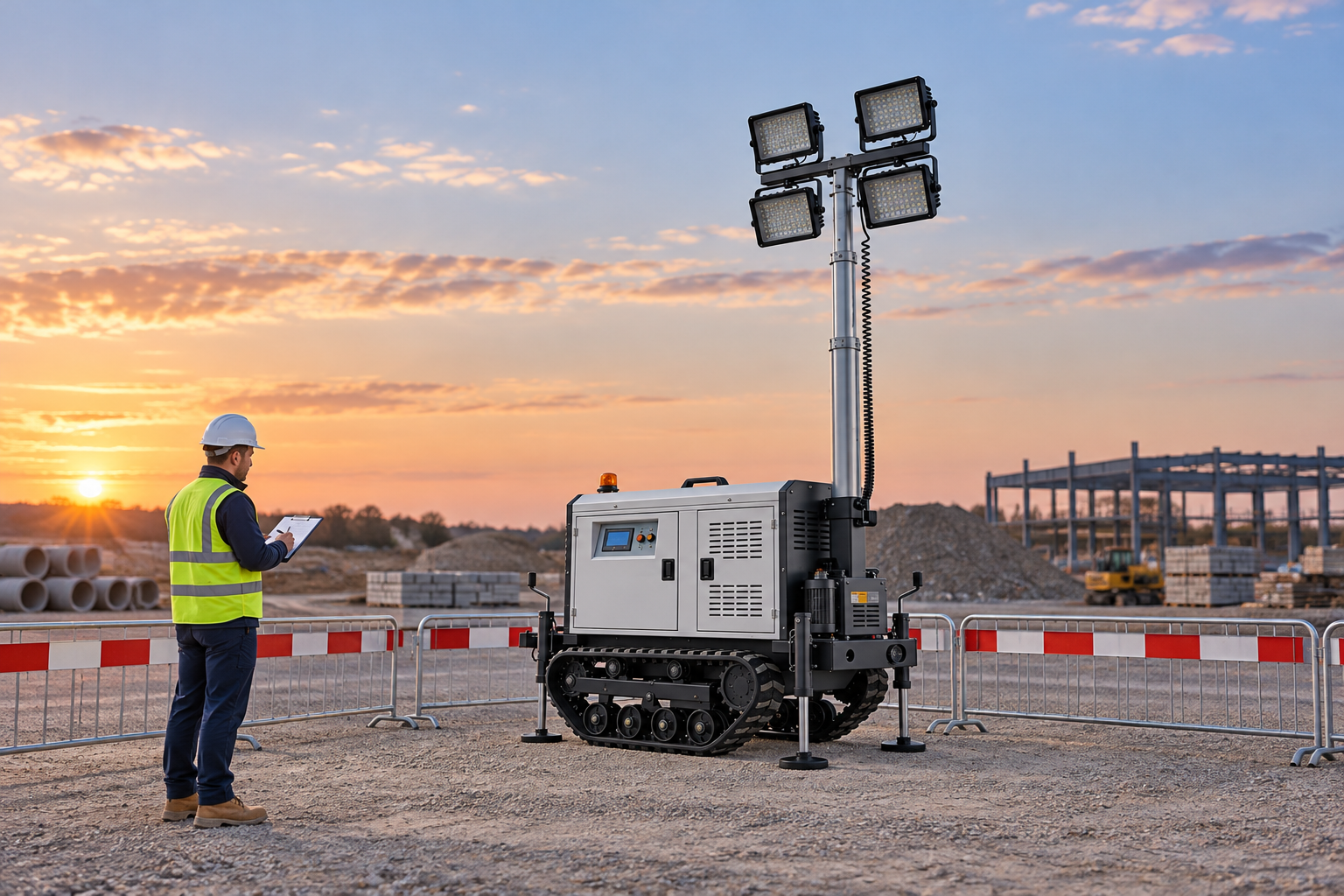
Place barriers and signs so that workers understand what ground is unavailable and why. Include space needed for the tower’s supports and the operating controls; do not put an operator’s normal standing position inside an excluded area. Coordinate with other trades so that barriers are not removed to create temporary storage or a shortcut.
During the shift, changed wind, poor visibility, altered traffic and moved materials can undermine the plan. Use the site’s stop-work conditions and the tower manufacturer’s operating limits. If the relevant boundary can no longer be maintained, stop the affected activity and have the location reassessed. Do not improvise a new approach while lighting demand is urgent.
If equipment may have contacted a line, keep people away and call the utility and emergency services. Do not touch the machine, the conductor or someone who may be in contact with energized equipment. Emergency arrangements should identify who raises the alarm and prevents people from approaching; this article does not provide a rescue or escape procedure.
Match the equipment record to the planned envelope
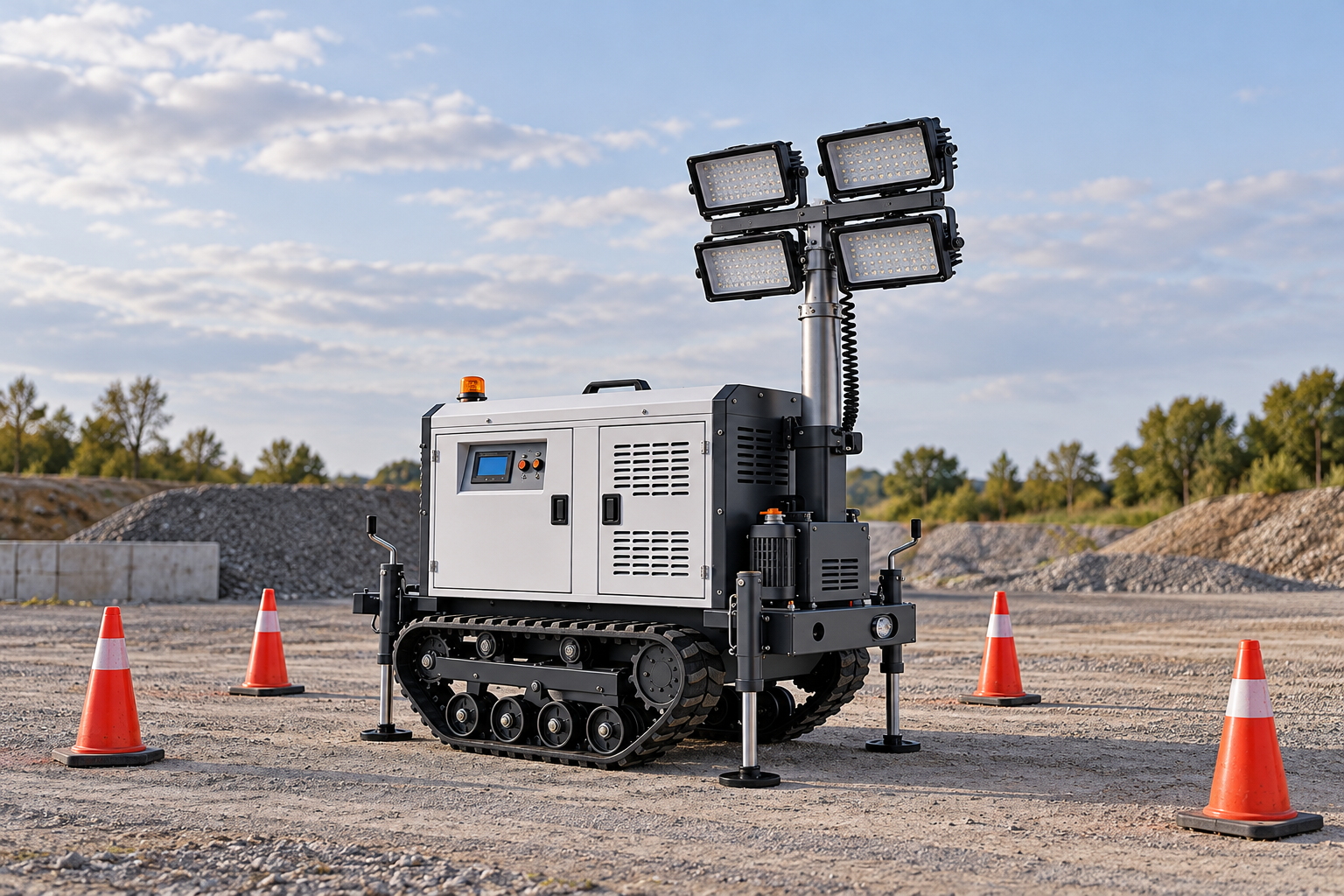
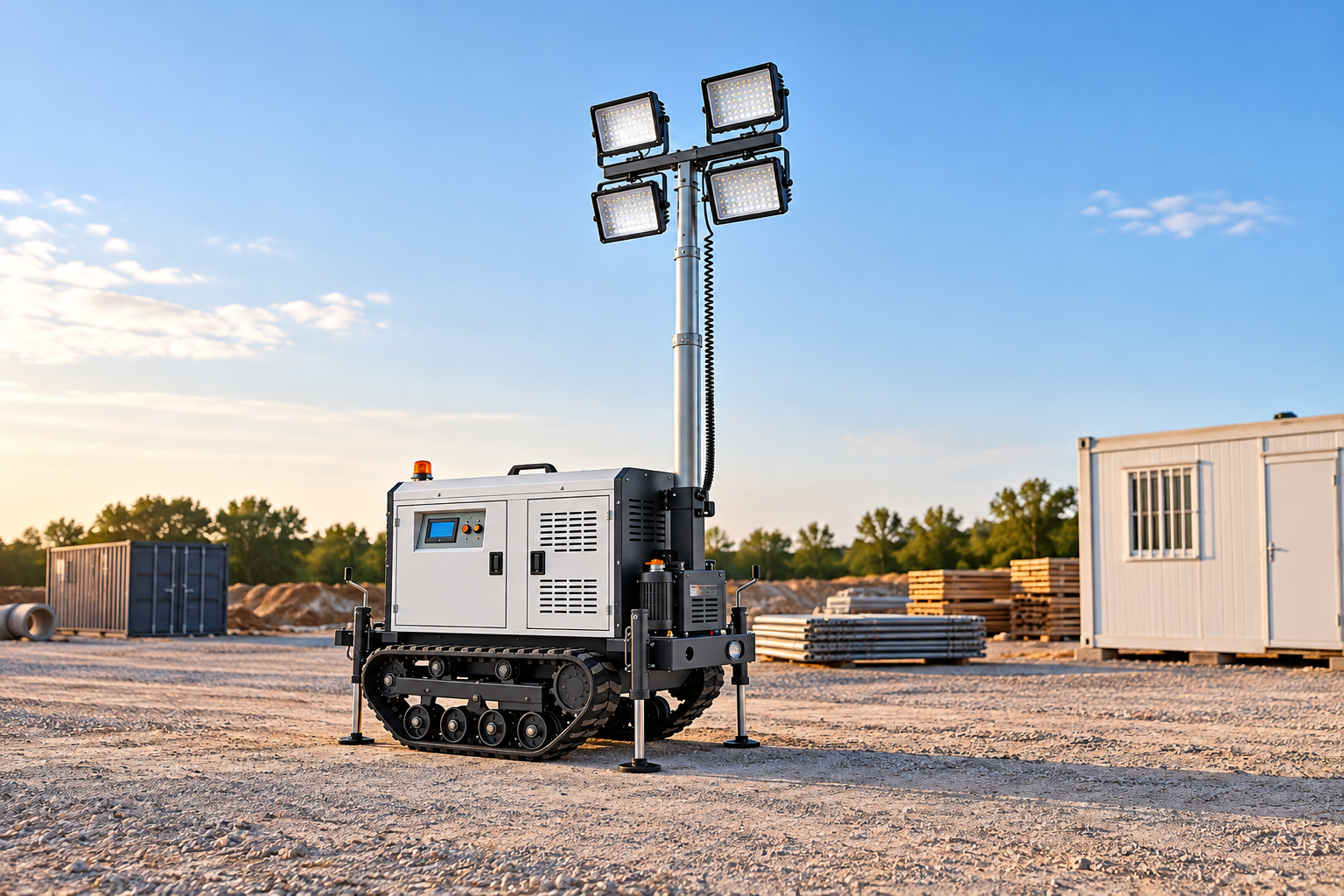
The reference product linked here is a tracked lifting light tower with four rectangular lamp heads. Its visible form helps a planner identify the type of moving assembly that must be considered. It does not establish an electrical insulation rating, approved approach distance or permission to operate near power lines. Confirm the exact supplied variant and its current manual before use.
A request for quotation should include the required transport dimensions, operating geometry, permitted mast movements, restraint details and available instructions. Ask for drawings rather than estimating from a marketing photograph. If a proposed substitute has a different lamp frame or mast arrangement, return it to the envelope review even when its advertised light output is similar.
Keep lighting performance and electrical separation connected in the layout decision. If the safe location leaves a workface poorly lit, redesign the lighting arrangement or add suitable equipment in another approved location. Do not solve the illumination shortfall by accepting an unassessed position under a line. The correct outcome may be a different layout rather than a taller mast.
Brief the crew and retain a usable release record
Before setup, walk the operator through the actual route, marked boundary, authorized position and stop conditions. Explain which information has been confirmed and which changes invalidate the release. A short briefing beside the approved location is more useful than a generic safety signature that never mentions the overhead service.
Retain the utility correspondence, equipment drawing, site sketch, named decision owner and final location check with the shift record. During removal, apply the planned lowering and travel method again. A controlled installation does not eliminate the risk at demobilization. Close the record only after the unit has left the affected area through the agreed route.
Equipment and related planning
Review the tracked lifting light tower product reference and the light tower safety overview. For adjacent decisions, read mast transport locks and wind-rating limits. Confirm the actual supplied configuration before applying any procedure.
Further learning from the Electrical Safety Foundation International
This independent electrical-safety resource explains the hazard discussed above. It is educational context, not a light tower repair, operating or approval procedure.
Watch the educational video on YouTube.
Frequently asked questions
Is ten feet always enough clearance?
No. Ten feet appears in some United States guidance, but the applicable distance depends on voltage, activity and jurisdiction. Obtain the line owner’s information and apply the relevant rules before positioning or moving the tower.
Does a tracked base make the tower electrically insulated?
No. Rubber tracks are mobility components, not a verified electrical protective system. Do not use them as a reason to reduce an exclusion zone or touch potentially energized equipment.
Can a spotter approve a closer approach?
A spotter helps maintain an already approved boundary. The spotter cannot replace utility coordination, required protective measures or the applicable clearance assessment.
What should happen after possible contact with a power line?
Keep people away from the machine and the surrounding area, alert the utility and emergency services, and follow the site emergency plan. Do not touch the tower or attempt an improvised rescue.