
Light Tower Dust Exposure Assessment: Sources, Crew Routes and Control Checks
Assess nearby dust-producing tasks, lighting-crew exposure, access routes and control failures without confusing enclosure ratings with worker protection.
Light tower dust exposure assessment should identify the dust-producing activities near the lighting work, determine who may breathe the dust, and agree effective controls before deployment. A tower's enclosure rating does not describe the quality of the air around its operator. Good illumination also cannot show every harmful particle. Assess setup, checks and retrieval as work activities within the wider site, then coordinate with the contractor controlling the dust source. Where exposure is uncertain, obtain competent occupational-hygiene advice rather than treating a clear-looking scene or an outdoor location as proof that controls are adequate.
Define the people and tasks within the assessment
Start with the lighting crew's actual movements. A tower may remain stationary while people walk past a cutting area, wait beside a haul road or return to inspect the unit. Include delivery personnel, supervisors, cleaners and maintenance workers where their activities bring them into the affected area. Note the time and location of each activity instead of assessing only the tower's final parking position.
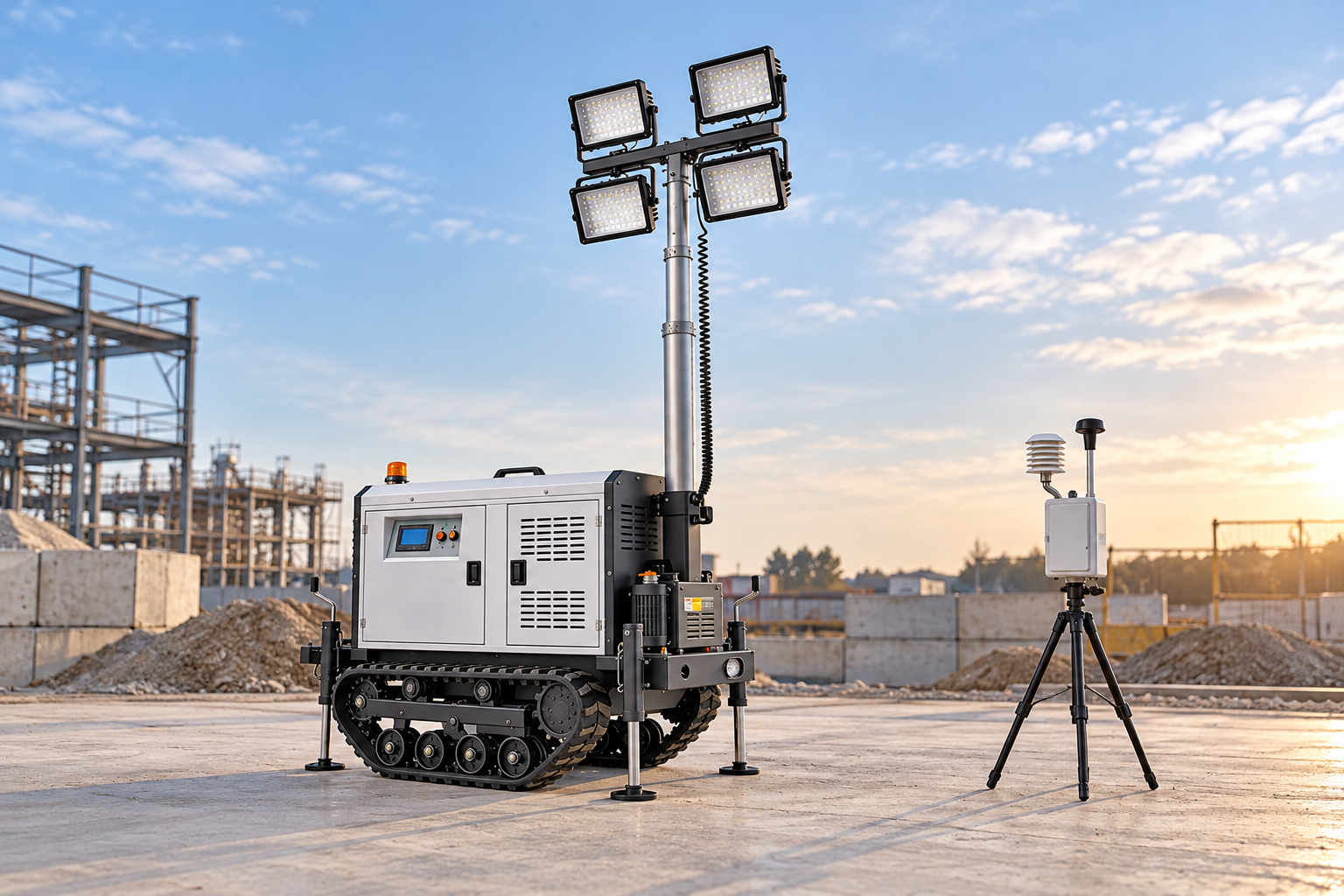
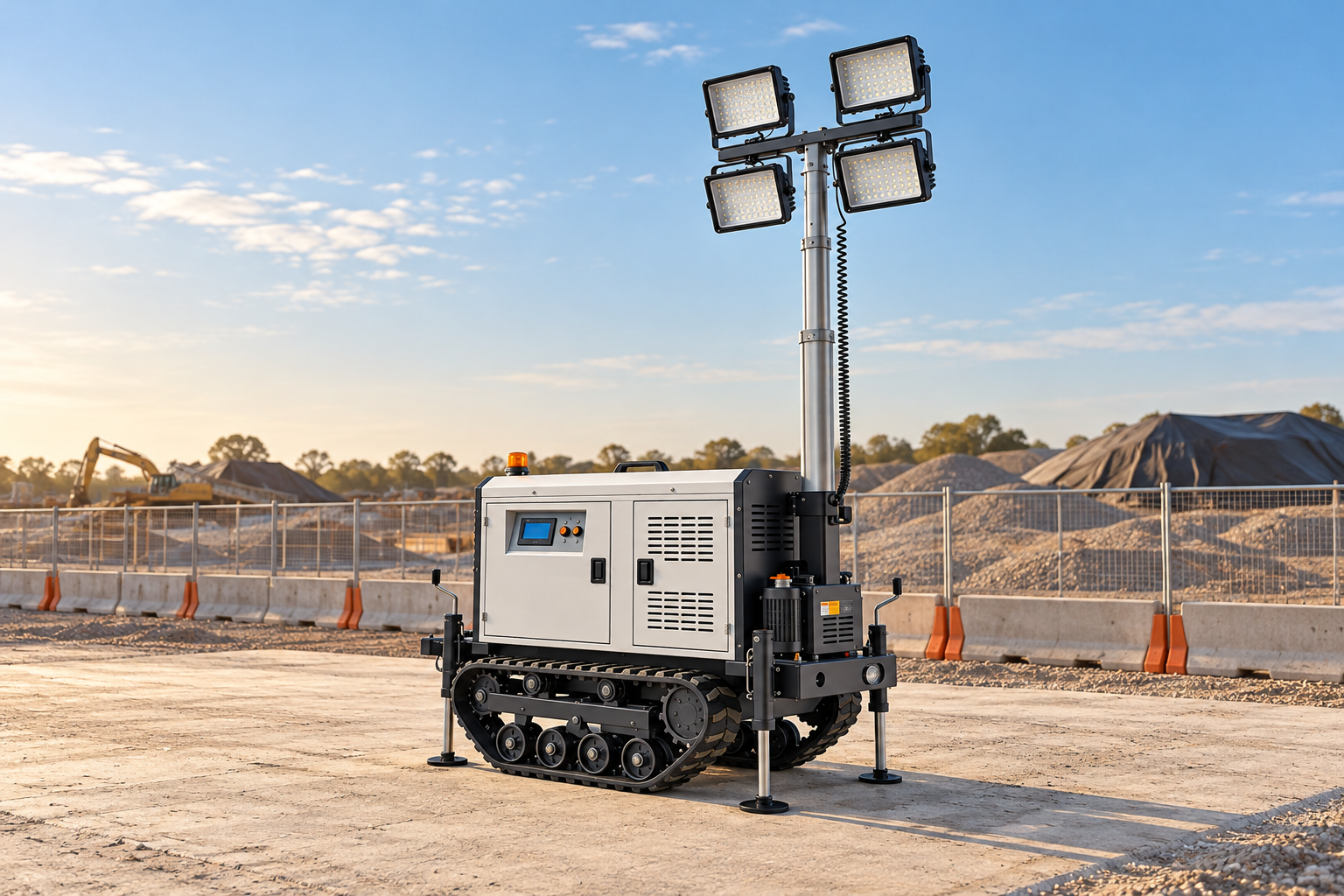
The Keyyou tracked lifting light tower is the equipment reference in this article. Its crawler tracks, stabilizers, silver cabinet, mast and four lamp heads identify the pictured product. They do not establish a dust-exposure limit, a hazardous-area approval or a respiratory-protection requirement. Obtain the delivered machine instructions for its placement and maintenance needs. Assess worker exposure separately, while ensuring that the selected work position also meets the equipment and site requirements.
Identify the source before selecting controls
Ask what materials will be cut, drilled, broken, tipped or moved during the lighting shift. Construction dust is not a single substance. Material composition and the work method influence what may enter the air. Obtain relevant task information from the contractor performing the work, including the material and planned dust controls. A generic entry saying dusty site does not tell the lighting crew which route or activity needs a change.
HSE construction-dust guidance uses an assess, control and review approach. For the lighting interface, make the first assessment specific: which nearby task can affect the crew, when it will occur, and who controls it. Do not assume that a machine operating at a distance creates no exposure, or that every visible cloud has the same significance. If the material or exposure cannot be characterized confidently, escalate the uncertainty before assigning a supposedly safe position.
Planning basis: Construction dust – HSE, Dust – HSE, COSHH Essentials – COSHH. The table organizes qualitative site decisions; it does not establish numerical exposure limits or machine approvals.
| Observed condition | Decision | Evidence or responsibility |
|---|---|---|
| Material and source task are unknown | Obtain the task and material information before selecting controls | Source contractor supplies the relevant assessment and method |
| Dust-producing work moves beside the access path | Review the route and coordinate an alternative | Site lead checks exposure and the new route hazards |
| Extraction or suppression is not working as agreed | Pause affected access and escalate to the source contractor | Named contact confirms restoration or an accepted alternative |
| A monitoring result has no task or method context | Seek competent interpretation before relying on it | Occupational hygienist defines sampling scope and limitations |
| Deposits remain on returned equipment | Plan handling and cleaning using the substance and machine instructions | Receiving team confirms method and any specialist support |
Map the source, airflow and crew route
Mark the tower pad, access path, work positions and recovery area on the same site sketch as the dust-producing tasks. Consider changing wind, temporary barriers, vehicle movements and enclosed or sheltered spaces. The purpose is to understand likely interfaces and avoid unnecessary exposure. It is not to draw an arbitrary circular boundary around the tower and declare everything beyond it safe.
Review the sketch at the time of work. A route selected in the morning may be unsuitable after another contractor moves a cutting station or opens a stockpile. Workers should know how to report that change and which alternative route is approved. Avoid moving the tower informally in response to dust; a new position also needs checks for stability, traffic, overhead hazards and lighting performance. Coordinate the exposure control and the equipment relocation as related decisions.
Control the dust-producing activity where possible
Discuss whether the dusty task can be avoided, changed, enclosed, extracted or otherwise controlled through an appropriate method. The responsible contractor and competent advisers should select and verify those measures. Moving a lighting operator away from an uncontrolled source may reduce one person's exposure while leaving others at risk. Source control is therefore a shared planning issue, not a problem the lighting supplier can resolve alone by choosing a different lamp angle.
Agree what evidence will be available before the lighting crew enters the area. This might include a confirmed task method, a control inspection or a specialist review, depending on the work. A promise to keep dust down is too vague if nobody checks whether the control is functioning. Record the person authorized to pause the affected work when the agreed measures fail. Keep that instruction practical for a crew arriving after the main site briefing.
Decide whether monitoring is needed and what it can answer
A competent occupational hygienist can advise whether exposure measurements are needed and select an appropriate sampling strategy. Clarify the substance, task, worker group, period and decision the measurement is intended to support. Personal exposure assessment and an area observation answer different questions. A monitor standing beside the tower does not automatically represent the air breathed by a worker moving between tasks.
Ask how the instrument and method will be checked, how results will be interpreted and what limitations apply. Do not use a consumer display, a photograph of a dust cloud or an unexplained number as proof of compliance. Record the relevant task conditions with the result so a later reviewer can tell whether the work was representative. If the contractor changes the material, method or duration, ask whether the original assessment still applies before reusing its conclusion.
Do not use the beam as a dust detector
Light beams sometimes make airborne material more visible, but visibility is influenced by the light direction, background and particle characteristics. A beam that looks clear cannot demonstrate the absence of hazardous dust. Equally, a dramatic photograph cannot quantify a worker's exposure. Use visible dust as information that may require action, while relying on the appropriate assessment and controls for the actual decision.
Keep dust-exposure questions separate from lighting-quality questions. Dust can affect visibility and prompt a review of the work arrangement, but increasing brightness does not remove the substance from the air. Avoid a cycle in which the crew keeps adding illumination while an uncontrolled dusty task continues. Coordinate a pause or change with the source contractor and reassess the lighting requirement only after the work area and access arrangement are suitable.
Manage respiratory protection through the site program
Where respiratory protective equipment is needed, its selection, fit, compatibility, training and maintenance belong within a competent protection program. This article does not prescribe a universal mask type for light tower work. The decision depends on the substance, exposure, work activity and applicable requirements. A loose instruction to wear a mask leaves important questions unanswered and should not substitute for controlling the source.
Discuss other protective equipment and task demands at the same time. Communication, vision, heat and compatibility can affect how a worker carries out an inspection or responds to a problem. If the required protection makes the proposed activity impractical, change the activity with competent advice. Do not instruct workers to remove essential protection to see controls more clearly or communicate with a colleague. Provide a method that preserves all the necessary safeguards.
Include cleaning and maintenance without spreading contamination
At handback, tell the owner or maintenance contractor what dust-producing work surrounded the unit and what information is known about the material. This allows the receiving team to plan its assessment and handling method. Do not label all collected deposits harmless road dust without evidence. Equally, do not invent a contamination classification from the appearance of the cabinet or tracks.
The manufacturer's cleaning instructions and the site's substance-control requirements both matter. Do not improvise compressed-air cleaning, dry brushing or a washdown method that could create another exposure or damage the unit. The appropriate person should decide how deposits are managed, what protection is required and whether specialist handling is necessary. A machine that looks clean externally may still need a documented review before maintenance involving enclosed areas or accumulated material.
Set change triggers and a clear pause instruction
Before the shift, identify observable changes that require review: a different material, a relocated source, failed extraction, an unplanned dusty route or a substantial change in the work sequence. The lighting crew does not need to diagnose the exposure to report that the agreed arrangement has changed. Give them a named contact and an instruction for waiting in a suitable location while the responsible team responds.
Make the pause decision compatible with equipment safety. Authorized personnel may need to secure or isolate the tower, while other workers leave the affected area through an appropriate route. Avoid sending someone back through the dust simply to collect a routine reading. Any emergency response should follow the site plan and the responder's competence. Resume the activity only after the relevant controls have been restored or an alternative arrangement has been accepted.
Keep a useful exposure-interface record
Save the task description, source contractor, route sketch, control commitments and any specialist assessment reference with the deployment package. Include the date and the actual work conditions. A record that says dust checked provides little help when the next crew faces a different material or work method. Preserve uncertainty openly so a later supervisor knows what still needs to be established.
At closeout, ask whether the lighting crew could use the agreed route, whether controls stayed in place and whether unplanned entries occurred. Use the findings to improve the next coordination meeting. Keep personal health information within the appropriate confidential process rather than putting it in general equipment notes. The final result should explain how workers can reach, use and leave the lighting position without relying on assumptions about invisible exposure.
Equipment and related guidance
Use the Keyyou tracked lifting light tower product reference to identify the product context; obtain the actual delivered unit documentation for operational decisions. Continue with Light Tower Safety and Operation, plus demolition lighting and work interfaces, approved washdown and equipment release.
Further learning: Workplace Health Campaign – Dust
HSENI explains occupational lung disease and dust exposure in its Workplace Health Campaign. Use the film to support reporting and control awareness; it does not select a sampling method, exposure limit or respiratory protection for this deployment.
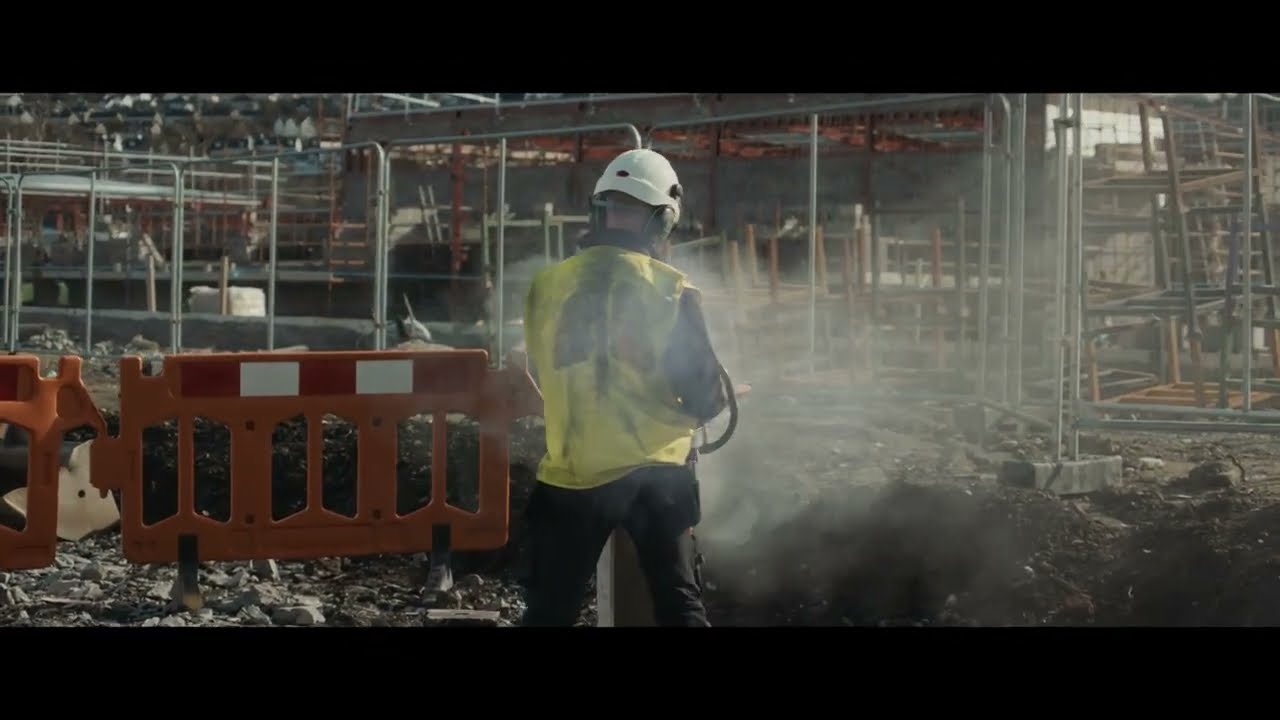
Watch the educational video on YouTube.
Frequently asked questions
Does an IP rating prove the operator is protected from dust?
No. An enclosure rating concerns equipment ingress under specified conditions. It does not measure the air breathed by workers or establish their exposure controls.
Can a clear light beam prove the air is safe?
No. Visibility is not a reliable exposure measurement. Use the relevant assessment, source controls and competent monitoring where required.
Is outdoor work automatically free from dust-exposure risk?
No. Workers can be exposed close to a source or along a dusty route. Consider the actual task, material, airflow and controls.
Can a fixed monitor beside the tower replace personal sampling?
Not automatically. Area and personal measurements answer different questions. A competent occupational hygienist should select the strategy for the decision being made.
Sources and scope
These authorities provide general principles within their respective jurisdictions. Apply the current destination rules and manufacturer instructions; these sources do not certify the pictured tower or establish machine-specific operating limits.