
Light Tower Cable Protection: Plan Routes, Crossings and Inspection Holds
Protect light tower supply and auxiliary cables with a planned route, suitable crossings, connector protection and clear defect isolation responsibilities.
Light tower cable protection requires a route that avoids traffic, sharp edges, hot surfaces, water and the machine's moving or supporting parts. Where a crossing cannot be avoided, use an arrangement assessed for the actual cable and traffic. Keep connections suitably protected and accessible for authorized inspection. A cable ramp does not make a damaged lead, an unsuitable supply or an unverified electrical arrangement safe.
This guide covers external supply, approved charging and auxiliary leads where the actual light tower configuration uses them. It does not assume that every tower has every connection. The objective is a route and inspection plan that remains safe when the site, weather or tower position changes, supported by the responsible electrical personnel.
Identify which cables actually belong to the system
Start with the delivered equipment and its current manual. List external power inputs, charging connections and auxiliary outputs that are supplied or approved. Do not assume that a socket visible in a photograph has a particular rating or function. Confirm the relevant circuit, connection arrangement and operating restrictions before planning the route.
Distinguish external temporary leads from factory-installed mast wiring. A lead on the ground and the cable moving with a telescopic mast face different stresses and need different instructions. Do not reroute, extend or secure mast wiring using a generic ground-cable method. Refer damaged or displaced factory wiring to the appropriate service process and keep the affected operation on hold.
Draw the route before connecting
Walk the path between the approved supply or outlet and the served equipment. Mark pedestrian movement, vehicle routes, doorways, storage areas, excavations and places where water collects. Consider the whole shift rather than the quiet setup period. A route that looks clear before deliveries begin may later cross the main forklift approach.
Prefer a route that avoids these conflicts through layout, rather than relying on protection at every conflict point. HSE advises separating cable routes and vehicle traffic where possible in event electrical planning. Apply that principle to the actual worksite with the responsible personnel, while retaining all local installation requirements and the manufacturer's instructions.
Record both ends of the route and the intended connection responsibility. A cable that disappears behind stacked materials is difficult to inspect and may encourage an operator to pull it without seeing a trapped section. Keep sufficient access for the authorized inspection and isolation process. Do not create a new obstruction in an emergency exit while trying to shorten a cable run.
Keep clear of the tower footprint
Protect the full contact area of tracks, wheels and stabilizer feet as applicable. A cable should not be routed through a place where the tower may settle, turn or be supported. Include the approach and relocation path, not only the final parked position. A lead can remain trapped beneath a track after the visible free section has been moved aside.
Look upward as well as along the ground. The mast, lamp frame and moving supports may catch an external lead if it is tied to an unsuitable part. Do not use the tower as an improvised overhead support unless an approved system specifically permits that use. Routing decisions should preserve access to controls, emergency stops, cabinet doors and required ventilation.
Assess unavoidable crossings as a system
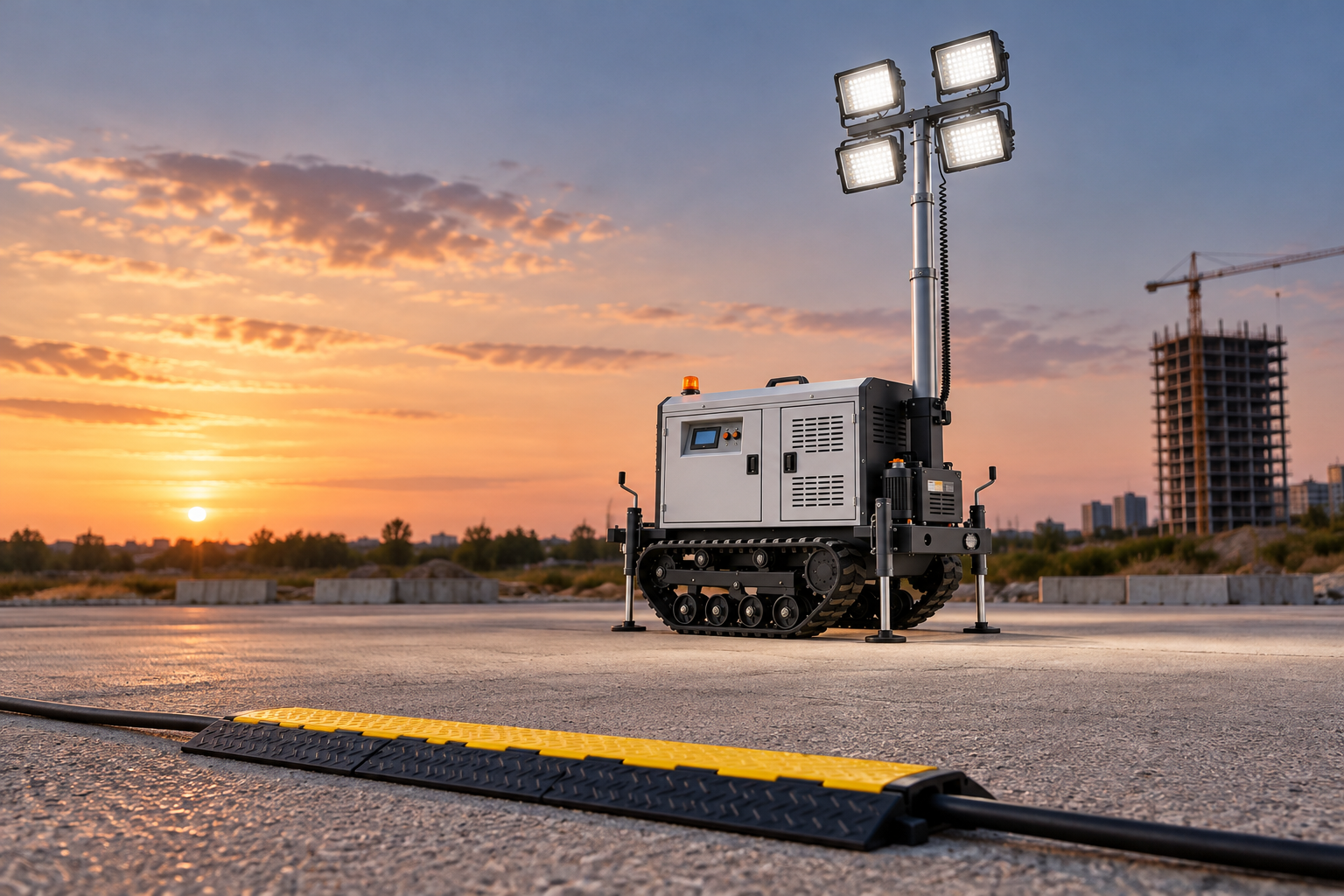
Where traffic must cross a lead, choose a protection arrangement for the actual vehicles, surface and cable. Check the manufacturer's load and installation limitations for the crossing equipment. A small pedestrian cover cannot be presumed suitable for a loaded construction vehicle. The channel must accommodate the lead without crushing it or preventing the protector from closing correctly.
Place the crossing where drivers and pedestrians can recognize it and approach as planned. Consider turning wheels, uneven ground, displaced sections and changes in traffic direction. An otherwise suitable ramp can become a hazard if it rocks, separates or is moved by repeated passes. Include visibility and walking access in the assessment, especially where people carry tools or work at night.
If an overhead route is proposed instead, have competent personnel design suitable supports, clearances and protection for the situation. Do not copy a height from an unrelated project or hang an energized lead from makeshift sharp hooks. The route must address strain and foreseeable contact as well as the electrical installation requirements.
Protect connections without hiding them
Select connectors and their environmental protection for the actual service and exposure. An enclosure rating belongs to a specified assembly under stated conditions; it is not a promise that an arbitrary plug joint can sit in water. Keep joints placed and supported as required by the approved arrangement and inspect accessible condition under the site procedure.
Do not wrap a joint in an improvised bag or tape and call it weatherproof. Such a cover can conceal damage and does not establish a tested connection system. If the specified protection is missing or the proposed location remains unsuitable, stop and have the arrangement corrected. Avoid pulling on cable insulation to disconnect or relocate equipment.
Check electrical suitability separately
Mechanical protection is only one part of the decision. The electrical team must also verify the supply, cable suitability, protective measures, connected load and relevant testing. A clean ramp cannot compensate for an overloaded outlet or an incompatible connector. Keep these approvals identifiable so a route inspection is not mistaken for electrical commissioning.
If the served load or route length changes, return the proposal to the responsible electrical person. Do not authorize an extra extension lead solely because its plug fits. Likewise, replacing a cable with a different type or adding a connection can change the original assessment. Record permitted uses with the handover instead of relying on an informal verbal understanding.
Use a route inspection table
The following qualitative table supports a site walkdown. Its basis is the separation, protection and housekeeping approach in the HSE and WorkSafe guidance linked below. It provides no cable sizing, vehicle load rating or universal inspection interval; those must come from the actual system and assessment.
| Condition or evidence | Required decision | Record or limitation |
|---|---|---|
| Pedestrian path | Reroute away from routine walking lines where practicable. | Check access, trip hazards and emergency egress |
| Vehicle crossing | Use an assessed crossing arrangement suitable for the actual traffic. | Verify load suitability, visibility and cable space |
| Wet or exposed connection | Use the specified connector protection and placement. | Do not leave joints in standing water |
| Relocation or crushed lead | Stop use of the affected circuit through the authorized process. | Inspect and obtain release before reuse |
Assign responsibility for checking each vulnerable location. If a crossing is shared by several contractors, identify who can close the route and who replaces displaced protection. A shared route without an owner is easily missed when each team assumes the other maintains it. Explain how defects will be reported during both working hours and an unattended operating period.
Inspect condition without improvised repairs
Within the operator's permitted role, look for cuts, crushing, abrasion, heat damage, loose components and displaced protection. Follow the authorized procedure for making equipment safe before any handling or closer inspection. Do not touch suspected energized damage or open connectors to investigate. Keep other people clear and call the responsible electrical personnel.
A cable that has been driven over, trapped or exposed to an unusual event may need assessment even if the outer surface appears acceptable. Record the event and affected circuit. Do not place it back in service merely because the lamps still illuminate or a protective device has not operated. Functional operation is not proof of intact insulation or a safe connection.
Recheck after relocation and site changes
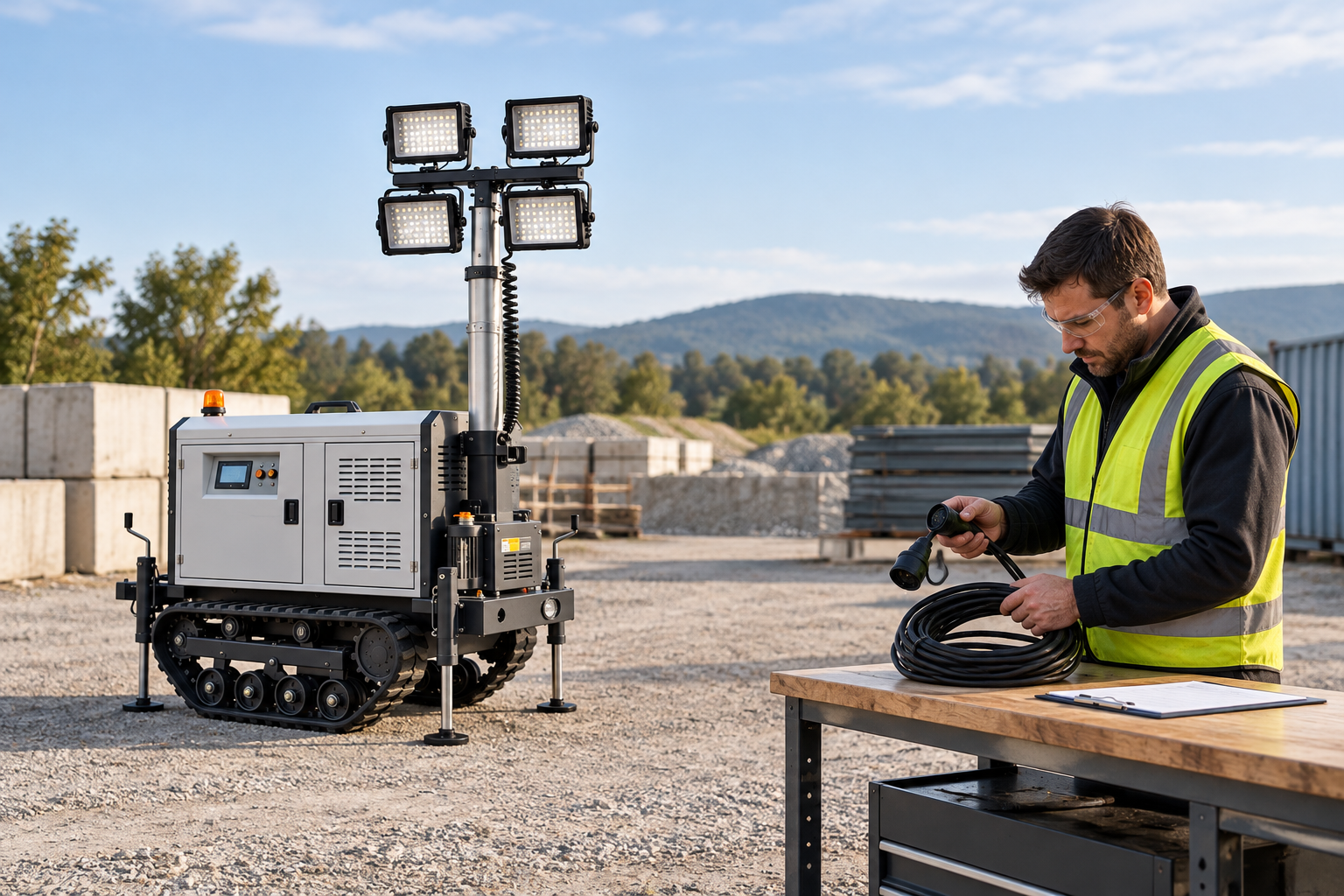
Before moving the tower, identify every external connection and use the approved disconnection and preparation process. Avoid allowing a lead to become the final unnoticed tether between the machine and another installation. Establish who confirms the route is clear before travel and who approves the new route before service resumes.
Repeat the relevant checks after changed traffic, rainfall, new stockpiles, shifted barriers or a different workface. Look for locations where people have created a shortcut or moved a ramp to improve access. Treat these as reasons to improve the arrangement, rather than simply reinstalling the same obstacle without understanding why it was moved.
Hand over a route that can be maintained
Keep a simple route sketch, connection identification, relevant approvals, inspection responsibility and defect response with the site record. The next shift should be able to find the cable path and know which changes require review. A generic instruction to keep cables safe is less useful than identifying a particular crossing and the person responsible for it.
The linked tracked light tower provides a visual product reference only. No external supply, outlet rating or charging function is inferred from its photograph. Ask for the delivered configuration's connection documents, cable requirements and operating restrictions before procurement or hire. Confirm who supplies any approved protection accessories and who accepts the completed site installation.
المعدات والتخطيط التكميلي
Confirm the exact supplied configuration using the Keyyou tracked lifting light tower product reference. Continue with the سلامة وتشغيل برج الإضاءة, plus grounding and bonding arrangements, auxiliary power outlet limits.
Neutral safety education
ESFI explains extension-cord safety fundamentals. This awareness video complements the route inspection; it does not replace construction-site electrical design, the equipment manual or local requirements.

Watch the educational video on YouTube.
الأسئلة الشائعة
Does a cable ramp make a damaged lead safe?
No. A ramp can protect a suitable cable route against assessed external hazards. It does not restore damaged insulation, correct an unsuitable cable or replace electrical protection and inspection.
Can a cable run beneath a tower track or stabilizer?
Plan it clear of the machine’s contact and movement areas. Tracks and support feet can crush or abrade a cable, and later movement may create damage that is difficult to see.
Does this apply to every light tower?
Apply it to the actual cables supplied or approved for the configuration. Some towers have no external supply lead in normal use; auxiliary outlets and charging connections must be confirmed rather than assumed.
Who may repair a damaged connector?
Use the site’s competent authorized electrical service process. Operators should identify and report defects within their role, not make improvised live checks or repairs.
المصادر والنطاق
The sources below provide general principles. Apply the actual manufacturer instructions, workplace assessment and rules for the destination; these references do not certify this light tower.