

Light Tower Environmental Permit Condition Register: Owners and Evidence
Connect temporary light tower activities with applicable site permit conditions, named responsibilities, controlled instructions and reliable deployment records.
Light tower environmental permit condition registers should connect the site's actual permit conditions with the people who operate, move and service temporary lighting equipment. Identify the applicable condition, explain the relevant task, assign an owner and retain the evidence required by the permit and management system. Do not assume that every temporary tower needs a separate environmental permit or that every tower is exempt. The regulated activity, location and issued documents determine what applies, with competent advice where the scope is uncertain.
This guide explains an editorial recordkeeping workflow for an equipment user. It uses Environment Agency guidance for England as background, and a US regulator's educational video as a separate example of reading permit documents. It does not interpret an individual permit, set emission limits or certify the illustrated Keyyou equipment for a regulated site.
Begin with the issued document and the regulated activity
Obtain the current permit and relevant variations through the responsible site team. Record the permit holder, site identity, document reference and version used for the review. A superseded copy in a procurement folder can lead the equipment contractor to follow instructions that no longer match the operating conditions.
Ask the permit owner or competent environmental adviser to identify how temporary lighting activities relate to the regulated operation. The question is more precise than whether “light towers need permits.” Access, operating hours, energy supply, servicing and associated materials may have different relevance depending on the site and permit. Do not assign obligations by copying another facility's checklist.
Keep planning, wildlife, public-access, workplace safety and environmental permitting requirements distinct even where they interact. The register can point to related controls without pretending that one approval settles every regime. A machine's technical documentation is also separate from the operator's permission to carry out a regulated activity.
Translate relevant conditions into tasks without rewriting their meaning
For each applicable condition, retain the original reference and have the competent owner explain the operational requirement. An internal summary can help an operator, but it must not silently weaken the issued wording or invent an exception for temporary equipment. Where the meaning is uncertain, record the question and obtain the appropriate clarification before relying on an interpretation.
The register should identify the activity affected: setup location, operation, inspection, servicing, incident response or record retention, for example. State which team performs the task and which team checks the evidence. Avoid vague entries such as “environmental compliance: supplier” that leave both the site and supplier unsure who must act.
Do not populate the register with generic limits from web articles. If a permit specifies a limit, monitoring method, location, period or reporting route, use the applicable document and competent instruction. The qualitative checklist in this article is intended to organize decisions, not supply missing legal or technical values.
Distinguish an equipment requirement from a site control
An equipment requirement may concern the actual supplied configuration, operating instructions or documentation needed by the site's assessment. A site control may concern where the unit can operate, how it is serviced or which records the operator must keep. Procurement should ask for the first set while the permit holder remains responsible for defining the second through its competent management arrangements.
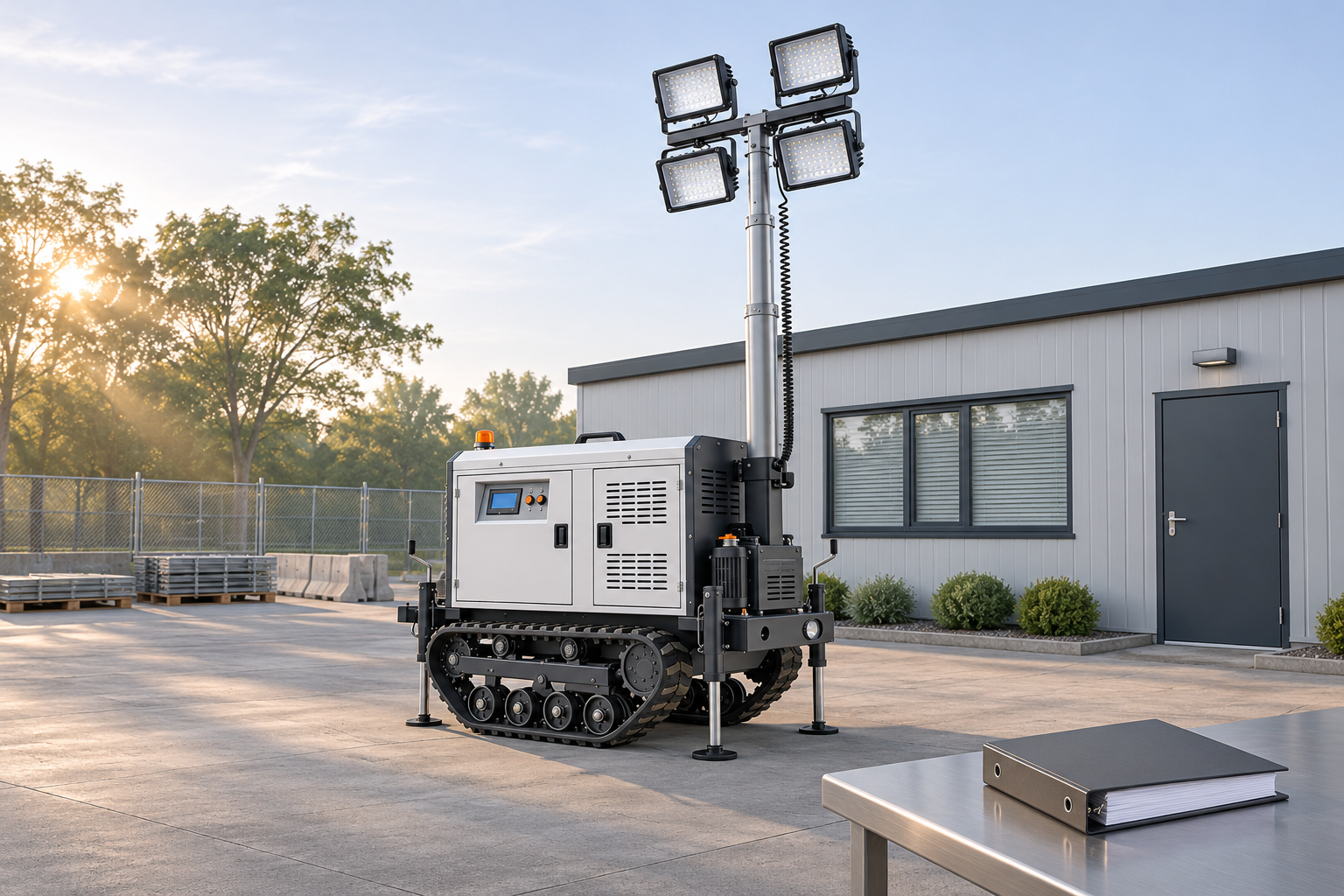
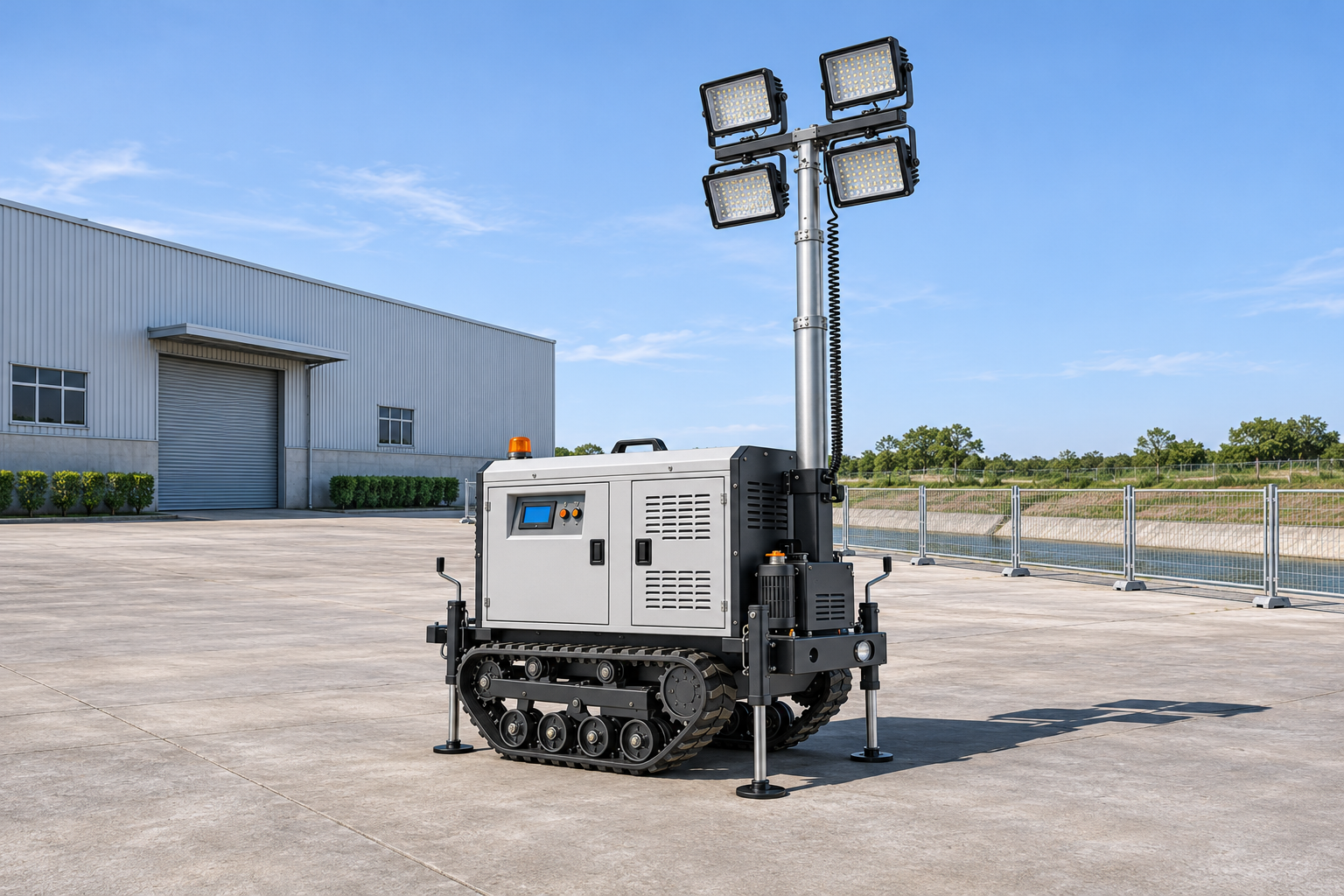
For the referenced tracked Keyyou tower, request the information relevant to the actual unit rather than extrapolating from its visible cabinet, tracks, mast and four lamps. The generated images illustrate an equipment context. They do not establish emissions, noise performance, fuel characteristics, containment capability or any environmental certification.
If a proposed operating mode or maintenance method conflicts with the site controls, resolve the conflict before dispatch. A purchase order should not instruct a contractor to perform something the machine manual does not allow. Likewise, an equipment feature does not remove a permit condition merely because it appears likely to reduce an impact.
Build a register that supports a real handover
The following qualitative table shows useful fields and questions for a deployment register. It is an editorial tool, not an Environment Agency form. Link each applicable entry to the site's current documents and retain the evidence actually required. Entries that are not applicable should have a reason confirmed by the competent owner rather than being marked complete without review.
| Zustand | Überprüfung oder Aktion | Evidence or responsibility |
|---|---|---|
| Current permit reference | Identify document and relevant variation | Permit owner and controlled copy |
| Applicable condition | Map condition to actual lighting activity | Competent environmental review |
| Operational instruction | Brief task, restriction and escalation route | Site supervisor and briefing record |
| Evidence requirement | Define record, checker and storage location | Assigned evidence owner |
| Equipment or hours change | Review before revised activity where required | Permit owner and change record |
| Collection completed | Close equipment custody but retain outstanding duties | Site lead and records owner |
Diese qualitative Koordinierungsliste unterstützt den hier besprochenen Arbeitsablauf; wenden Sie die Zuständigkeit und den Umfang der Environment Agency: how environmental permits are regulated. Es bietet keine universelle numerische Akzeptanzgrenze.
Use a status that distinguishes action from evidence. A task can be assigned while its supporting document remains missing; a document can be available while the operator has not been briefed. Separating those states makes the pre-delivery review more useful than a single green tick that conceals an unresolved responsibility.
Connect the register with the site management system
Environment Agency guidance describes the role of a written management system for permitted operations, including relevant procedures, competence and records. The lighting register should connect to those controlled arrangements rather than create an isolated spreadsheet nobody uses after delivery. Ask the site lead where the final instructions and records belong.
The people receiving the equipment need a practical briefing. Identify the approved position, relevant operating restrictions, checks assigned to them and the escalation contact. Give them access to the current instructions in the format used on site. They should not be asked to interpret the entire permit unaided at the start of a night shift.
Keep recordkeeping proportionate to the actual obligations and risks. Where the permit or management system requires a specific record, preserve its fields and retention arrangements. Where an additional internal record is useful, explain its purpose and owner. Avoid collecting numbers that nobody can verify or that imply a level of monitoring the site is not actually performing.
cURL Too many subrequests by single Worker invocation. To configure this limit, refer to https://developers.cloudflare.com/workers/wrangler/configuration/#limits
cURL Too many subrequests by single Worker invocation. To configure this limit, refer to https://developers.cloudflare.com/workers/wrangler/configuration/#limits.
cURL Too many subrequests by single Worker invocation. To configure this limit, refer to https://developers.cloudflare.com/workers/wrangler/configuration/#limits.
cURL Too many subrequests by single Worker invocation. To configure this limit, refer to https://developers.cloudflare.com/workers/wrangler/configuration/#limits.
cURL Too many subrequests by single Worker invocation. To configure this limit, refer to https://developers.cloudflare.com/workers/wrangler/configuration/#limits
cURL Too many subrequests by single Worker invocation. To configure this limit, refer to https://developers.cloudflare.com/workers/wrangler/configuration/#limits.
cURL Too many subrequests by single Worker invocation. To configure this limit, refer to https://developers.cloudflare.com/workers/wrangler/configuration/#limits.
cURL Too many subrequests by single Worker invocation. To configure this limit, refer to https://developers.cloudflare.com/workers/wrangler/configuration/#limits.
Verify records at collection and close the deployment
Before the tower leaves, confirm that the required operational, servicing and departure records have been supplied to the correct owner. Identify any outstanding action and who retains responsibility for it. A collection signature records custody; it does not automatically close a monitoring, reporting or document-retention obligation.
Use the educational video below to understand the discipline of reading an issued permit and locating its obligations. The example is a US air-permitting context and cannot be applied as English law or as proof that this lighting unit needs that permit. The transferable point is to read the actual document rather than rely on a generic description.
An effective supplier enquiry explains the intended regulated-site task and asks for the actual equipment information needed by the competent reviewer. A useful deployment handover then connects the applicable conditions, instructions, people and evidence. This lets the site manage temporary lighting as part of its existing system without inventing equipment approvals or overlooking the responsibilities of the permit holder.
cURL Too many subrequests by single Worker invocation. To configure this limit, refer to https://developers.cloudflare.com/workers/wrangler/configuration/#limits
Identifizieren Sie den Ausrüstungszusammenhang mit dem Keyyou verfolgte Produktseite für Hebelicht-Türme. Fordern Sie Dokumentation für die tatsächliche gelieferte Konfiguration an. Lesen Sie die Sicherheit und Betrieb von Lichtmasten und die dazugehörigen Hinweise zu environmental incident reporting, Beschwerdebehandlung bei Lichtbelästigung.
Further learning: How to Read Your Air Quality Operating Permit Webinar
Nevada environmental regulators explain how to read an air quality operating permit. This US educational example illustrates document-reading discipline only; it is not English permitting law or evidence that the pictured tower requires that permit.
Watch the educational video on YouTube.
Häufig gestellte Fragen
Does every temporary tower need its own environmental permit?
Do not assume that. The regulated activity, location and applicable documents determine what is required; obtain competent advice for uncertain scope.
Can equipment documentation replace site permit review?
No. Machine documentation supports the assessment but does not replace the permit holder’s responsibilities or the actual issued conditions.
What should a condition register record?
Record the applicable condition reference, affected task, responsible person, instruction, evidence requirement and current status.
Does collection close every permit obligation?
No. Record retention, reporting or follow-up duties may continue after equipment custody changes.
Quellen und Umfang
Diese Quellen unterstützen die oben diskutierten spezifischen Hintergrundprinzipien. Ihre Zuständigkeiten und Themen unterscheiden sich; sie zertifizieren nicht die abgebildete Ausrüstung oder genehmigen eine einzelne Sendung oder Installation.


