

Light Tower Maintenance Intervals: Build a Traceable Service Register
Build a light tower interval register from exact manuals, hour and calendar triggers, actual service evidence, abnormal-condition records, and release decisions.
Light tower maintenance intervals should come from the documents for the exact supplied tower and its components, then be scheduled against operating hours, calendar time, and the actual duty conditions. Use the applicable trigger that occurs first when the manufacturer specifies more than one, and keep an abnormal-condition inspection separate from routine service. There is no reliable universal oil-change or mast-service interval for every tower. This guide shows fleet managers how to build a traceable interval register, preserve service evidence, and identify overdue equipment without replacing the manufacturer's instructions. It applies to the complete lighting tower, including mechanical, electrical, lighting, and transport systems where fitted.
Identify the configuration before assigning intervals
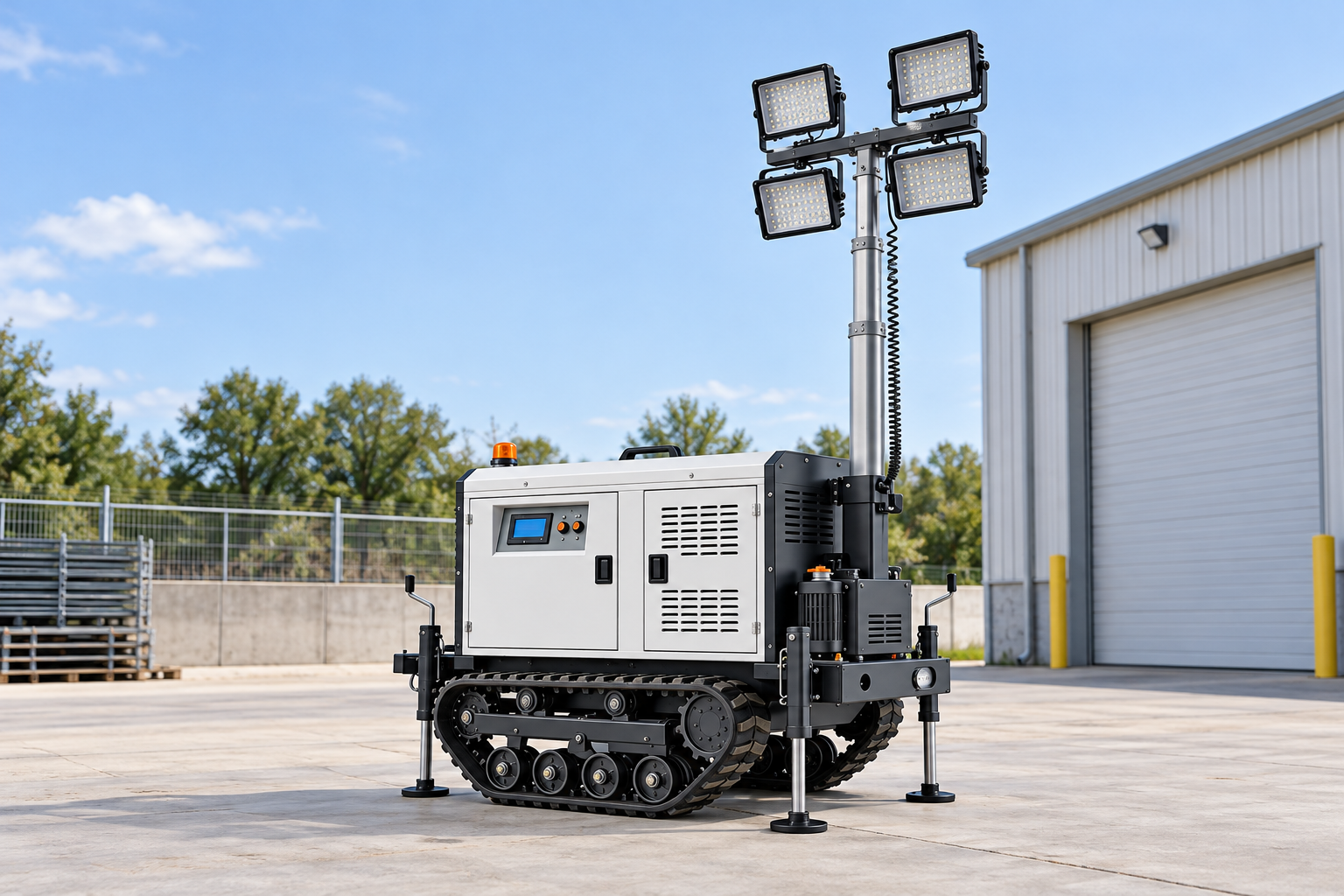
Record the tower identifier, model, supplied engine or energy system, mast mechanism, lamp configuration, and applicable transport equipment. Retain the manual revision and any component documents delivered with it. A tracked tower, a wheeled trailer, and a solar unit can share a fleet category while requiring different checks. An interval copied from a visually similar machine can therefore be wrong even when the lamps and cabinet look familiar.
Connect replacement components and approved modifications to the asset record. If the engine, battery, controller, or lifting arrangement changes, review the affected service requirements before carrying over the previous schedule. Do not assume that a fleet-wide spreadsheet remains valid after a change in configuration. The interval register must describe the equipment currently supplied and operated, rather than the original purchase description alone.
Separate operating-hour and calendar triggers
Some service requirements depend on accumulated operation, while others depend on elapsed time or a specific event. Record each trigger exactly as the applicable instruction defines it. Do not convert every task into engine hours, particularly when the task concerns a mast, battery, transport assembly, or prolonged inactivity. State the starting reference, the last completed service, and the next due condition.
Where the manufacturer specifies both an operating-hour and a calendar requirement, preserve the specified relationship between them. A heavily used machine and a lightly used stored machine can reach different triggers first. The register should make the next action visible without asking a dispatcher to reinterpret the manual during a handover. Unavailable or unreliable meter information must be recorded as an evidence gap, rather than silently treated as zero use.
Keep pre-use observations separate from scheduled service
An operator's permitted condition check does not replace service by an authorized technician. Define which visible observations the operator can make and which work requires isolation, access to components, or specialist competence. Record an unsafe or abnormal condition through the site's withdrawal and inspection process. Do not wait for the routine interval to expire before responding to damage, a changed sound, a fault indication, or an altered support condition.
Likewise, completing a routine inspection does not automatically resolve an unrelated reported defect. Keep the defect record connected to the required action and acceptance decision. This distinction avoids a service entry being used as an unexplained blanket statement that the machine is fit for every operating condition. State exactly what was checked and what remains unresolved.
Interpret difficult service conditions through the documents
Dust, moisture, repeated transport, temperature exposure, and other operating conditions may affect the supplied maintenance requirements. Ask the manufacturer how the actual application should be classified and whether the documents prescribe different checks or intervals. Do not invent a percentage reduction or halve every interval because a site is described as demanding.
The U.S. Department of Energy operations and maintenance guide explains different maintenance approaches and the value of structured records. It supports planning methods; it is not a tower-specific service schedule. Apply the actual equipment instructions to the task, keeping the reason for a changed interval and the person authorizing it in the record. If the classification is unresolved, identify the missing decision instead of claiming the standard schedule has been independently validated.
Build one task record for each service requirement
A useful task record contains the asset, affected component, document reference, trigger, permitted performer, required evidence, and next due condition. Use wording that identifies the actual work rather than a broad service complete entry. If the instruction requires a test or measurement, record its method and applicable limits from the supplied documentation. This article deliberately supplies no torque, lubricant, electrical-test, or engine-service values.
Keep consumables and replacement parts traceable where required. A purchase receipt alone does not establish that the correct part was fitted or that the prescribed work was completed. Retain the technician's record and any follow-up action. The goal is a schedule that can be audited against the supplied instructions, rather than a colorful calendar that conceals missing service evidence.
Use a maintenance interval register
| Register field | What to enter | Error it prevents |
|---|---|---|
| Asset and configuration | Current identifier and supplied component arrangement | Applying another model's schedule |
| Source instruction | Manual revision and task reference | Untraceable interval copied from general advice |
| Trigger | Exact hour, calendar, or event condition | Treating all maintenance as engine-hour work |
| Last completion | Date, meter reference, performer, and evidence | Assuming a booking equals completed service |
| Next due condition | Calculated trigger using the required rule | Overlooking low-use calendar requirements |
| Abnormal condition | Defect, withdrawal status, and required inspection | Waiting for routine service despite a reported problem |
| Return decision | Completed action and responsible acceptance | Marking unresolved equipment available |
This original table organizes evidence rather than prescribing intervals. The maintenance-method discussion draws on the Department of Energy guide, and all numerical service requirements must be supplied for the actual equipment. General machinery and electrical-safety sources inform the boundary between observation and authorized work.
Reconcile meters with dispatch and service records
At relevant handovers, record the meter reading or approved alternative and its source. Investigate a meter replacement, an implausible change, or an unavailable reading before relying on the resulting due date. Rental duration and lamp operation may not mean the same thing as engine runtime. State which measure drives each task and retain any documented adjustment.
A machine can be on hire while shut down, or operating for periods not reflected by a simple dispatch record. Avoid presenting booked days as measured operating hours. Where an estimate is temporarily necessary, label it and set a plan to recover the actual evidence. Do not convert an estimate into a confirmed service record merely because it makes the fleet dashboard easier to read.
Schedule service without hiding withdrawal time
Reserve sufficient time for the required work, parts, inspection, and acceptance. Track equipment that is awaiting diagnosis separately from a machine booked for routine service. A service appointment is a planned event; it should not automatically mark the task complete or the asset ready for dispatch. The responsible person must record the actual completion and release decision.
When a requirement becomes overdue, use the applicable instructions and the site's control process to decide what service is permitted. This article does not grant a grace period. Record who made the decision and what evidence supported it. If required documentation or inspection is unavailable, preserve that status rather than returning the machine to service simply to meet a utilization target.
Preserve safe access and isolation for the work

Maintenance planning should identify where and by whom the required task can be carried out. The safe arrangement depends on the actual engine, batteries, stored energy, lifting system, and electrical configuration. Follow the supplied instructions and applicable site procedure for shutdown, isolation, and access. Closing a control switch is not a universal substitute for verifying an appropriate isolated condition.
For combustion-powered configurations, plan exhaust and occupied-space safety whenever an authorized running check is required. The CDC generator-safety material below explains the carbon-monoxide concern. It does not prescribe maintenance intervals or establish that every tower uses the same fuel or engine. Do not run equipment inside a storage or maintenance bay merely because a door has been opened.
Prepare a configuration-specific supplier request
Request the complete maintenance schedule, manual revision, parts information, permitted service methods, and any condition-specific requirements for the offer. Clarify who performs commissioning and warranty-related inspections and what evidence must be retained. Ask whether remote alerts or service reminders are actually supplied; a general intelligent-control description is not proof of a functioning fleet service system.
The illustrations show the current Keyyou tracked lighting tower, with a white enclosure, crawler chassis, stabilizer legs, and four square floodlights. They identify the equipment family for this discussion, rather than supplying engine details or a service procedure. Use the exact purchased configuration's documents before assigning tasks or buying consumables. Keep those documents accessible to the people who schedule and release the asset.
Review the register after real operating experience
Compare planned service, actual completions, faults, and interruptions over a defined period. Identify missed records, recurring defects, inappropriate task grouping, or unclear responsibility. Review proposed changes with the manufacturer and responsible maintenance team. Improving the register can mean better evidence and clearer triggers; it does not necessarily mean extending intervals.
Retain the historical record when a task changes. Explain which instruction or approved finding led to the change and when it takes effect. A future audit should be able to reconstruct why equipment was considered due, serviced, or unavailable at a particular handover. That makes preventive maintenance useful for reliable lighting service while preserving a clear distinction between an intended schedule and work actually completed.
Ausstattung und ergänzende Planung
Bestätigen Sie die angebotene Konfiguration auf dem Keyyou-Produktseite für Beleuchtungsstärken und verwenden Sie die Handbuch zur Planung mobiler Leuchtmasten für einen umfassenderen Auswahlrahmen. Überprüfen Sie ergänzende Themen in Leuchtturmwartung und Inspektion von Kabeln in Leuchtmaststangen.
Abgassicherheit bei autorisierten Fahrtests
Das CDC-Video „Verwendung eines Generators sicher“ erläutert die Kohlenmonoxidgefahr im Zusammenhang mit dem Betrieb eines Verbrennungsgenerators. Es unterstützt die separate Diskussion über die Sicherheit des Abgases während einer autorisierten Funktionsprüfung; es legt keine Serviceintervalle, Pflegemaßnahmen oder die Erdungsvorrichtung fest. Verwenden Sie es nur bei einer mit Verbrennungsmitteln betriebenen Konfiguration.

Ansehen: „Verwenden Sie einen Generator sicher“.
Häufig gestellte Fragen
Is there one maintenance interval for every lighting tower?
No. Use the exact tower and supplied component documents. Engine, battery, mast, transport, and other systems can have different triggers; a visually similar machine does not establish the same schedule.
Does booking service mark the task complete?
No. Retain the actual work record, performer, required checks, and acceptance decision. Equipment awaiting a defect assessment must remain distinguishable from an asset that has completed its required service.
Can an operator wait until routine service to report a fault?
An abnormal condition belongs in the applicable reporting and inspection process independently of the routine due date. Record the observation, required status, responsible assessment, and release evidence rather than waiting for a scheduled interval.
Quellen und Umfang
Das zitierten Primärmaterial unterstützt die besprochenen spezifischen Planungs- und Sicherheitsprinzipien. Die jährliche CFR-Veröffentlichung bezieht sich ausdrücklich auf die Ausgabe von 2025; das verantwortliche Team muss die aktuellen geltenden Anforderungen überprüfen. Die Entscheidungstabelle ist original und enthält keine erfundenen Gerätebegrenzungen. Die genaue angebotene Konfiguration und die bereitgestellten Anweisungen regeln die Gerätefunktionen.