
Utilisation de la flotte de tours de lumière : Disponibilité, affectations et heures de fonctionnement utiles
Mesurez l’utilisation de votre flotte de tour de lumière grâce à des définitions de temps claires, à des enregistrements de départs fiables, à des groupes d’équipements compatibles, à des exclusions de maintenance et à des décisions d’expédition.
Light tower fleet utilization measures how consistently available equipment serves a defined lighting requirement during a defined reporting period. Start with a unit register, record availability and actual assignments separately, and explain every denominator before comparing sites. A rental booking, engine hour, night shift, and productive lighting hour describe different things. Treating them as interchangeable can conceal an unavailable tower or reward an unnecessary deployment. For a mixed fleet, compare compatible equipment groups and retain safety and maintenance exclusions. A useful report supports dispatch decisions without pressuring operators to keep unsuitable equipment running simply to improve a percentage.
Define the decision before choosing a utilization measure
A dispatcher needs to know whether a suitable tower can reach an approved work area when required. A maintenance planner needs to know whether service can be completed before the next assignment. A supervisor needs lighting that remains appropriate through the shift. Each decision requires a different view of the same equipment record. Choose the question first, then select the measure. Otherwise the reporting system can produce an impressive average that answers none of these practical questions.
Keep the reporting window explicit. Calendar days help describe ownership or contracted possession; planned operating shifts help describe demand; verified lighting hours help describe actual operation. A tower reserved for an emergency standby role may be fulfilling its assignment while its lamps remain off. Report that role separately rather than classifying all standby time as avoidable waste. Likewise, do not count maintenance downtime as productive work simply because the unit remains at a customer location.
Build a register around the actual supplied unit
Give each tower a stable identity and connect that identity to the supplied manual, configuration, service history, and current location. Record its power arrangement, permitted operating conditions, transport requirements, and the evidence needed for release. Group machines by the work they can actually support. A visually similar enclosure does not establish matching runtime, lamp output, electrical arrangement, or mast limits. Confirm these details from the documents belonging to the specific delivered machine.
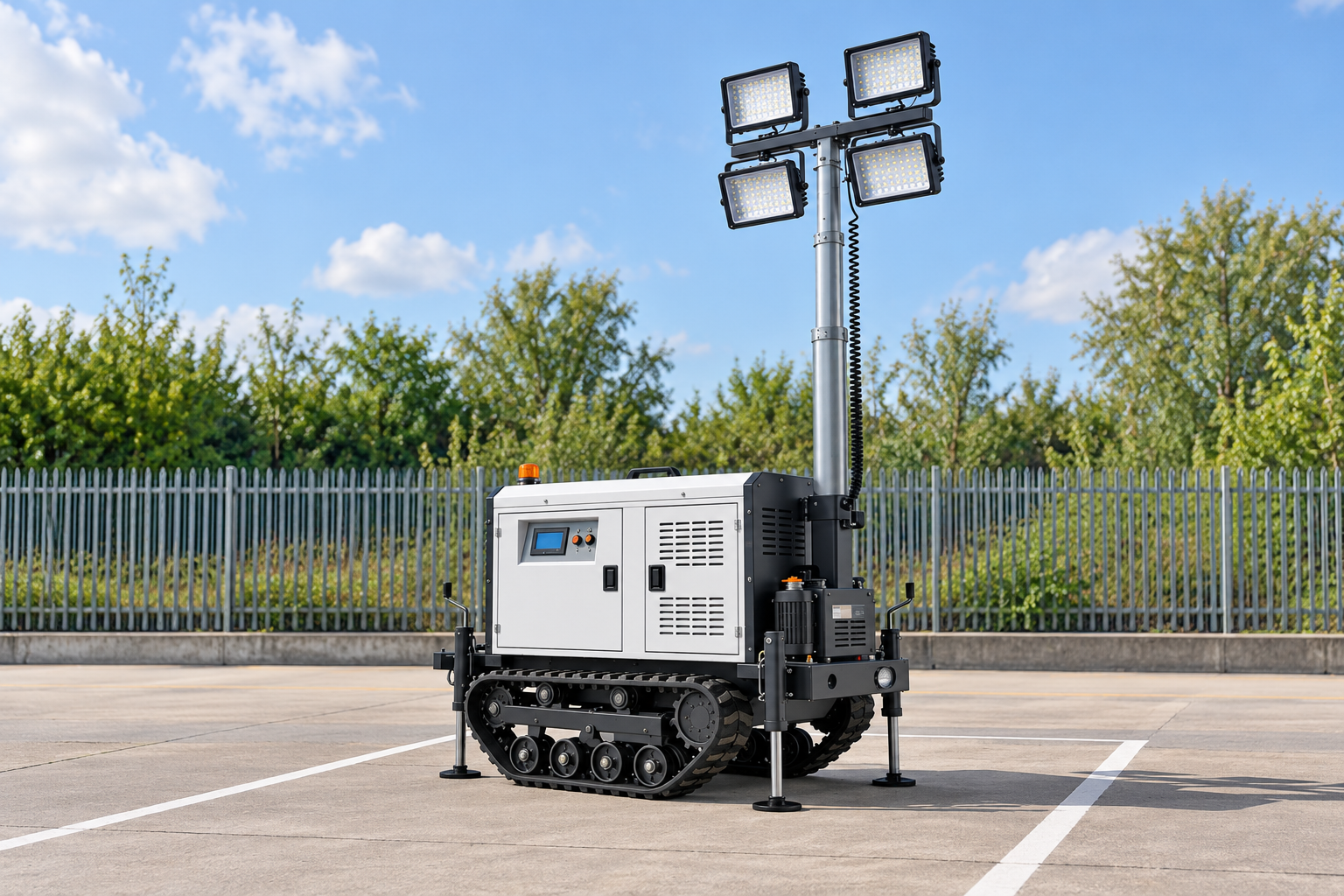
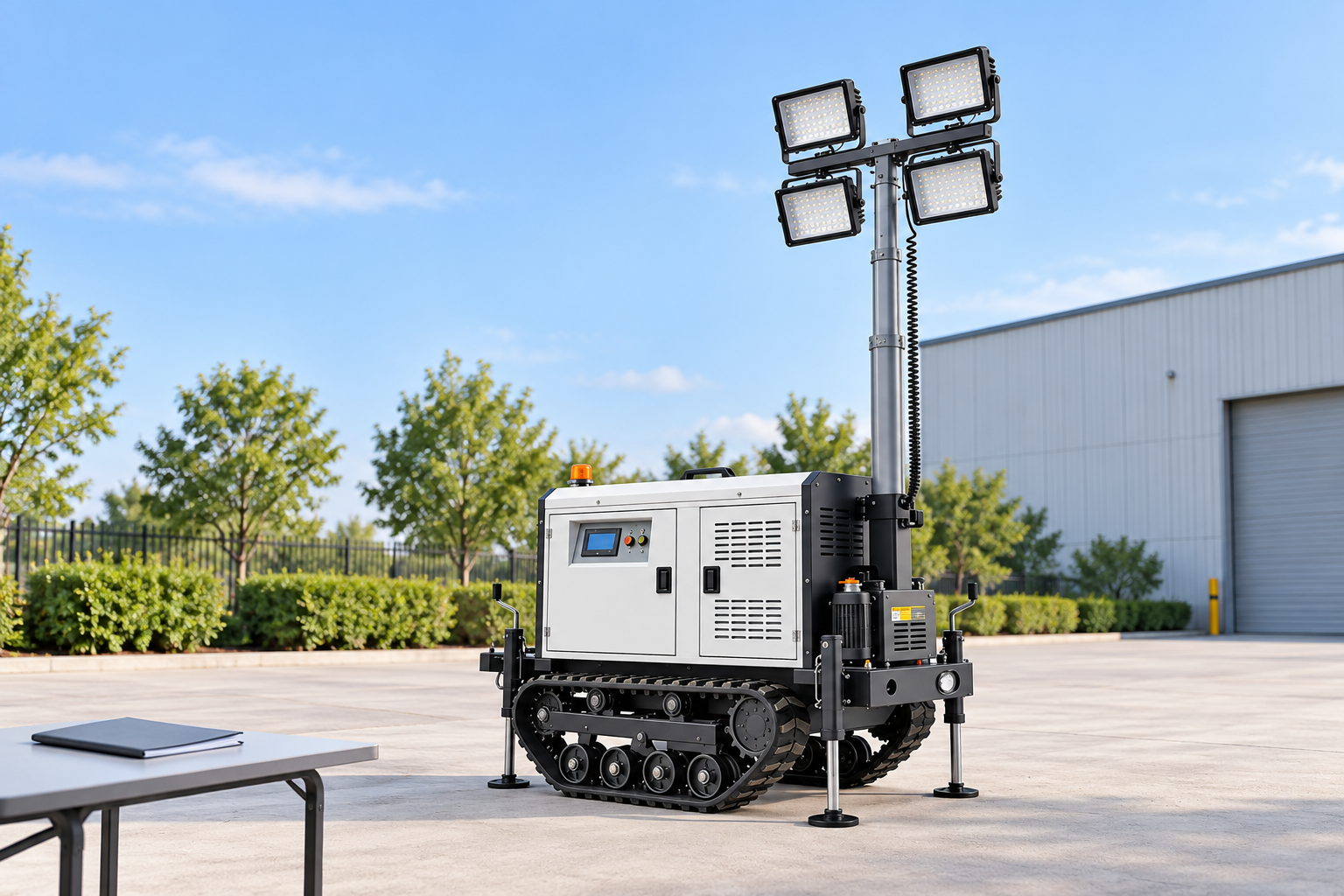
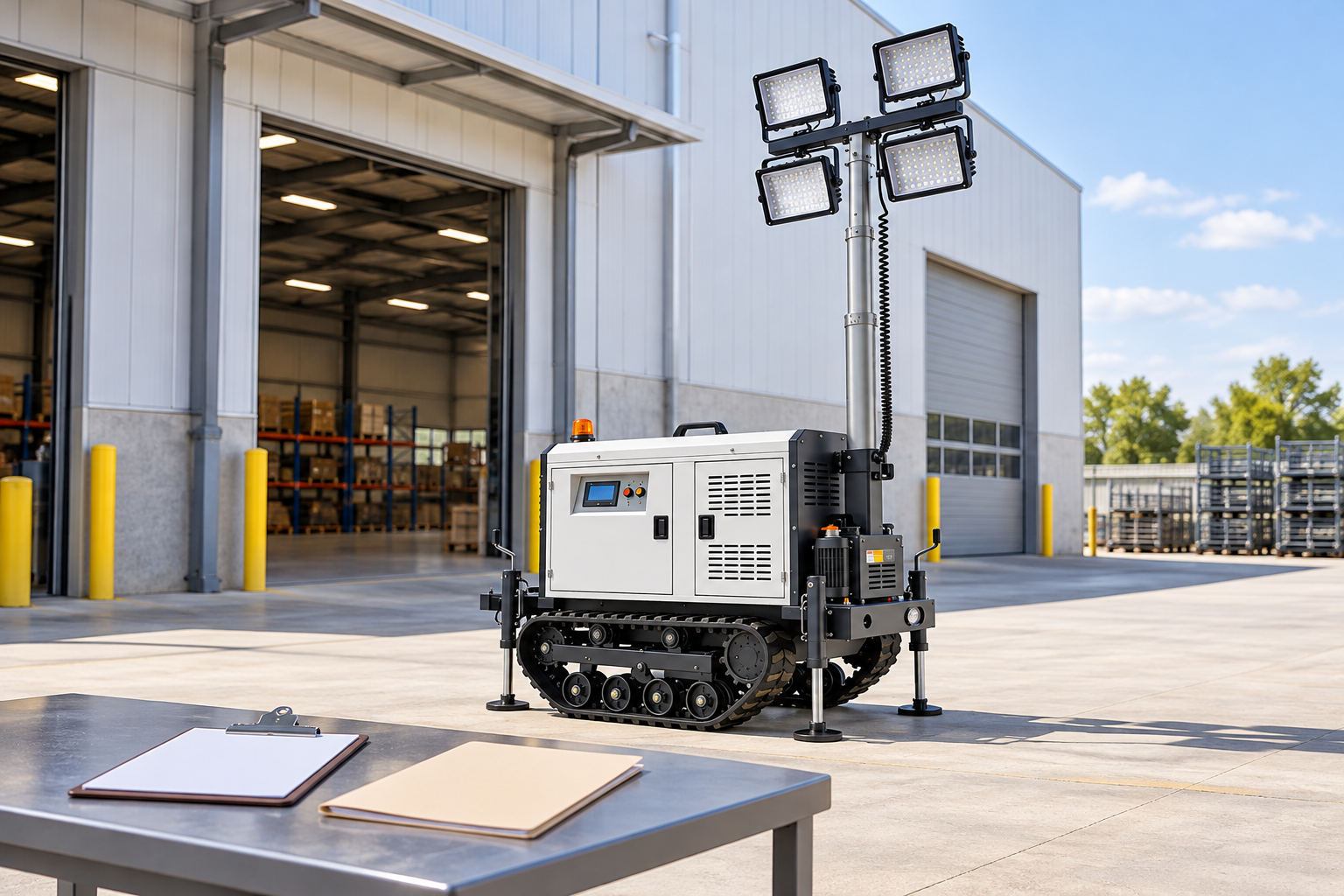
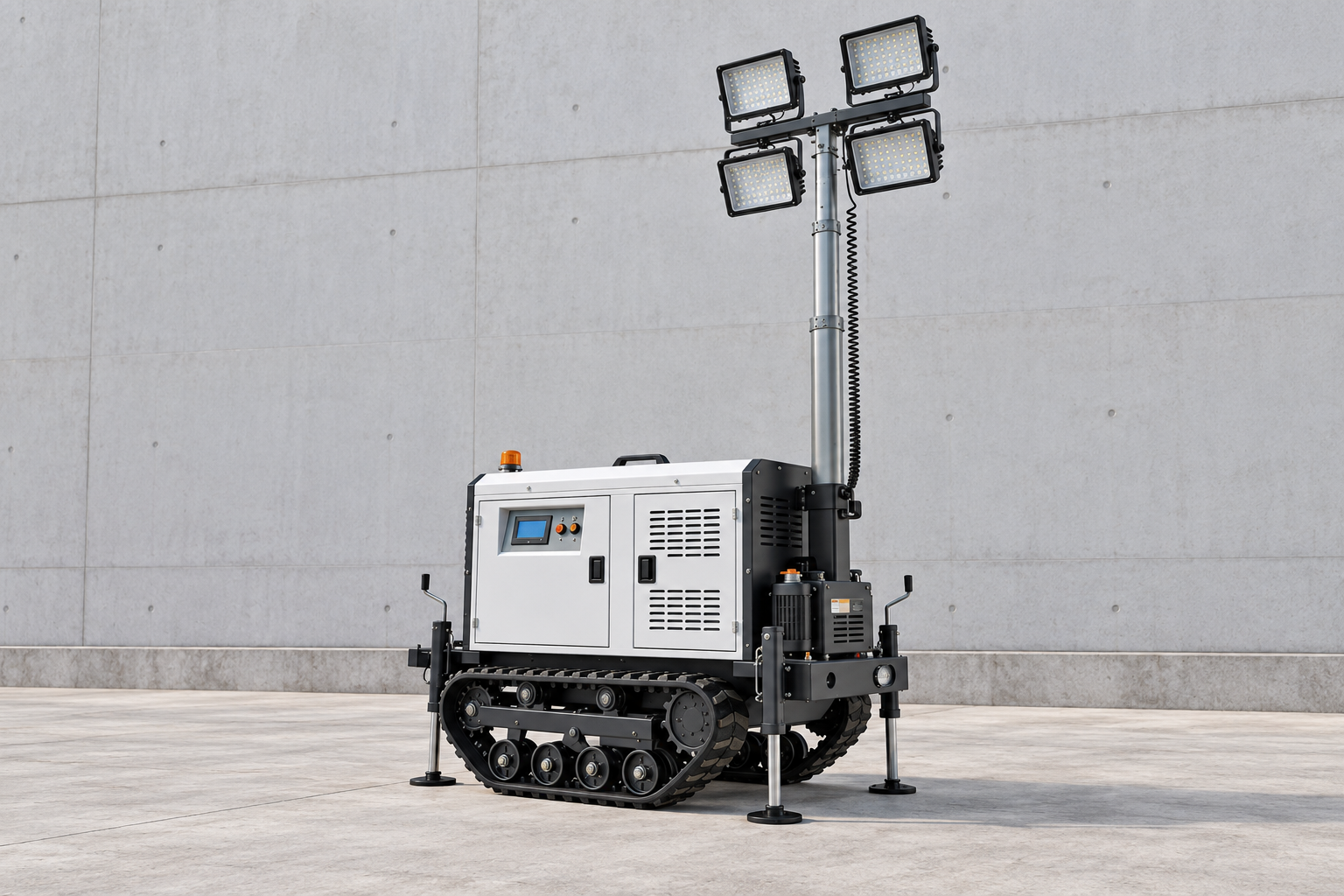
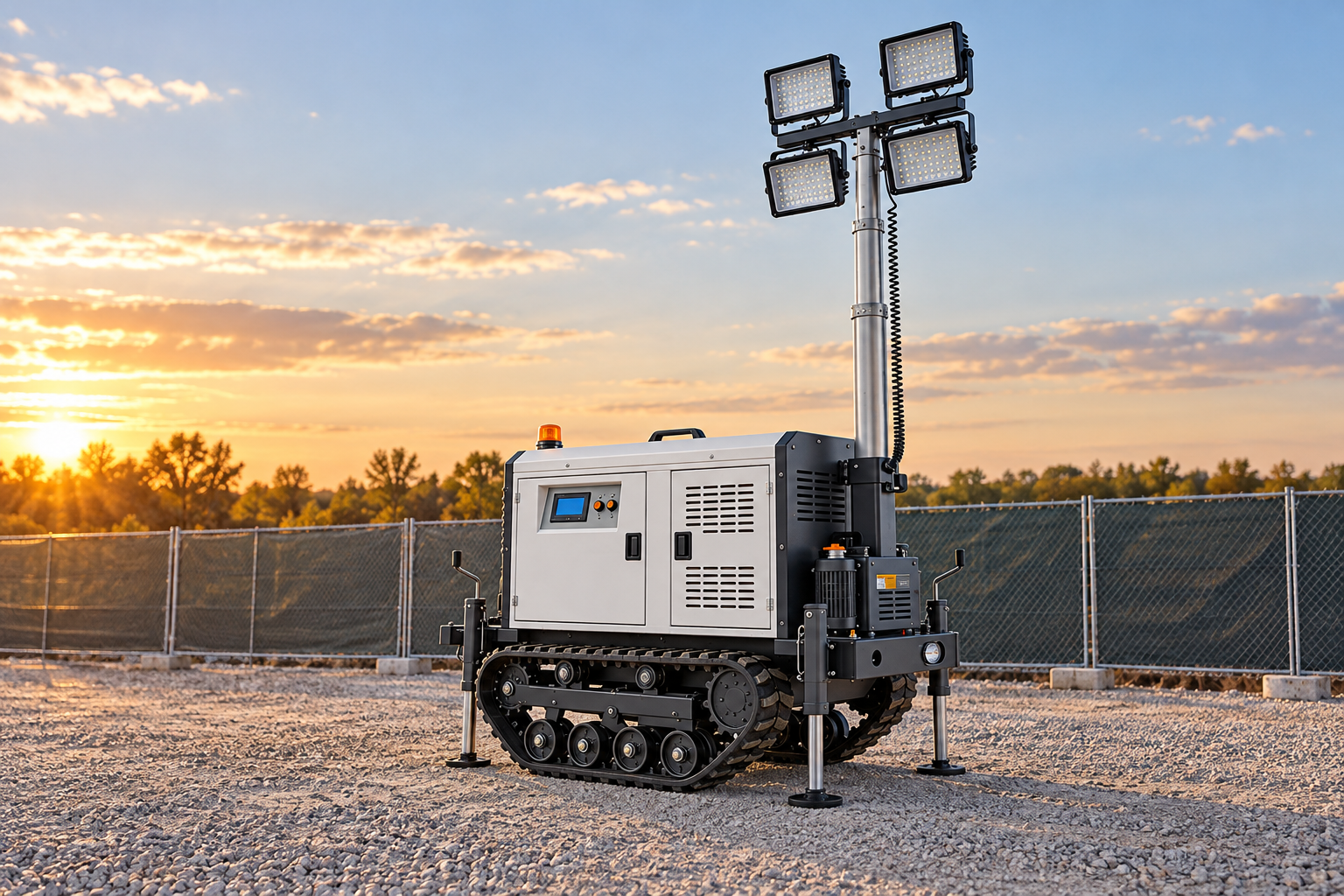
The tracked tower illustrated here identifies a visible product arrangement: a white equipment enclosure, crawler chassis, stabilizing supports, telescopic mast, and four lamp heads. It does not establish a remote monitoring system, automatic starting capability, certified wind limit, or a fuel consumption figure. Use the manufacturer's configuration record for those questions. A simple manual register is sufficient to begin; purchasing a tracking platform cannot repair unclear definitions or missing equipment identities.
Separate availability, assignment, and operation
Availability means a unit meets the agreed release conditions and can be considered for a compatible assignment. Assignment means someone has reserved or deployed it for a specified purpose. Operation means the relevant activity was observed or reliably recorded. These states overlap, but they are not equivalent. Keep their timestamps and reasons separate so that a reviewer can explain what happened during a shift without reconstructing the story from a single total.
For example, a tower may be assigned overnight but delayed because the proposed deployment area has not been accepted. The assignment record remains true, yet it does not prove productive lighting. Another unit may be available in the yard because there was no compatible demand. That is a planning question rather than a maintenance failure. Avoid recording either case as an equipment breakdown. Honest state definitions reveal where an intervention will actually help.
Calculate rates with compatible units and explicit exclusions
An illustrative time utilization measure is verified task lighting hours divided by eligible available hours for the same equipment group and reporting window, multiplied by one hundred. Both terms must use the same time unit. If a hypothetical group has forty eligible hours and twenty-four verified lighting hours, this measure is sixty percent. These numbers illustrate arithmetic only; they are not a Keyyou performance claim, benchmark, or recommended operating target.
Define eligible hours before collecting the period's result. Explain how planned service, quarantine, transport, inspection, weather restrictions, emergency standby, and unavailable operators are treated. If the denominator is zero, report the rate as not applicable and show the underlying state instead of dividing by zero or substituting an arbitrary percentage. When source data are incomplete, display the missing interval and label the calculation provisional. Precision in a spreadsheet cannot make uncertain records reliable.
A separate assignment rate can divide assigned eligible shifts by available eligible shifts. Call it an assignment measure and retain its original unit. Do not compare that percentage directly with an hourly operating measure. Aggregated fleet rates should come from summed compatible numerators and denominators, not a simple average of unit percentages with different exposure. Keep unusual units visible so a long idle period does not disappear inside a fleet total.
Use a state table to resolve dispatch questions
| Recorded state | Éléments de preuve à conserver | Immediate planning response |
|---|---|---|
| Available and unassigned | Release check, location, compatible configuration | Compare with confirmed demand before ordering additional capacity |
| Assigned but awaiting site approval | Reservation, deployment hold reason, responsible contact | Resolve the site requirement without counting the interval as lighting operation |
| Operating for the agreed task | Shift record, start and stop evidence, task location | Confirm coverage remains suitable as the work area changes |
| Reserved for emergency standby | Approved standby role and response requirement | Report readiness separately from ordinary productive hours |
| Under service or quarantine | Defect record, service scope, release authority | Remove from dispatch consideration until authorized release |
| Record incomplete | Missing timestamp, conflicting entry, review owner | Correct the evidence and label affected rates provisional |
This table defines a reporting approach rather than a universal regulatory classification. Adapt it to the supplied instructions, contracts, and site procedures. Electrical work and combustion-generator operation still need the applicable precautions described in the cited safety sources; a high dispatch priority never changes those requirements.
Capture a short record at each handover
Collect the unit identity, assignment purpose, actual location, observed condition, operating interval, and unresolved restrictions at handover. A named person should confirm what they observed and distinguish it from information supplied by another shift. Where an hour meter exists, record what it measures. Engine hours may include periods with no useful lighting, and an energized circuit does not prove that the intended work area was adequately illuminated.
Keep correction history. If a shift entry was assigned to the wrong unit, retain the original entry and the reason for correction. If clocks differ, resolve the time basis before calculating a duration. For manual records, a clear photograph of a readable meter may support a reading when permitted by local procedures, but do not expose personal information or assume a photo proves every operating condition. The register should make uncertainty visible rather than hide it.
Inspect the return condition before promising the next deployment
A returned tower is not automatically available. Confirm the actual configuration and check for reported damage, contamination, missing items, service requirements, and unresolved operating restrictions. Use the supplied inspection procedure and qualified personnel where required. Keep the unit out of the dispatch pool if release depends on an unfinished assessment. Recording a realistic availability time helps the next site plan; an optimistic status can create a late and unsafe substitution.
Reserve time for transport preparation, receiving inspection, and site acceptance. These intervals are part of delivering a usable lighting service even if they do not contribute to task lighting hours. Compare planned and actual turnaround to find recurring delays, such as missing documentation or repeated collection problems. Change the process that causes the delay rather than removing necessary inspections to improve a utilization chart.
Match demand to equipment before moving units
Review the work area, intended lighting task, access route, ground assessment, power arrangement, and operating restrictions before allocating equipment. A tower that is nearby but unsuitable is not useful spare capacity. The receiving site must approve the deployment conditions and verify the lighting result. Equipment selection and deployment planning cannot be replaced by an availability percentage or an attractive photograph of another location.
When one site reports unused equipment and another requests additional capacity, confirm timing, transport feasibility, compatibility, and the original site's reserve requirement. Moving the unit may solve a mismatch, but it can also remove necessary contingency capacity. Record the decision and its owner. Compare like assignments over several reporting periods before concluding that a fleet is oversized or that a single quiet week represents normal demand.
Keep safety exclusions visible during busy periods
Electrical inspection, servicing, and connection decisions belong to authorized personnel using the applicable procedures. The cited work practice rules provide relevant safety boundaries; they do not define a utilization target or approve a particular light tower installation. If a defect or environmental change makes an assignment unsuitable, stop and reassess according to the actual instructions. Do not relabel a safety hold as productive time to preserve a reported rate.
Where a supplied tower includes combustion generation, exhaust placement is an additional operating constraint. CDC guidance explains why generators must be operated safely away from enclosed or partly enclosed spaces and openings where exhaust could accumulate. Follow the applicable instructions and site assessment for the actual arrangement. A quiet yard, outdoor location, or open door does not by itself demonstrate acceptable exhaust exposure. Battery and solar equipment require their own applicable operating precautions.
Review exceptions before expanding the fleet
Read the exception log alongside the utilization totals. Frequent idle assignments can indicate changing work plans, unclear release responsibilities, or equipment booked too early. Repeated unavailability can indicate defects, maintenance scheduling conflicts, transport delays, or an unsuitable configuration mix. These causes require different responses. Investigate the actual constraint before buying additional units or demanding more operating hours from equipment already in service.
A useful weekly review ends with a small number of concrete decisions: release an unnecessary reservation, correct a recurring record error, schedule an overdue inspection, or verify the next site's requirements earlier. Assign an owner and a review date. Measure whether that action reduced the identified problem in the next period. Keep the reporting definitions stable long enough to compare results, and annotate any necessary changes so an apparent improvement is not merely a new denominator.
Equipement et planification complémentaire
Compare the visible equipment arrangement on the Page produit de la tour d’éclairage Keyyou crawler. Utilisez le Guide de planification pour tour de lumière mobile for selection context, the Guide d'inspection préalable à l'opération for release preparation, and the Liste de contrôle de la remise for shift records.
Generator safety during fleet deployment
CDC explains combustion-generator carbon monoxide hazards. This supports the exhaust-safety boundary when an actual fleet unit includes combustion generation. It does not measure utilization or approve a deployment location.
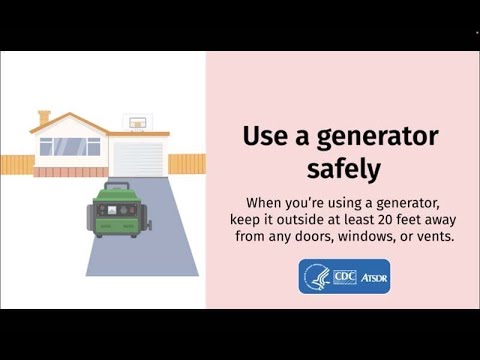
Regardez l'utilisation d'un générateur de manière sécurisée.
Foire aux questions
Are engine hours the same as productive lighting hours?
No. Engine hours can include operation without useful task lighting. Record what the meter measures and keep task lighting evidence separate from assignments and engine operation.
How should emergency standby affect utilization?
Record the approved standby role and readiness requirement separately. A unit can fulfill a standby assignment without its lamps operating; do not compare that role directly with ordinary productive lighting hours.
Can utilization justify skipping a return inspection?
No. Release the actual unit only after the applicable checks and restrictions are resolved. A dispatch target does not replace the supplied procedures, qualified electrical work, or site acceptance.
Sources et portée
The utilization formulas and state definitions are explained as an illustrative reporting method. The following official sources support electrical work and generator exhaust safety boundaries, not fleet performance benchmarks or product certifications.