
Coordenação do Levantamento de Serviço Subterrâneo da Torre de Luz: Configuração e Acesso
Coordene as rotas da torre de luz, estabilizadores e contactos terrestres com as informações atuais do serviço subterrâneo, revisão competente da pesquisa e registros de liberação claros.
Light tower underground service survey coordination starts before delivery: give the site team the proposed travel route, complete setup footprint and any ground penetration, then reconcile these with current service information and a competent survey. Do not treat an empty surface, an old drawing or a painted line as permission to park or deploy stabilizers. A crawler chassis does not establish the capacity of a buried service or chamber. The practical objective is a released equipment bay and access route, with uncertainties resolved by the people responsible for the services and ground conditions.
This guide addresses coordination around a temporary tracked lighting unit. It does not teach cable locating, authorize excavation or provide a universal separation distance. The HSE references concern work near buried services in Great Britain; projects elsewhere need their own applicable rules and utility-owner requirements. The checklist and handover examples below are editorial planning tools rather than an engineering design or a statutory form.
Start with the whole deployment, not just the mast location
Marking a single point on a drawing hides most of the activity that brings a light tower into service. The delivery vehicle needs an approach and unloading space. The machine needs a travel corridor, turning room and a setup area extending beyond the cabinet. Stabilizers may contact ground outside the track width. Servicing and eventual collection require access again after other contractors have changed the site.
Show these activities separately on the coordination drawing. Distinguish an indicative location requested by the lighting team from a location released for equipment use. Record who supplied the drawing and when the receiving supervisor accepted it. This makes a later relocation request visible instead of allowing the operator to assume that approval for one bay covers every nearby patch of ground.
Do not add stakes, grounding electrodes, fence posts or other penetrations as incidental details. If the proposed arrangement involves any ground penetration, bring that activity into the appropriate service-avoidance and authorization process. A lighting order and a permit to dig have different purposes. A surface-only arrangement still needs assessment where loading could affect shallow services, covers, voids or recently reinstated ground.
Understand what the available service information can establish
HSE describes planning, service location and safe excavation as complementary elements of work near buried services. Its cable guidance also explains that plans indicate possible locations rather than proving the exact conditions on the ground. For the lighting coordinator, the immediate lesson is to identify what evidence exists and who is qualified to interpret its limitations.
Ask for the latest relevant drawings, utility-owner information and survey outputs available to the project. Record their dates and the area they cover. A survey for an excavation elsewhere on the site may not cover the light tower route. Likewise, a drawing prepared before recent enabling works may omit temporary supplies or altered routes. Ask the site lead to confirm whether newer information supersedes the version in the delivery pack.
Read survey limitations alongside the plotted features. Do not convert an uncertain detection into an exact depth or infer that a blank area has been surveyed successfully. Equipment selection, survey method and interpretation belong with the competent survey team. Where information conflicts, report the discrepancy in plain terms and hold the affected location until the responsible team resolves it.
Separate machine information from ground acceptance
The supplier should identify the actual machine configuration and provide available operating instructions, transport information, stabilizer arrangements and relevant loading data. The site team should explain the intended position, surface construction, buried assets and access restrictions. Neither party can complete the other's assessment from a product photograph.
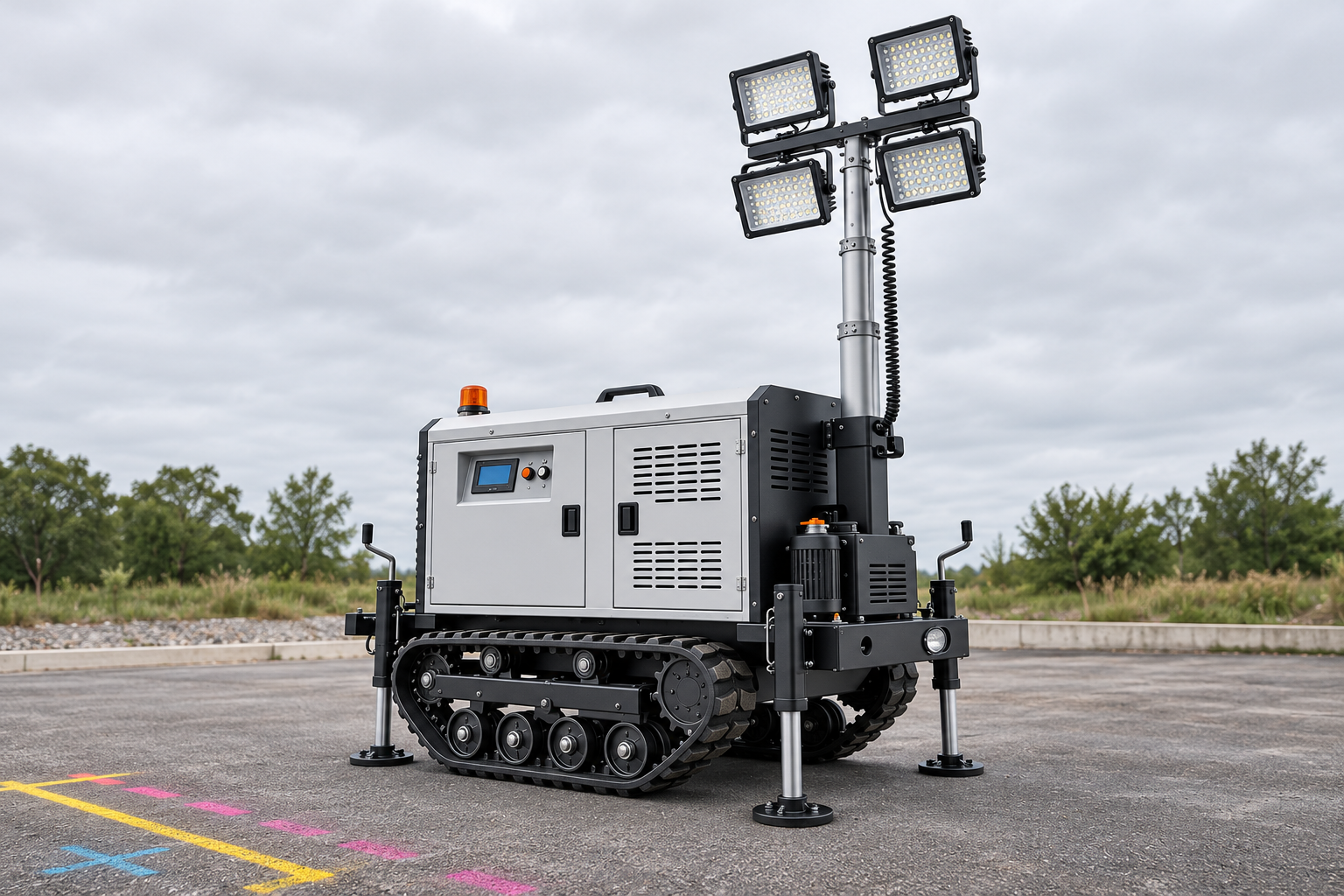
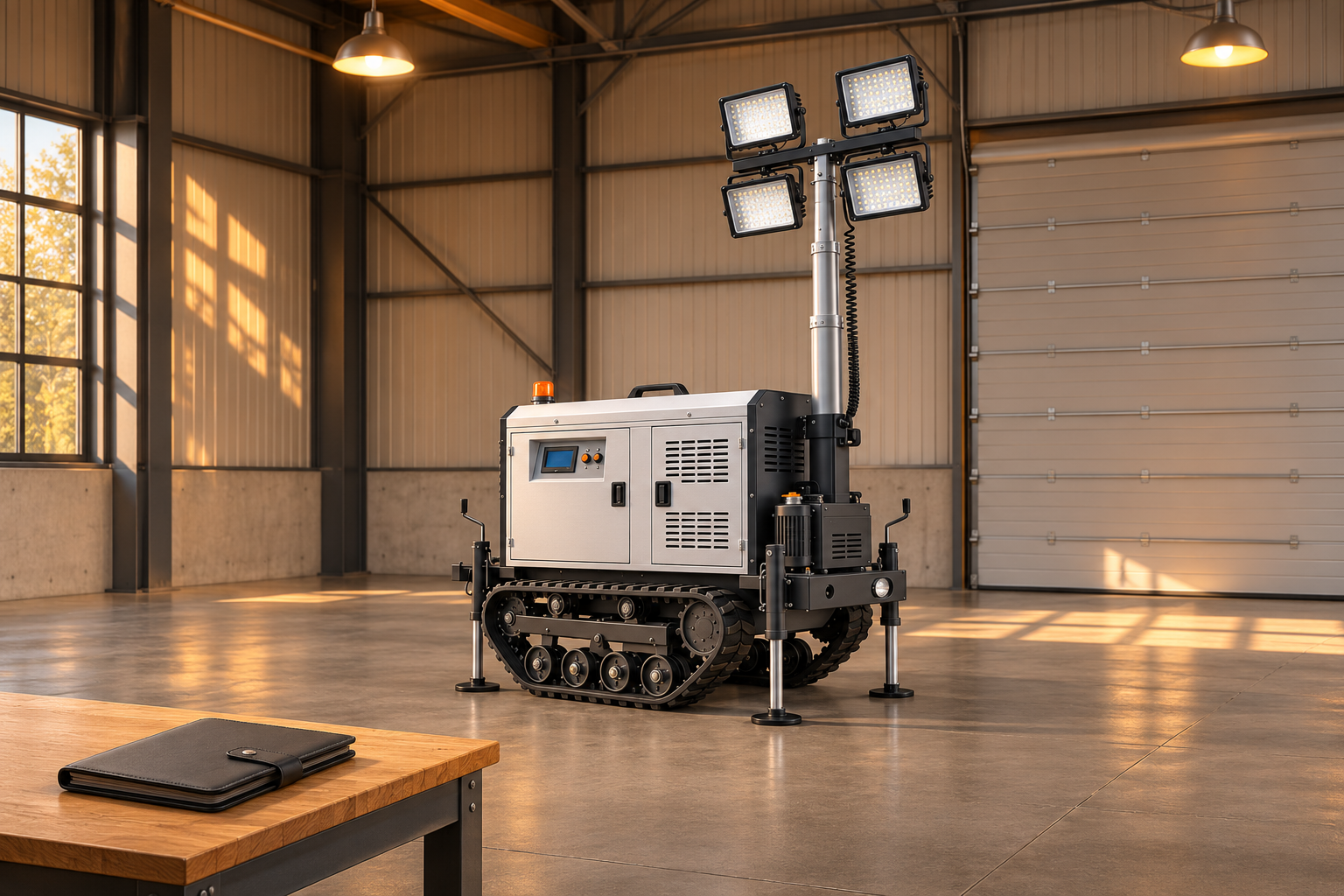
For the pictured Keyyou tracked lifting light tower, the visible cabinet, crawler tracks, mast and support legs establish the equipment context only. They do not establish a permissible pressure over a duct, the capacity of a chamber cover or the depth of a cable. Request information for the supplied unit rather than applying a figure from a similar-looking machine or another article.
If a protective mat or alternative support arrangement is proposed, have the necessary competent people assess both the machine setup and the asset below. A mat does not turn an unknown void into proven support. The released arrangement should explain where the supports may sit and which areas remain excluded. Keep the approved method available to the delivery and operating teams in a form they can actually use.
Use a coordination checklist with named owners
The following qualitative table organizes questions before mobilization. It deliberately contains no universal depth, clearance or bearing-pressure limit. Those decisions depend on the actual service, ground, equipment and competent assessment. Use the HSE guidance linked beside the checklist as background to the service-avoidance process, then apply the project's own controlled documents.
| Condição | Revisão ou ação | Evidence or responsibility |
|---|---|---|
| Route not covered by survey | Hold movement and obtain relevant review | Site logistics lead and competent survey team |
| Stabilizer proposed near cover | Assess actual support and buried asset | Competent ground and utility assessment |
| Ground penetration proposed | Bring the activity into service-avoidance controls | Authorized site work process |
| Drawing and markings disagree | Record discrepancy; hold affected location | Service information owner |
| Tower relocated | Review the new footprint and travel route | Site supervisor before release |
Esta lista de verificação de coordenação qualitativa apoia o fluxo de trabalho discutido aqui; aplique a jurisdição e o âmbito do HSE: avoiding danger from underground services. Não fornece um limite de aceitação numérico universal.
The person closing a checklist item should state the evidence used. “Survey complete” is too vague if the route was outside the survey boundary. A useful entry identifies the drawing revision, the reviewed area and any remaining exclusions. Where a decision is verbal, ask the site supervisor to capture it in the agreed record before the delivery team relies on it.
Make the delivery briefing usable at the gate
Before dispatch, send the receiving contact the equipment identity, arrival plan and current drawing revision. Confirm that the proposed holding area is available if access cannot be released. Giving a driver a named contact and a place to wait reduces pressure to improvise when the main entrance is blocked or the approved bay has become a storage area.
At arrival, compare visible conditions with the brief. Look for covers, fresh reinstatement, open excavations, damaged markings, changed barriers and new temporary services. These observations are reasons to check with the site lead, not opportunities for an untrained operator to diagnose the buried network. Record a mismatch without disturbing or testing the suspected service.
Keep the lighting unit in the authorized holding location until the affected question is resolved. If the released route has changed, update the route and briefing rather than writing an informal instruction such as “go around the other side.” The alternative may introduce a new crossing or put stabilizers on an area nobody reviewed.
Protect survey information during the lighting shift
Temporary lighting can help workers see a task while also making surface marks harder to interpret through glare, shadows or dirt. Agree how important information will remain available after dark. This might include the controlled drawing and a designated briefing point; it should not depend entirely on paint that traffic can remove.
Do not cover important marks or access points with the cabinet, tracks, pads, storage or cable protection without the appropriate review. Where the worksite needs continuing service access, include that requirement in the position selection. A tower placed for good illumination may still be an unsuitable obstruction to inspection or emergency access.
cURL Too many subrequests by single Worker invocation. To configure this limit, refer to https://developers.cloudflare.com/workers/wrangler/configuration/#limits.
cURL Too many subrequests by single Worker invocation. To configure this limit, refer to https://developers.cloudflare.com/workers/wrangler/configuration/#limits
cURL Too many subrequests by single Worker invocation. To configure this limit, refer to https://developers.cloudflare.com/workers/wrangler/configuration/#limits.
cURL Too many subrequests by single Worker invocation. To configure this limit, refer to https://developers.cloudflare.com/workers/wrangler/configuration/#limits.
cURL Too many subrequests by single Worker invocation. To configure this limit, refer to https://developers.cloudflare.com/workers/wrangler/configuration/#limits.
cURL Too many subrequests by single Worker invocation. To configure this limit, refer to https://developers.cloudflare.com/workers/wrangler/configuration/#limits
cURL Too many subrequests by single Worker invocation. To configure this limit, refer to https://developers.cloudflare.com/workers/wrangler/configuration/#limits.
cURL Too many subrequests by single Worker invocation. To configure this limit, refer to https://developers.cloudflare.com/workers/wrangler/configuration/#limits.
Equipment and related guidance
Identifique o contexto do equipamento utilizando a página do produto da torre de iluminação elevatória Keyyou. Solicite a documentação relativa à configuração efetivamente fornecida. Consulte as Segurança e Funcionamento da Torre de Iluminação e as orientações relacionadas sobre site risk assessment responsibilities, protected tree root zone coordination.
Further learning: Tom Dickey: Dig Safely
Safe Electricity explains why buried utility awareness matters before ground disturbance. This US public safety film supports the briefing only; it is not a survey method, UK permit or approval of a tower position.

Watch the educational video on YouTube.
Perguntas frequentes
Um chassi de rastreador torna a configuração segura sobre serviços enterrados?
No. Tracks do not establish service depth, cover capacity or ground support. The actual route and setup footprint require competent site review.
Um operador pode confiar apenas nos planos de utilidades?
Plans provide information with limitations. The responsible team must reconcile them with the required survey and site conditions; an operator should not interpret uncertainty as clearance.
É uma configuração apenas de superfície isenta de revisão?
Do not assume so. Loading, covers, voids and access can still matter. Any ground penetration must also enter the appropriate service-avoidance process.
O que acontece se a torre se mover?
Recheck the entire new footprint and travel route against current information and obtain release for the changed position.
Sources and scope
Estas fontes sustentam os princípios específicos de enquadramento acima abordados. As respetivas jurisdições e matérias são diferentes; não certificam o equipamento apresentado nem aprovam qualquer envio ou instalação individual.