

Reconciliação da Conta de Caixa de Alfândega da Torre de Luz: Rastrear Financiamentos e Encargos
Reconcilie a atividade da conta de caixa da torre de luz no Reino Unido com evidências de financiamento, referências de declaração, registos de envio e exceções claramente atribuídas.
Light tower customs cash account reconciliation starts by separating money paid into the account from charges taken for import declarations. Match the account holder, reporting period, declaration references and actual equipment purchases before finance closes the file. A bank transfer receipt alone does not show that a particular tower has cleared customs. For a UK buyer importing tracked lighting equipment, procurement should supply the order and shipment trail, while authorised finance and customs staff reconcile account activity and investigate exceptions. This guide concerns internal evidence coordination using current HMRC guidance; it does not initiate payments, choose declaration codes or confirm a tax treatment.
Define the account and shipment population first
Start with the business that owns the cash account, the relevant EORI and the period being reviewed. Ask the account owner to confirm that the downloaded transaction report relates to that business. A group company, agent or logistics provider may appear elsewhere in the commercial chain without owning this particular account. Record those relationships clearly before matching amounts. A similar company name is not a sufficient identity check.
For a light tower purchase, build a shipment index from the final invoice, packing list, transport record and declaration information supplied by the representative. An order may arrive in separate movements, and one declaration may include more than one commercial item. The index should describe what actually moved rather than forcing every customs charge into a one-order, one-payment model. Keep cancelled and revised references visible with their status explained.
Understand what each record can establish
HMRC describes the cash account as a means of paying customs charges through the Customs Declaration Service. Its account-management service provides transaction reports and other financial records. These records support reconciliation, but each has a different purpose: a bank record shows the banking event, a cash account report shows account activity, and declaration information explains the relevant import. None should silently replace the others.
Keep the supplier's invoice separate from the customs-account evidence. The invoice states the commercial supply and agreed price; customs charges follow the applicable import treatment. A difference between those figures is not automatically an error. Ask the representative and finance reviewer to explain an unexpected charge using the declaration and supporting calculation rather than changing a purchasing spreadsheet until the totals appear to agree.
Build a reconciliation schedule with traceable references
Use a schedule that identifies the report source, download date, period and reviewer. Retain the original report unchanged and make working annotations in a separate copy or reconciliation sheet. Each matched line should point to evidence that another authorised colleague can retrieve. Where a reference is missing, describe the gap explicitly; a coloured cell marked complete is not a substitute for the underlying record.
The following qualitative checklist organises responsibilities. It does not prescribe an HMRC accounting format or establish that a balance is correct. Adapt it to the actual report fields and business controls, and have the responsible reviewer confirm the method. Include a place for unresolved differences so that a partial reconciliation cannot be mistaken for a fully closed import file.
| Condição | Revisão ou ação | Evidence or responsibility |
|---|---|---|
| Identidade da conta | Confirm the account holder and reporting period | Account owner provides the unchanged report |
| Funding | Match relevant top-ups to banking and account evidence | Finance investigates missing or unallocated entries |
| Import charges | Connect the transaction to declaration and shipment references | Representative supplies the declaration information |
| Diferenças | Describe each unmatched line and evidence gap | Named reviewer records the question and resolution |
| Closure | Separate reconciliation from customs release | Finance and logistics retain their own outcome evidence |
Esta lista de verificação de coordenação qualitativa apoia o fluxo de trabalho discutido aqui; aplique a jurisdição e o âmbito do Use uma conta de caixa para declarações no Serviço de Declaração Aduaneira – GOV.UK. Não fornece um limite de aceitação numérico universal.
Separate top-ups from declaration charges
A top-up adds money to the account. It should be reconciled against the business's banking evidence and the corresponding account entry when available. A declaration-related debit uses account funds. It needs its own link to the relevant import information. Do not allocate a whole top-up to a tower simply because the transfer was made on the day the shipment was expected to arrive.
For example, a buyer may fund the account before a tower arrives, while other imports also use the available balance. Finance should review the actual transactions and the representative's records to identify the charges associated with the tower movement. An internal purchase-order note can explain the funding request, but it does not demonstrate how HMRC applied the funds. Preserve uncertainty until the actual account evidence resolves it.
Follow a difference from observation to resolution
Describe a discrepancy precisely. Useful questions include whether a top-up is absent from the report, a debit lacks a recognised declaration reference, a charge appears twice in the working schedule, or the reporting period excludes the relevant activity. These are different problems with different evidence owners. Avoid an unexplained label such as customs mismatch, which leaves the next person guessing what to investigate.
Assign the banking question to finance and the declaration question to the authorised representative. Procurement can retrieve the accepted order, final invoice and shipment documents. Keep a dated log of the question, recipient, response and evidence received. Do not contact a new payment destination supplied in an unverified message while investigating a difference; use the business's established verification process and official guidance for any proposed payment action.
Check authority without sharing credentials
Account reconciliation may require information from someone who already has authorised access to the customs financial account. It does not mean every procurement coordinator needs that access. HMRC's account-management guidance distinguishes account functions and authorities. Ask the account owner for the required report through the approved internal route rather than circulating credentials or asking a supplier to sign in for the business.
Where an agent uses an account, have the account owner confirm the actual authority and its scope. A commercial appointment and an account authority serve related but different purposes. Record which party can answer the transaction question and which party controls access. If an appointment changes, follow the responsible person's process for reviewing authority; a completed reconciliation does not itself remove or create access rights.
Connect equipment identity without inventing specifications
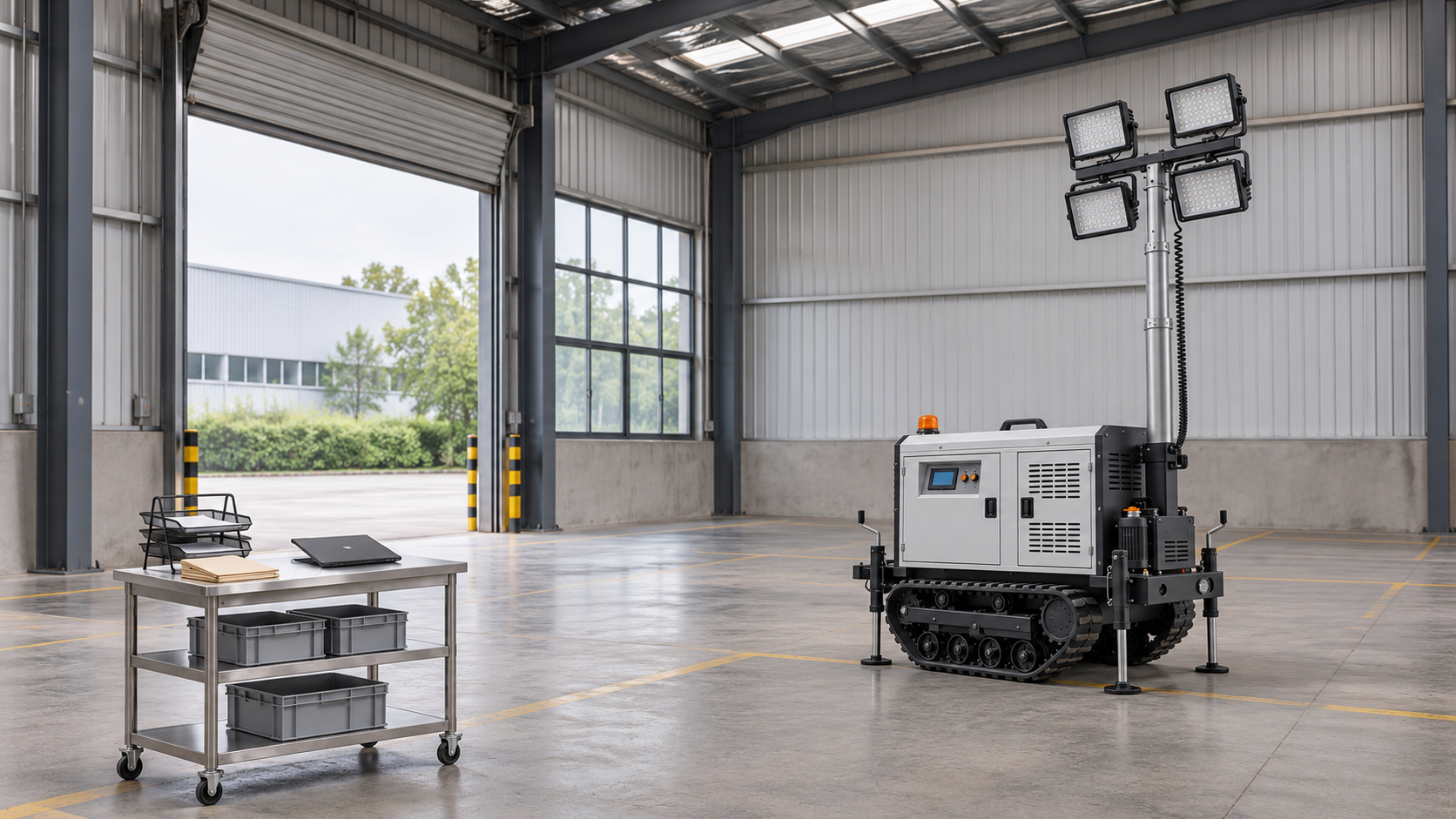
The pictured tracked light tower provides equipment context. Its visible cabinet, crawler base, mast and four lamp heads help distinguish the product family, but a photograph does not identify the customs charge. Use the actual supplied configuration, accessible equipment identification where available, packing record and declaration item information. Do not infer a serial number, tariff classification or electrical rating from an illustrative image.
If the shipment includes spare parts, separately packed accessories or more than one machine, make the shipment index specific enough to support the representative's explanation. Ask the supplier to clarify abbreviated invoice descriptions when necessary. Keep the original description and the dated clarification together. Replacing an earlier invoice in the shared folder can erase the evidence needed to understand what the declarant originally received.

Review timing before declaring a missing transaction
Select a reporting period that covers the relevant activity and record the report's actual cut-off. A payment instruction, banking event, account allocation and declaration activity may be recorded at different stages. Follow HMRC's current payment guidance and the account owner's checks when investigating timing. This article supplies no universal settlement interval and does not promise that any payment method will fund an account immediately.
Keep the exception open until the authorised reviewer has evidence of the outcome. If a report is refreshed, retain the earlier version and explain why the later one resolves the question. A screenshot of a transfer instruction is useful context but should not be described as confirmation of account credit. Likewise, an available balance is not evidence that the specific equipment has been released for collection.
Keep financial closure and physical release separate
Logistics needs the relevant customs release confirmation from the agreed representative before arranging actions that depend on release. Finance needs a supported reconciliation of account activity. The supplier needs commercial payment information. These milestones should be recorded separately even when they occur close together. A carrier booking or supplier receipt cannot substitute for the relevant customs status.
If the equipment is awaiting an examination or another control, an apparently settled account does not remove that requirement. Ask the representative what confirmation is outstanding and who will obtain it. Procurement should communicate a factual status to the project team, such as finance reconciliation complete and release confirmation pending, with evidence references and owners. Avoid a single all-clear label covering unrelated workstreams.
Create a practical month-end handover
A useful handover contains the unchanged account report, banking support for relevant funding, a declaration-to-shipment index, resolved-difference notes and an exception list. Identify who prepared it, who reviewed it and the date of review. Store sensitive financial documents with access limited to the authorised team. The public product page is useful context for the equipment, not a place to store transaction evidence.
For recurring tower imports, reuse the schedule structure while refreshing the actual facts. Check the importer, representative, goods and account for every new movement. An earlier reconciliation can explain a recurring charge pattern but should not become automatic proof that a later transaction is correct. Close the current file only to the extent supported by records, and carry unresolved items forward with named responsibility rather than dropping them at a reporting boundary.
Equipment and related guidance
Identifique o contexto do equipamento utilizando a página do produto da torre de iluminação elevatória Keyyou. Solicite a documentação relativa à configuração efetivamente fornecida. Consulte as Light Tower Customs Debt Liability Evidence: UK Buyer File e as orientações relacionadas sobre duty deferment payment handover, postponed import VAT evidence.
Further learning: How to use your customs financial accounts on the Customs Declaration Service
This HMRC webinar introduces Customs Declaration Service financial accounts, including the cash account. Use it to understand the account context; current GOV.UK guidance and the actual reports govern your reconciliation. It does not verify this shipment or initiate any payment.

Watch the educational video on YouTube.
Perguntas frequentes
Does a bank transfer prove that a tower cleared customs?
Não. Financiamento, atividade da conta e liberação alfandegária são eventos diferentes e precisam de suas próprias evidências.
Should the supplier invoice equal the cash account debit?
Do not assume so. The documents serve different purposes; finance and the representative should explain the actual charges.
Can procurement reconcile without account credentials?
Yes. Procurement can organise order and shipment evidence while the authorised account owner supplies the required reports.
What happens to an unresolved difference at month end?
Keep it on a dated exception list with a named owner and next action rather than silently closing or removing it.
Sources and scope
Estas fontes sustentam os princípios específicos de enquadramento acima abordados. As respetivas jurisdições e matérias são diferentes; não certificam o equipamento apresentado nem aprovam qualquer envio ou instalação individual.


