
Light Tower Ground Bearing Pressure: Reactions, Mats and Site Evidence
Check light tower ground bearing pressure using verified support reactions, effective mat area and assessed site conditions before deployment.
Light tower ground bearing pressure is the load transferred through a track, wheel, stabilizer foot or supporting mat divided by its effective contact area. Before deploying a lighting tower, obtain the support reactions for the actual operating configuration and compare the resulting pressure with a competent assessment of the ground. A low total machine weight does not prove that an individual support is safe. This guide explains the information a buyer should request, a transparent calculation method and the conditions that require further review. It does not assign a safe bearing capacity to a site or provide a deployment approval for any Keyyou model.
Separate travelling contact from deployed support
A crawler machine spreads its travelling weight over two tracks, but the load path may change when its stabilizers are extended. Depending on the approved setup, the supports may carry part or much of the operating load. The track contact area therefore cannot automatically be used to calculate pressure beneath a deployed stabilizer. Ask the manufacturer how the particular machine must be supported before raising its mast.
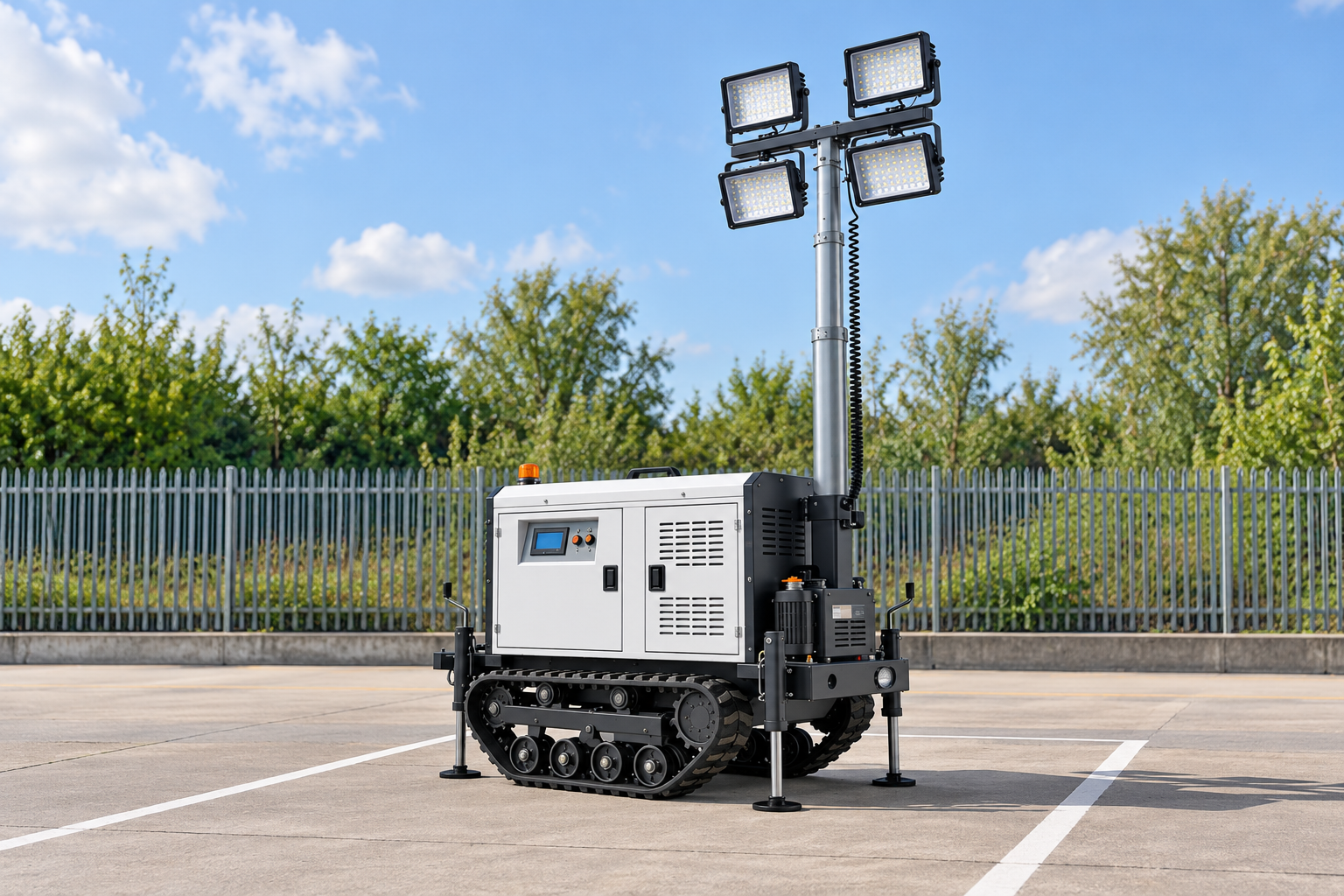
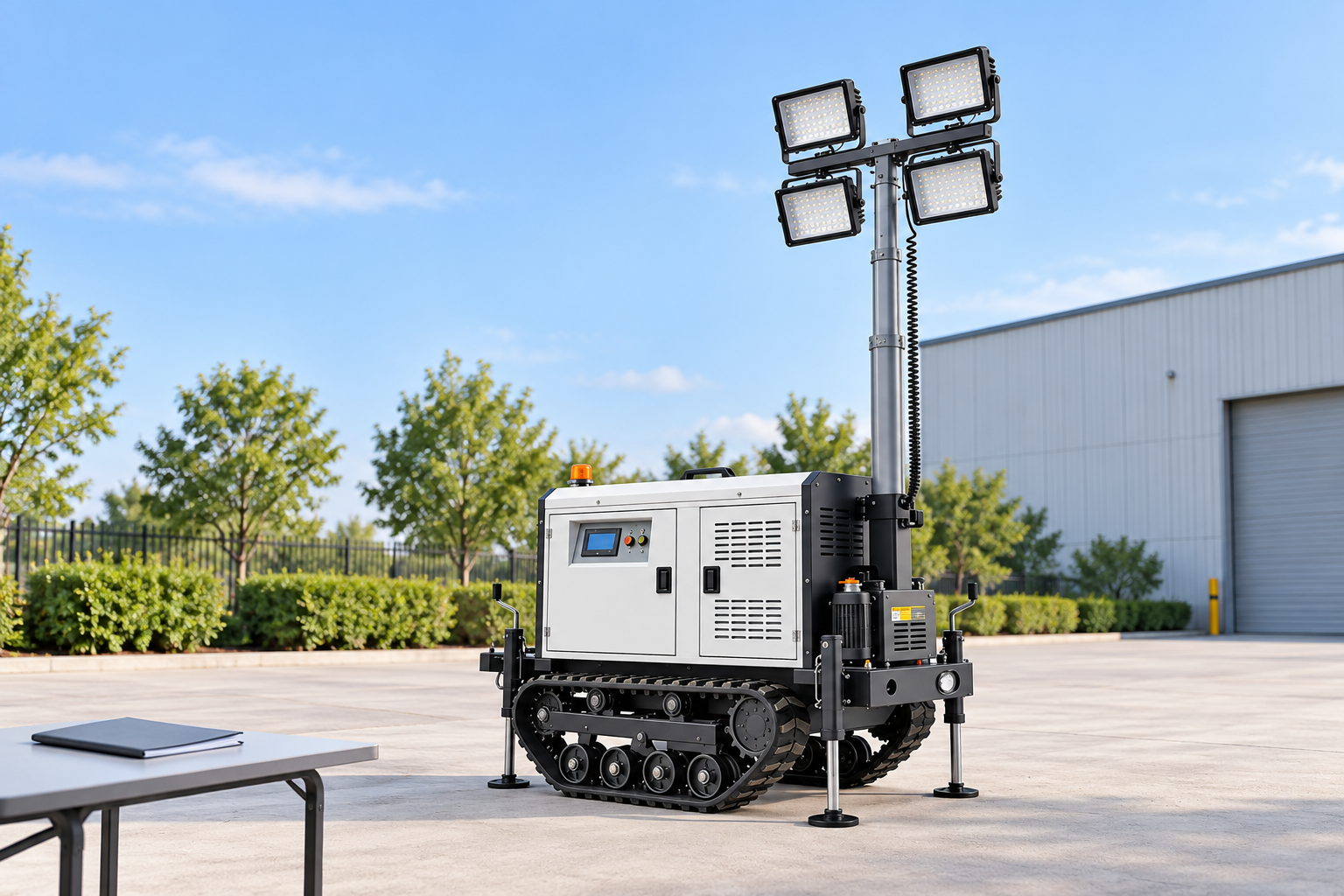
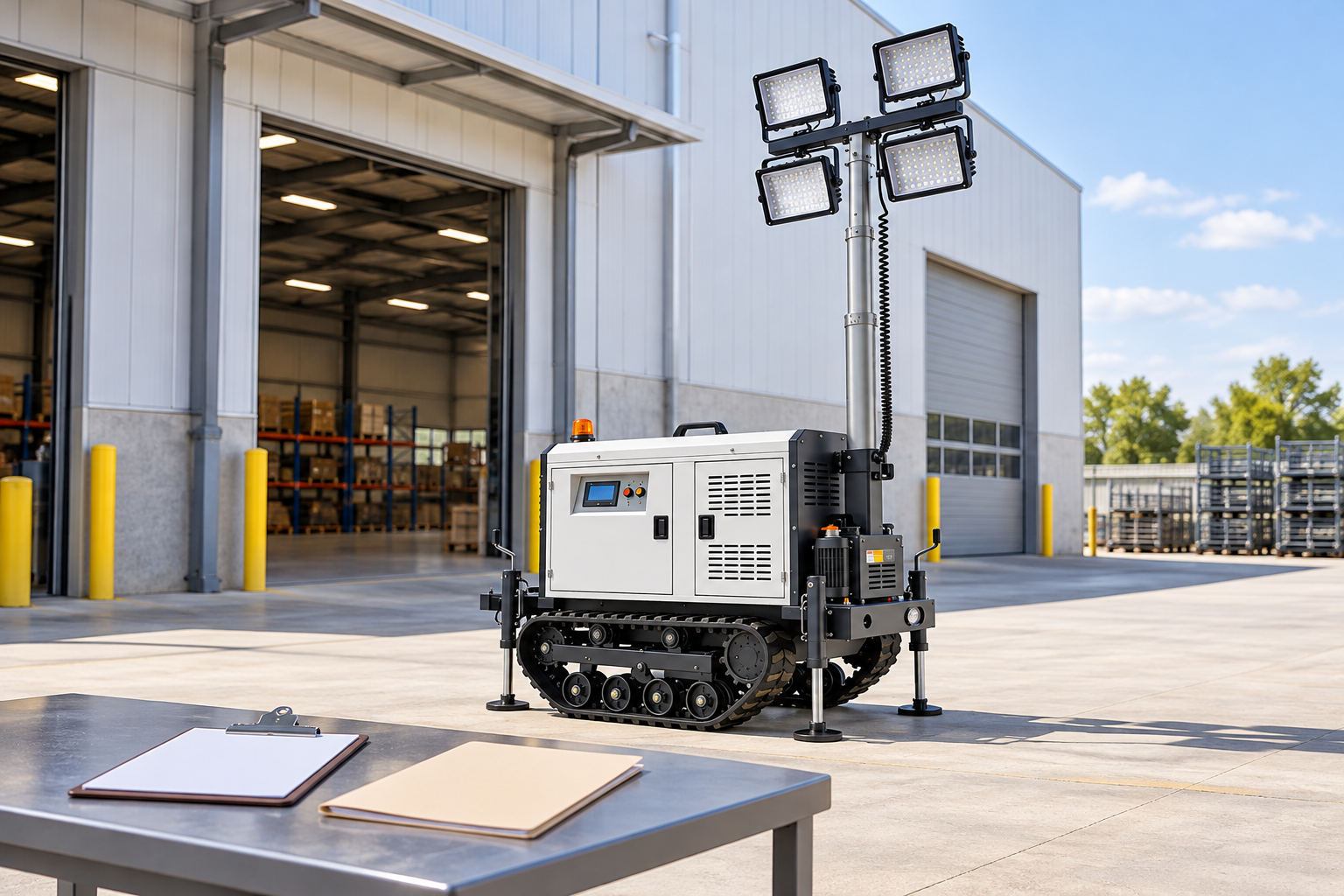
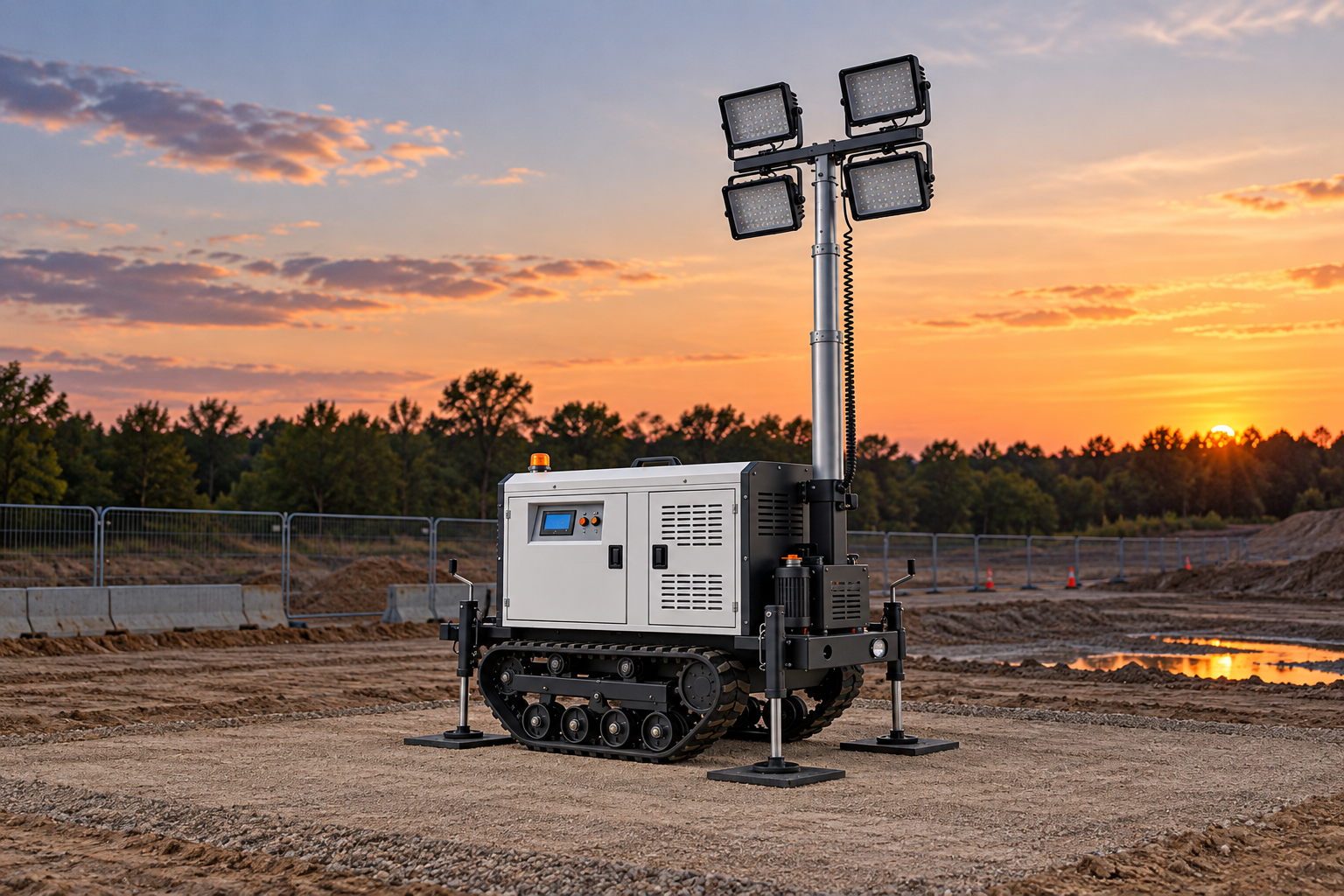
The illustrated Keyyou crawler product identifies the equipment family. Its visible tracks, round-foot supports and elevated lamp assembly do not establish its support reactions, allowable slope, approved mat dimensions or ground suitability. Those are separate engineering inputs. A photograph can support identification; it cannot replace the operating manual or a site assessment.
Request reactions for the actual configuration
A useful enquiry specifies the machine configuration, mast position, lamp orientation, installed options, permitted operating conditions and intended support arrangement. Request the maximum relevant downward reaction at each support and the assumptions used to derive it. Also ask whether the supplied reactions include the effects that the manufacturer requires for the proposed application. Avoid treating an unlabelled number in a sales sheet as a verified design reaction.
Dividing the total weight by four assumes equal loading of four supports. Real support reactions depend on geometry, centre of gravity, ground level and external actions. A mast or lamp assembly can change load distribution. If the supplier cannot provide an appropriate basis, refer the problem to a competent engineer. Do not resolve the missing information by adding an arbitrary percentage to an equally divided load.
Use pressure equals reaction divided by effective area
For a preliminary check using a verified vertical reaction, write q = R / A, where q is the average applied pressure, R is the support reaction and A is the effective bearing area. With R in kilonewtons and A in square metres, q is in kilopascals. Keep units visible in the calculation so that a value in tonnes is not accidentally treated as a value in kilonewtons.
As a purely illustrative arithmetic example, suppose an assessed support reaction is 8 kN and the effective contact area is 0.20 m². The average pressure is 8 / 0.20 = 40 kPa. These are invented teaching inputs, not Keyyou specifications or recommended ground limits. The answer describes average contact pressure only. It does not prove that the mat, ground, buried structure or whole machine is safe.
Effective area must be physically available
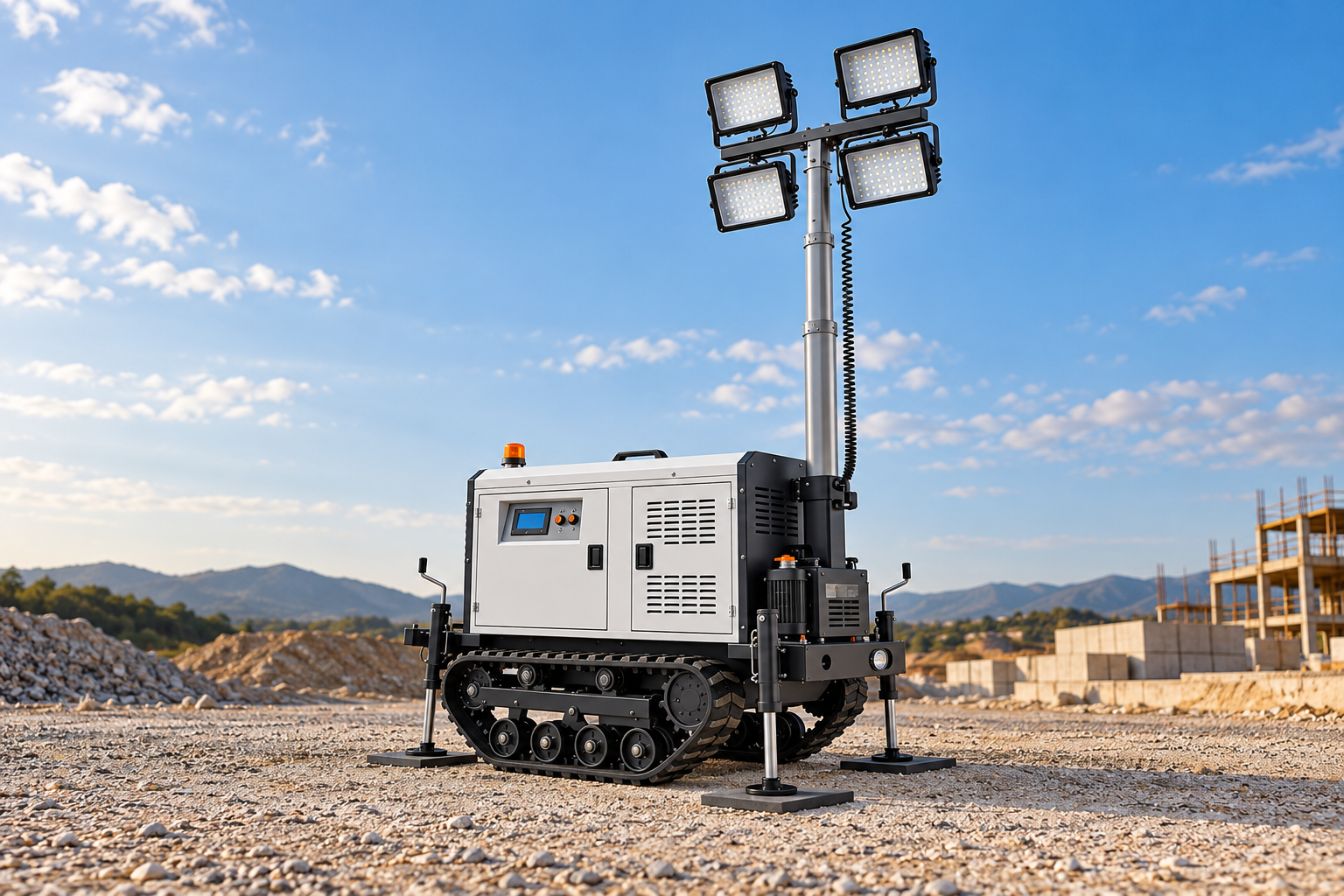
A mat measuring 0.50 m by 0.50 m has a geometric plan area of 0.25 m². That area is not automatically effective if part of the mat overhangs an edge, rests on a void or lacks continuous support. Bending, material strength, local punching and the position of the foot also matter. A visibly large board can still fail to spread a concentrated load as intended.
Ask for a support arrangement suitable for the documented reactions and ground conditions. Record the mat identification, dimensions, material condition and placement. Do not stack loose scrap material to achieve a convenient level. Where the intended support cannot be installed as designed, stop and obtain a revised arrangement. More surface area is useful only when the load can actually reach that area safely.
Compare with a site-specific ground assessment
OSHA's crane ground-condition provisions describe the importance of adequate supporting conditions, while HSE's mobile-platform guidance identifies weak covers and uncompacted backfill as stability hazards. These sources concern other equipment classes; their general risk principles are useful, but crane and platform requirements must not be copied as lighting-tower ratings. The tower supplier and responsible site assessor must address the actual equipment and location.
Ground that looks firm may conceal a trench, service duct, poorly compacted fill or a weak cover slab. Asphalt and concrete surfaces also need assessment of the layers or structure beneath them. Record where the tower will stand, the evidence available for that location and any restrictions. A generic description such as hardstanding is not enough to establish a numerical allowable pressure.
Keep the evidence in one deployment record
| Required input | أدلة للطلب | What it decides | Hold point if missing |
|---|---|---|---|
| Operating configuration | Approved manual and installed-option list | Which support arrangement applies | Do not assume transport data applies |
| Individual support reaction | Manufacturer or competent engineering basis | Load used in the pressure check | Obtain reactions before selecting mats |
| Effective support area | Suitable mat design and placement details | Area actually available to spread load | Reject unsupported overhang or damaged mats |
| Ground capacity and hidden hazards | Competent site assessment and service information | Whether the location can accept the load | Relocate or obtain a documented assessment |
| Weather and site changes | Inspection triggers and named responsibility | When the approval must be reconsidered | Suspend use when conditions change |
This table is an original document-control aid, not a regulatory checklist. Use the linked OSHA and HSE material to understand ground-support risks and the supplied equipment instructions for the actual setup. The person approving deployment should be able to trace each input to its source and identify who can release a hold point.
Check edges, services and drainage before setup
Mark the proposed footprint and inspect the surrounding area before the unit arrives. Discuss nearby excavations, backfilled trenches, retaining structures and buried services with the site team. The relevant influence zone can extend beyond the visible foot. Do not choose a universal distance from an edge without an appropriate engineering basis. A lightweight tower still requires a location capable of supporting its particular reactions.
Drainage deserves its own check. A pad that is acceptable in dry conditions may deteriorate after rain or water discharge. Look for erosion, settlement and paths where water could collect. Arrange the work area so that an inspection can be performed without entering traffic or touching moving machinery. If conditions are uncertain, use a different assessed location rather than trying to compensate by extending the mast less.
Distinguish local bearing from overall stability
A satisfactory average bearing-pressure calculation addresses only one part of deployment. The machine must also meet its permitted slope, stabilizer arrangement, mast configuration and wind conditions. Do not trade one requirement against another. Larger mats do not authorize operation above the documented wind limit, and firm ground does not permit an improvised support arrangement.
The calculation also does not assess a suspended slab, underground chamber roof or bridge deck. Those structures may require a structural assessment that considers concentrated loads and load paths. Identify the supporting surface accurately in the enquiry. If a tower is proposed on a roof or elevated deck, obtain the structure owner's approval and competent assessment before delivery, rather than relying on the equipment's total weight alone.
Inspect after installation and after change
Before operation, the responsible person should confirm that the machine is in the assessed location and configuration, the supports are installed as instructed and the supporting materials match the approved arrangement. Record the condition of each contact point. Where inspection reveals rocking, settlement, cracking or unexpected movement, keep personnel clear and follow the approved procedure for taking the equipment out of service.
Set review triggers in advance. These may include heavy rain, nearby excavation, vehicle impact, relocation, a changed mast or lamp configuration and evidence of ground movement. The appropriate trigger depends on the equipment instructions and site risk assessment. A previous signature is not a permanent approval when the physical conditions have changed. Preserve the original record and add the reassessment rather than overwriting history.
Ask a supplier for usable evidence
An effective request states the proposed location, lighting configuration, site surface, available ground information and intended deployment duration. Ask the supplier for the operating manual, relevant support reactions, support-foot details and any restrictions affecting mat use. Include photographs and a dimensioned location sketch where available, clearly distinguishing measured information from estimates.
For procurement, require the evidence before the decision that depends on it. A promise to provide support data after the unit arrives leaves the site unable to confirm its deployment plan. If a reaction or ground input is still unknown, show that uncertainty explicitly in the enquiry and agree who will resolve it. The outcome should be a traceable deployment decision, not a guessed pressure figure presented as a product benefit.
المعدات والتخطيط التكميلي
حدد المعدات الموضحة في الصورة صفحة المنتج لبرج الإضاءة Keyyou Crawler. Read the دليل أبراج الإضاءة القابلة للقطر والمقطورة, ثم استشر كم يبلغ وزن برج الإصاءة؟ فئات النقل وتخطيط الحمولة الناقلة و طباعة بصمات تثبيت برج الإضاءة: تخطيط المساحة والتركيب.
Further learning: Loading and unloading mobile plant
This Work Safe Queensland film explains changing ground conditions, firm level loading areas and control of access around mobile plant. It supports the discussion of assessing the approach and supporting surface; its loading-ramp instructions are not a lighting-tower bearing-pressure calculation or permission to use a particular mat.
Watch Loading and unloading mobile plant.
الأسئلة الشائعة
Can I divide the tower weight equally across four feet?
Not without an appropriate engineering basis. Obtain support reactions for the actual configuration and assess each relevant support.
Does a larger mat always make deployment safe?
No. Effective load spreading, mat strength, ground support, stability and equipment limits must all be assessed.
Are the example pressures Keyyou specifications?
No. The numbers demonstrate arithmetic only and are not equipment ratings or allowable site pressures.
المصادر والنطاق
The sources explain support and stability risks for other equipment classes. They do not provide Keyyou support reactions or a site allowable bearing capacity. The arithmetic is a labelled teaching example and the document-control table is original.