
Replaceable Battery Packs for Light Towers: Fleet Design Guide
Evaluate replaceable light tower battery designs with a practical check of pack compatibility, safe handling, depot charging and fleet downtime. No unverified swap claim.
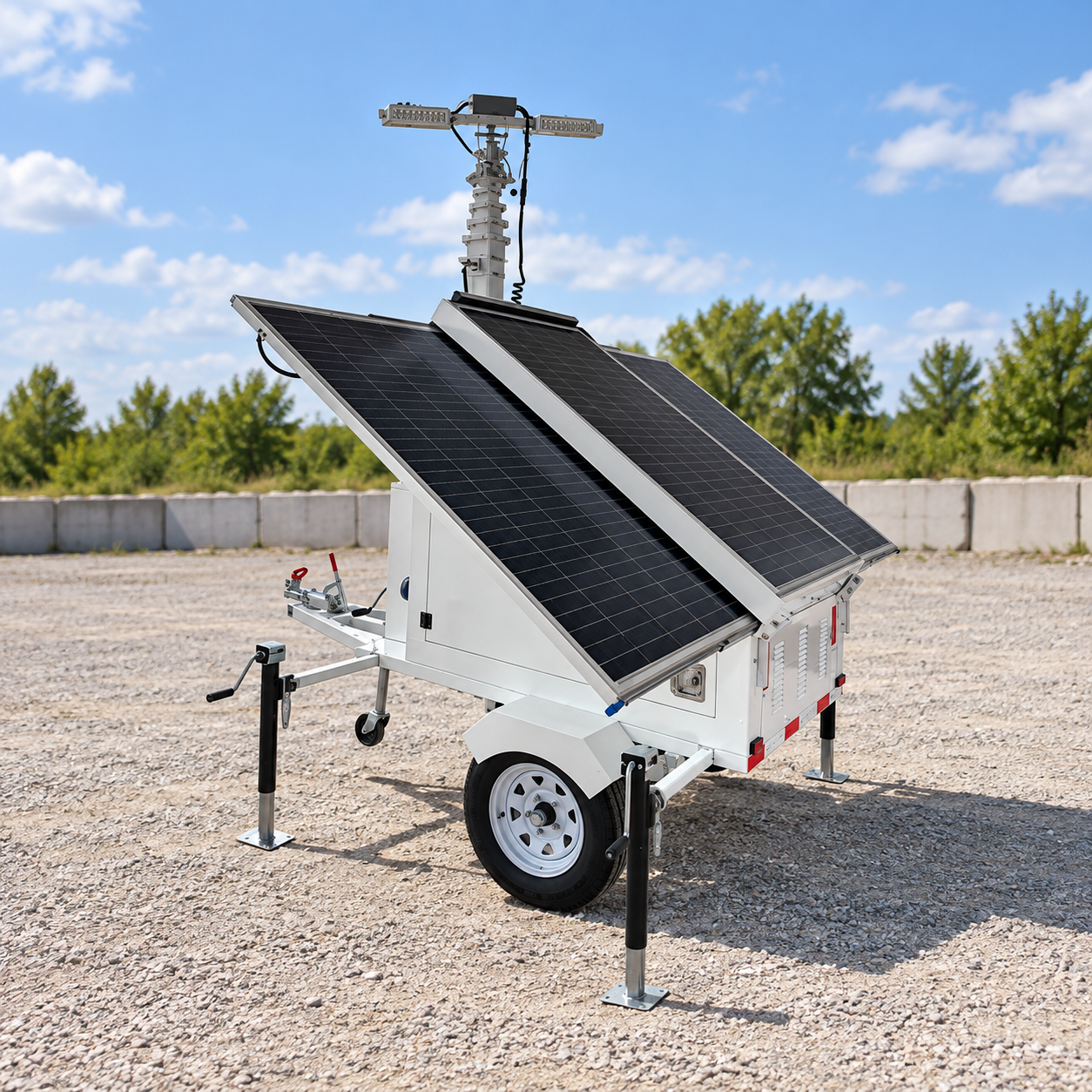
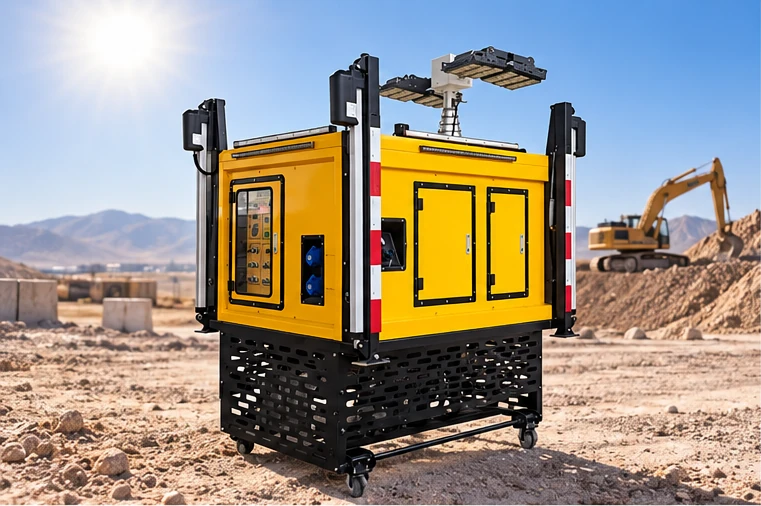
A replaceable light tower battery can reduce idle time only when the tower, pack, charger, mechanical interface and fleet operating procedure were designed and approved as one compatible system. A battery that can be serviced by a technician is not necessarily a field-swappable module. Before ordering “quick swap” capability, ask the manufacturer to demonstrate the exact pack on the exact light-tower variant, including isolation, lifting, connector protection and charging outside the machine. This fleet design guide explains the decision points. The pictured Keyyou product is a real mobile light tower with a closed power cabinet; its image is a product-category reference and does not establish that its battery is removable.
Define the word “replaceable” in the purchase order
There are at least three different configurations. A service-replaceable battery is removed during maintenance by qualified technicians with the machine isolated and possibly disassembled. A tool-assisted exchangeable module can be replaced at a depot using approved lifting and service steps. An operator-swappable pack is engineered for frequent field exchange with a protected interface and a trained procedure. The last category is much more demanding than the first. Ask for a written statement of the permitted users, tools, access position, safe isolation state, expected exchange process and environmental limitations.
Do not infer a swap system from a battery “pack” in a brochure. A sealed battery pack may be permanently installed in a cabinet, and a door may be intended for servicing rather than routine access. The battery-management system, wiring protection and enclosure seals are part of the design. Replacing a pack with a similar-looking but unapproved unit can defeat those protections. UL Solutions’ discussion of battery module and pack testing emphasizes assessment of both the pack and its interaction with the whole system. This article does not claim a particular UL listing for a Keyyou tower.
What must match between pack and light tower?
| Interface | Question for the supplier | Evidence to obtain |
|---|---|---|
| كهربائي | Do voltage range, current, protection and connector mating match? | Approved pack part number, wiring and protection diagram |
| Battery management | Does the controller exchange SOC, temperature and fault information correctly? | Compatibility matrix and fault-response test |
| ميكانيكي | Is the mass supported and restrained during towing and operation? | Mounting drawing, lifting points and retention test |
| Environmental | Is the sealed interface protected in dust, rain and vibration? | Rated condition and inspection procedure |
| جاري الشحن | Is the off-machine charger approved for this exact pack? | Charger model, settings and temperature limits |
| العمليات | Who may exchange it, and where? | Operator procedure, training and emergency instructions |
Ask the supplier to identify revisions of both the pack and the tower. Two packs of the same nominal kWh can have different allowable currents, connectors, communications or temperature envelopes. The correct purchasing unit is an approved pack–tower–charger combination, not a generic battery capacity. Record serial numbers and firmware versions if the management system uses them for compatibility.
Assess downtime with energy and logistics, not a slogan
Swapping changes where charging happens; it does not remove the need to replenish energy. A fleet may need enough charged packs for the next shift, a charger bank, safe storage, transport and a return process for depleted packs. Compare the total cycle: tower operating hours, time to isolate and exchange, depot travel, charging time, inspection and contingency for a failed pack. For a fixed-site crew, on-board charging during an idle shift may be simpler. For frequent deployment with short turnarounds, a genuinely approved exchange system may be useful.
Use the charging-time calculation to size the replenishment window; it is a separate question from physical swap speed. If each pack supports one shift but the charger cannot refill it before the next, an extra pack or charger is needed. Count reserve packs against the worst reasonably expected run time and weather, not only a brochure’s maximum runtime. The state-of-charge monitoring guide helps establish a consistent handover reading.
Design a safe exchange procedure before the first deployment
An approved procedure should say where the tower is parked and stabilized, how the lighting load is switched off, how charging is disconnected, how residual energy is handled, and how the pack is physically supported. It should identify the tools, personnel, protective equipment and handling aids actually required by the manufacturer. Do not reach into an energized cabinet to meet a shift deadline. If a module is damaged, hot, swollen, leaking or reports a fault, isolate it according to the supplier’s emergency instructions rather than moving it as a routine spare.
OSHA’s lithium-ion battery safety guidance stresses a workplace emergency action plan, trained workers and response procedures based on manufacturer instructions. Application differs by chemistry, jurisdiction and installation; do not transplant one document as the complete local code. Fleet staff should know where to stage a suspect pack and whom to call. Storage and transport also need their own rules. A pack moved between sites should be protected from short circuits, impact and unsuitable temperatures as specified by its maker.
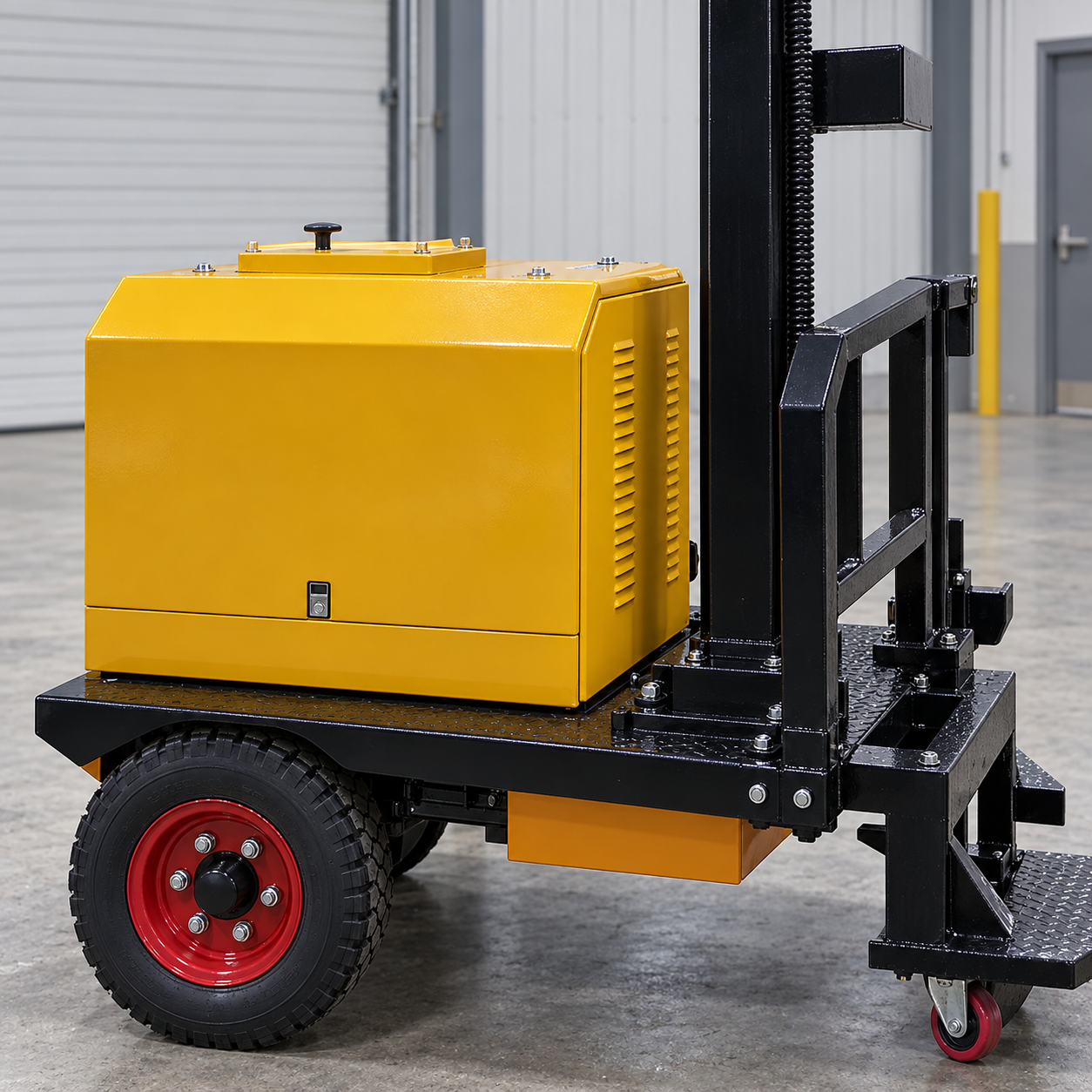
Mechanical design matters as much as electrical design. An exchangeable pack may be too heavy or awkward for a person to lift safely. The tower needs a stable exchange position and a retention mechanism that remains secure during towing and mast operation. An unrestrained battery can be damaged by vibration or shift the machine’s center of gravity. Verify the actual mass, center of gravity and handling method in the supplied drawings; this article does not invent a weight limit or a universal two-person lift rule.
Charging spare packs away from the tower
A separate charger is not automatically compatible with an approved on-board battery. Verify the charger part number, charge profile, connector, communications, permitted temperature range, protection and electrical supply. A cabinet designed for the tower may supply monitoring or cooling that a free-standing pack lacks. Ask whether a pack can be charged outside the tower, and under what enclosure and supervision conditions. A pack and a charger carrying unrelated marks do not establish system-level compatibility; UL Solutions’ portable power pack Q&A illustrates why the scope of a certification matters.
Label each authorized pack clearly in the fleet asset system, but do not alter a safety label or obscure manufacturer identification. Record charge cycles, fault history, storage location and inspection date. A first-in-first-out rotation can help distribute use, subject to the maker’s storage SOC and maintenance instructions. The goal is not to force every pack into identical use: a pack with abnormal heat, damage or repeated faults must be removed from service and assessed.

How to evaluate a supplier demonstration
- Choose a representative unit. Use the exact tower and battery variant to be ordered, with the operator and charger planned for the fleet.
- Observe safe shutdown. Check isolation, indicators and the documented sequence before anyone touches a battery interface.
- Measure the actual exchange. Record people, equipment, access clearance, lifting steps, inspection and time; repeat after normal field contamination.
- Test the restart. Confirm pack identity, SOC reading, fault reporting and lighting operation, then log any alarms.
- Test replenishment. Charge the removed pack using its approved charger, record energy and time, and verify the next shift’s reserve.
- Review failure cases. Ask what happens with a wrong pack, incomplete latch, moisture, temperature limit or communication fault.
Ask for an evidence package: dimensional drawings, pack restraint and connector details, handling instructions, battery and charger identifiers, fault behavior, warranty boundaries and any applicable conformity documents. It is reasonable to decline a “quick swap” claim if the only evidence is a photo of an access panel. Separate the swap feature in the quotation so it cannot be accidentally assumed for a standard variant.
Applying this framework to Keyyou mobile towers
ال Keyyou portable lifting lighting tower standard model shows a compact wheeled platform with a closed yellow power cabinet and configurable power options. That makes it a relevant physical reference for fleet packaging and access discussions. The visible product page does not establish an operator-swappable battery. If this capability is required, ask Keyyou to confirm a specific approved battery option, pack interface, charger and exchange procedure in writing. If it is not offered, use a fixed-battery design and schedule charging or select another approved product rather than modifying the cabinet in the field.
Battery lifetime and service decisions also depend on operating conditions. The thermal-management article explains why temperature control remains important even when packs rotate. A replaceable design can simplify logistics, but only a validated system reduces downtime without introducing an electrical or handling hazard.
Further learning: batteries as complete storage systems
Clean Energy States Alliance’s educational Energy Storage 101 session introduces battery technology and system-level considerations. It provides background for comparing pack and charger options, not a demonstration of a Keyyou exchange mechanism.

الأسئلة الشائعة
Can a technician-replaceable battery be advertised as field-swappable?
Not without a manufacturer-approved field procedure and suitable interface. Service replacement and routine operator exchange are different design claims.
Can I mix packs of equal kWh from different suppliers?
Not by capacity alone. Electrical, control, mechanical, charger and safety compatibility must be documented for the exact tower variant.
Does an extra pack eliminate charging downtime?
It may shift charging to a depot, but the fleet still needs enough chargers, charged spares, safe storage and logistics for the next shift.
Does the pictured Keyyou model have a swappable pack?
The product photo and public description do not confirm that feature. Request written model-specific confirmation before ordering it.