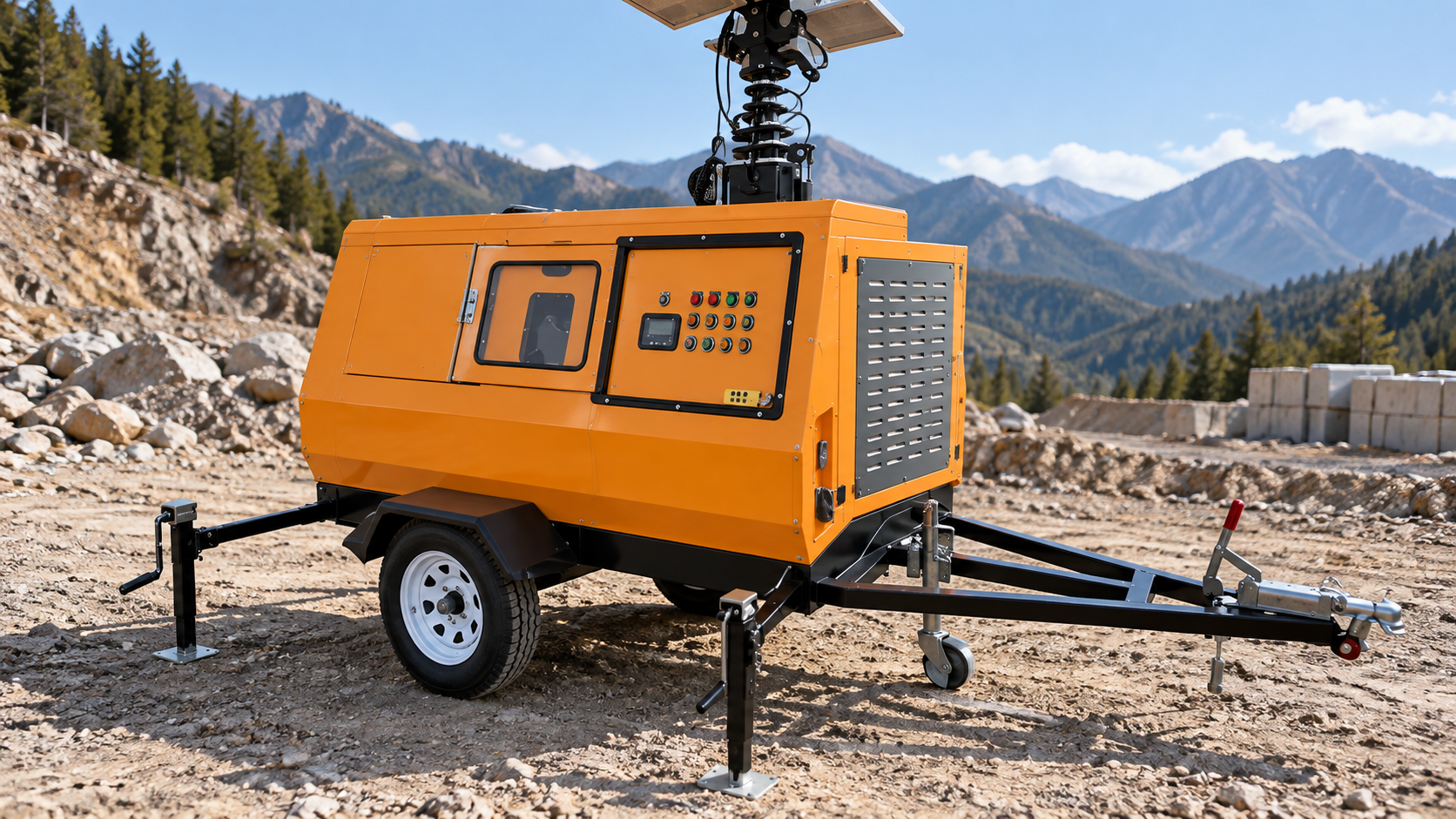

Light Tower Generator Load Factor: Why Oversizing Causes Problems
Calculate light tower generator load factor, distinguish kW from kVA, and avoid chronic low-load operation without sacrificing startup capacity or site safety.
Light tower generator load factor is the average real electrical load divided by the generator set’s applicable real-power rating, normally expressed as a percentage. It should be calculated across a defined time window and duty rating, not guessed from cabinet size or lamp nameplates. Oversizing can leave a diesel engine at chronically low load, while undersizing can cause poor voltage response, overload trips or inadequate starting capacity. The correct selection balances steady demand, transient demand, site derating and the engine maker’s permitted operating range. This guide uses hypothetical examples only; request the exact engine, alternator and controller data for the supplied Keyyou configuration.
Use the correct numerator, denominator and time window
For a steady operating interval, load factor (%) = measured real load in kW ÷ site-available generator rating in kW × 100. For a changing shift, calculate energy delivered in kWh divided by rated kW multiplied by the hours in that same interval. A ten-hour shift delivering 30 kWh from a generator site-rated at 6 kW has an average load factor of 30 ÷ (6 × 10) = 50%. That average does not reveal a brief motor-starting peak, so transient capability must be checked separately.
Use the rating that applies to the intended duty. Standby, prime and continuous ratings describe different permissible service. Cummins’ generator-set application manual explains rating categories and the importance of sufficient operating load, but its numerical recommendations belong to the covered Cummins equipment. They must not be copied as universal limits for an unidentified light-tower engine. Obtain the exact supplier’s permitted loading, maintenance and exercise requirements.
| Input | Use in the calculation | Verification source |
|---|---|---|
| Site-rated real power | Denominator in kW | Exact generator-set data at altitude and temperature |
| Running LED demand | Continuous numerator component | Measured power at each lighting mode |
| Auxiliary demand | Add only approved simultaneous loads | Load schedule and field meter |
| Power factor and kVA | Checks alternator current loading | Driver and alternator documentation |
| Starting or step load | Separate transient check | Equipment startup data and voltage-dip limits |
| Operating hours by mode | Builds the time-weighted average | Controller logs and shift plan |
Why simply buying a larger generator can create a mismatch
A generator selected only for the sum of every possible nameplate load may spend most nights far below its intended range. LED lighting often has a much lower running demand than older lamp systems, especially when dimmed. An oversized diesel engine must still overcome internal friction and maintain coolant and exhaust temperatures while producing little useful electricity. Low-load operation can reduce fuel efficiency per delivered kWh and may contribute to incomplete combustion or deposits, depending on the engine and aftertreatment design.
Oversizing also raises purchase, transport and service burden. A physically larger set can add trailer mass and fuel capacity without improving the site’s lighting requirement. Yet choosing the smallest possible machine is not the solution: it must accept lamp-driver inrush, mast or accessory loads where applicable, temperature and altitude derating, and any approved receptacle demand. The engineering target is an appropriate operating envelope, not the highest average percentage possible.
Cummins’ generator sizing paper emphasizes identifying load types, sizes and starting behavior. Use such methodology to frame questions, while relying on the exact supplied set for final numbers. Our altitude derating guide explains why the sea-level number may not be the correct denominator at the project site.
Worked example with changing lighting modes
Assume a hypothetical generator is site-rated at 5.0 kW for the intended duty. The tower runs four hours at 2.8 kW, then six hours at 1.6 kW after an approved dimming change. Shift energy is (4 × 2.8) + (6 × 1.6) = 20.8 kWh. Average load is 20.8 ÷ 10 = 2.08 kW, and the ten-hour load factor is 2.08 ÷ 5.0 × 100 = 41.6%. The first interval is 56%, and the second is 32%. These values are illustrative and are not specifications for the pictured Keyyou tower.
Now add a hypothetical 1.5 kW auxiliary device for one hour. Total shift energy becomes 22.3 kWh and the average load factor becomes 44.6%, but the simultaneous one-hour load may be 3.1 kW or 4.3 kW depending on when the device runs. If it has a motor, its starting kVA may be more important than its running kW. A time-average can hide that peak. Put each load step on a timeline and check steady kW, kVA, power factor and allowable voltage/frequency dip.
Do not use lamp watts alone. Drivers, controls, enclosure fans, battery charging on hybrid variants and authorized outlets can change the measured input. Conversely, do not add equipment that cannot physically or contractually operate together. Cummins’ generator sizing FAQ discusses load diversity: connected load is not necessarily simultaneous demand. Build a credible operating schedule rather than applying a blanket diversity percentage.
Low load, wet stacking and fuel efficiency are related but distinct
Chronic light loading may keep some diesel engines below intended temperature, but a low calculated percentage does not itself diagnose damage. Wet exhaust residue, abnormal smoke or rising oil level can have several causes. The wet-stacking guide explains symptoms and qualified diagnosis. Follow the engine maker’s thresholds and corrective procedure; do not apply a rental-fleet rule to a different engine or force an arbitrary load bank without approval.
Fuel consumption should be compared as liters per hour and, when useful, liters per delivered kWh at real operating points. A larger engine may burn more fuel per hour at the same small lighting load, but the exact curve is model-specific. Our fuel-tank sizing guide shows how load-specific fuel rates affect shift planning. Record the actual lamp mode and auxiliary loads with each fuel measurement so the result can be reproduced.
If the application regularly has long low-load periods and occasional peaks, ask the manufacturer about a smaller approved set, staged loads, battery-hybrid operation or an engineered load-management sequence. Do not add wasteful electrical load merely to improve a percentage unless the engine/set manufacturer specifies a safe test or maintenance procedure. The purpose is reliable light with appropriate engine operation, not consumption for its own sake.
Procurement and commissioning workflow
- Identify the exact power option. Record engine, alternator, controller, duty rating and emissions configuration.
- Create a load schedule. List each LED mode, controls, approved auxiliaries, hours and simultaneous combinations.
- Apply site conditions. Obtain the manufacturer’s rating at project altitude and maximum operating temperature.
- Check transient performance. Review lamp-driver inrush, motor starts and acceptable voltage/frequency dip.
- Compare permitted range. Use the exact maker’s low-load and maximum-load instructions, not a generic percentage.
- Measure the delivered unit. Log kW, kVA, power factor, hours, fuel and alarms through a representative shift.
- Review after changes. Recalculate if lamps, dimming, outlets, engine option or site elevation changes.
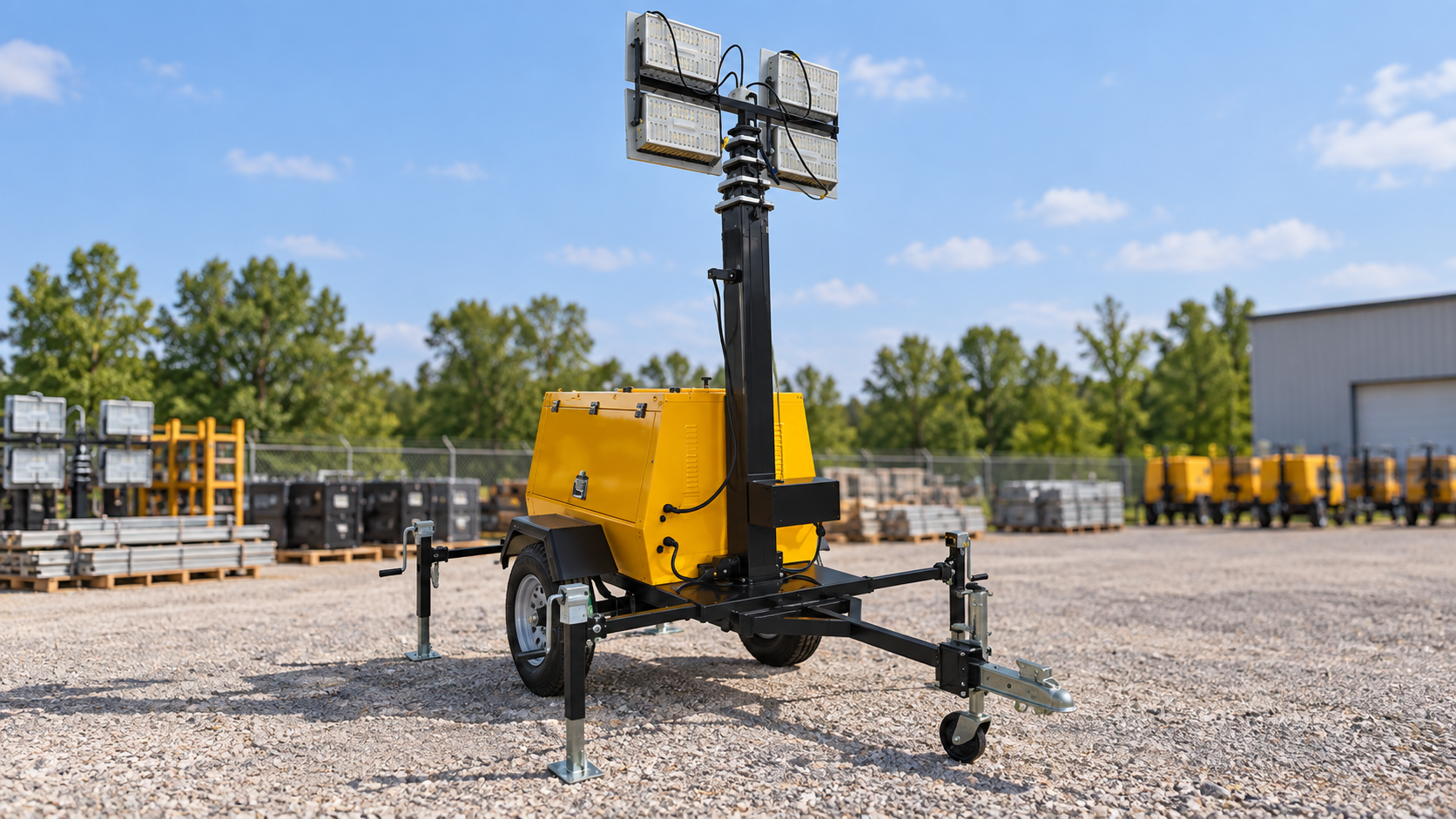
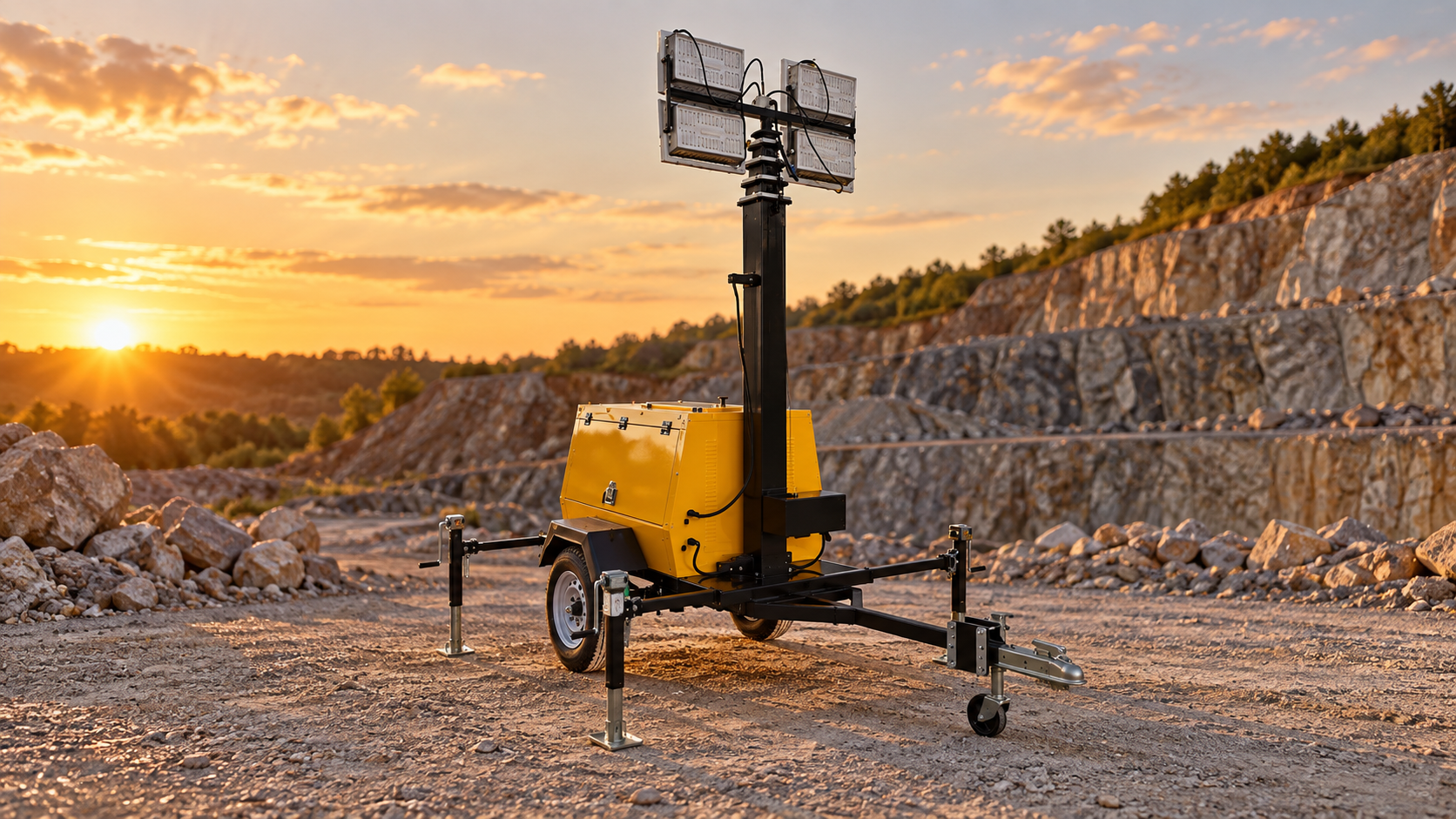
The Keyyou electric-pole trailer light tower is a relevant physical example with a yellow enclosure, single axle, stabilizers, black mast and four rectangular lights. Its product family can be configured with different power options. The reference photographs do not establish a generator rating. The RFQ should state the project load profile and require the exact configuration’s site-rated kW/kVA, duty class, fuel curve and permissible loading guidance.
Commissioning should preserve raw measurements rather than only a final percentage. Record timestamped kW, kVA, power factor, voltage, frequency, lamp mode, ambient temperature and any controller alarm at short enough intervals to capture changes. Note whether the engine was warming, the lamps were starting or an auxiliary was connected. Calculate minimum, maximum and time-weighted average load, then compare each against the manufacturer’s applicable limits. Repeat the test after a major lamp or control update. This evidence lets procurement, operations and service teams distinguish a sizing problem from an isolated maintenance fault.
Also review the consequence of failure. A road crew that can tolerate a brief restart has a different continuity requirement from an emergency response perimeter. Spare capacity should be justified by credible loads, redundancy and transient response, not a vague desire for “more power.” If redundancy is essential, two appropriately controlled sources may be more useful than one chronically underloaded set, but only when the manufacturer approves the arrangement and the site can manage changeover, maintenance and fuel safely. Document the chosen philosophy in the acceptance criteria.
Safety video: operating portable generators outdoors
The CDC video below reinforces safe outdoor generator placement. It does not size the generator or set a load-factor limit; those decisions require the exact manufacturer’s data and qualified site review.

View the CDC generator safety page and transcript.
Frequently asked questions
What is a good load factor for every diesel light tower?
There is no universal value. Use the exact engine and generator-set manufacturer’s permitted operating range, duty rating and site conditions.
Should I divide lamp watts by generator kVA?
No. Calculate real-power load factor using kW, then separately check kVA, current and power factor against the alternator rating.
Does a larger generator always provide more reliability?
No. It may improve some transient margins but create chronic low-load operation, extra mass and poor efficiency. Size against the full load profile.
Can load factor diagnose wet stacking?
No. It identifies operating history, not a fault by itself. Inspect symptoms and follow an engine-maker-approved diagnostic procedure.