
Off-Grid Temporary Site Lighting Load: Estimation Guide
Off-grid temporary site lighting load is the watt-hour demand your fixtures and related tower systems will draw over the planned operating period—not the generator nameplate, battery label, or a marketing coverage claim. Define that load first; storage, array, and backup decisions come after.
This guide is for contractors, site managers, and distributors who need an auditable load table before comparing solar, hybrid, or generator-backed towers. For array context after daily demand is known, see the site’s solar-panel sizing discussion. Browse the Blog archive for related Solar & Hybrid topics.
Contents
- Part 1. What does off-grid lighting load estimation actually decide?
- Part 2. Which project inputs must be defined before estimating load?
- Part 3. How do you build a fixture-level lighting load table?
- Part 4. How should auxiliary and tower-system loads be included?
- Part 5. What margins and reserve factors belong in the load estimate?
- Part 6. Which RFQ questions help verify the lighting load profile?
- Part 7. What common mistakes distort a temporary-site load estimate?
Part 1. What does off-grid lighting load estimation actually decide?
Lighting load estimation decides how much electrical demand the site will place on its off-grid power path during the hours lighting must run. It answers a different question than “how large is the battery” or “how many panels fit on the trailer.” Those downstream decisions require a defined load profile.
Search results for this topic often jump directly to generator kilowatts or battery kilowatt-hours. That skips the step buyers still need: a fixture-level record of watts, operating hours, and auxiliary draw. Without that record, two quotes with the same headline “4 kW tower” can imply unlike nightly energy use.
The IEEE recommended practice for sizing stand-alone PV systems treats load calculation as an input to system design. Its scope is PV-only stand-alone systems with lead-acid batteries, so hybrid towers or grid-assisted charging still need their own documented inputs. The principle remains: define what must be powered before comparing equipment labels.
| Planning question | Load estimation answers | Downstream sizing answers |
|---|---|---|
| How many fixtures at what brightness? | Yes | No |
| How many hours per night must they run? | Yes | No |
| What nightly Wh does that produce? | Yes | Partially—storage math follows |
| What battery Ah is required? | No | Yes—after DoD and voltage |
| What panel wattage is required? | No | Yes—after solar resource inputs |
Part 2. Which project inputs must be defined before estimating load?
Start with inputs the project team can defend in a site plan or RFQ. Without them, any wattage figure is a placeholder.
Input checklist
| Input | Why it matters | Example record |
|---|---|---|
| Work area and task illumination need | Drives fixture count and brightness | General construction zone vs detailed assembly |
| Fixture type and count | Sets base lamp draw | Four LED heads vs two metal-halide legacy heads |
| Brightness or dimming mode | Changes average watts | Full output vs scheduled dimming after midnight |
| Required operating hours per period | Converts watts to Wh | 10 h continuous vs split shifts |
| Tower deployment count | Scales total site lighting load | Two towers on opposite zones |
| Auxiliary loads on tower circuits | Adds non-lamp demand | Mast motor, controller, GFCI outlets |
| Concurrent non-lighting loads | May share the same off-grid source | CCTV, communications, small tool chargers |
| Season and site location | Affects hours of operation | Winter short-day extension per winter operation guidance |
Forum discussions often show buyers collapsing “lighting” into one headline generator rating. A Mike Holt forum lighting-load thread reminds electrical planners that lighting on non-dwelling projects is commonly treated as continuous load when code-based distribution is designed. That distinction matters for temporary panel and feeder sizing even when the first planning step is still a fixture wattage list.
Part 3. How do you build a fixture-level lighting load table?
Convert each lighting item into watt-hours (Wh) before discussing kilowatts, amp-hours, or generator classes. Wh links power and time directly.
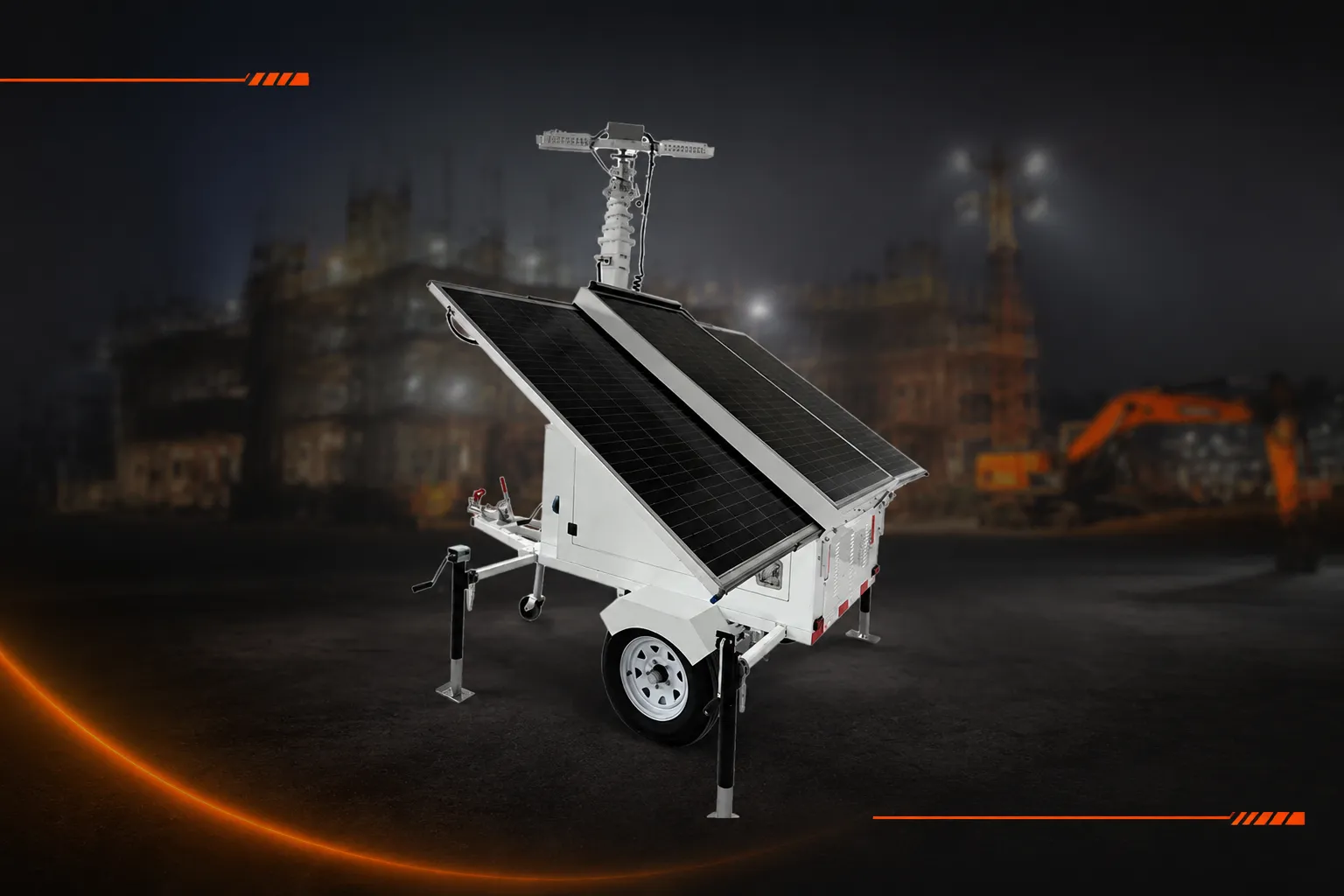
Calculation sequence
- List each fixture group on every tower or fixed temporary luminaire that must operate during the defined period.
- Record average power (W) for each group at the planned brightness setting. Use the fixture or driver data for the selected equipment, not a generic LED guess.
- Record operating hours (h) for that setting within the planning period—usually one night, but multi-shift sites may need a 24-hour window.
- Multiply to obtain Wh per group:
Wh = W × h. - Sum groups across all towers for total lighting Wh per period.
- Extend across days if the planning window covers more than one operating cycle before recharge.
Example (illustrative only, not a product recommendation):
| Fixture group | Towers | Avg. power (W) | Hours | Energy (Wh) |
|---|---|---|---|---|
| LED head group A | 2 | 350 | 10 | 7,000 |
| LED head group B | 1 | 200 | 10 | 2,000 |
| Perimeter string lights | 1 circuit | 120 | 10 | 1,200 |
| Subtotal per night | 10,200 |
Industry planning references often cite LED mobile tower lamp draw in roughly 400–1,500 W total per unit and legacy metal-halide towers at higher lamp-side demand. A Projul temporary power and lighting guide notes that four 400 W LED tower lights add 1,600 W to a site load if all run simultaneously. Those ranges help sanity-check a table; they do not replace the selected fixture’s documentation.
OSHA construction illumination requirements set minimum lighting levels for general construction and other work areas in foot-candles. Illumination level influences how many fixtures or what output setting is needed; it does not by itself define electrical watts without fixture efficacy and mounting height.
Part 4. How should auxiliary and tower-system loads be included?
Lamp watts alone rarely equal tower-system load. Add auxiliary items that draw from the same off-grid path during the lighting period.
Common auxiliary categories:
- Mast raise/lower motor on powered telescoping towers—short duration but must be budgeted if it runs from the same battery or generator bus.
- Control electronics that remain energized while lights are on—controller, telemetry, or inverter idle draw.
- Built-in outlets on light-tower skids—phone chargers, small tools, or security devices if the project assigns them to the tower circuit.
- Battery charging path overhead—not part of the lighting load itself, but relevant when the same source must recharge storage while lights run.
A Powerlink Energy light-tower wattage guide explains that many diesel light towers must support both lamp load and auxiliary uses without overloading. For solar or battery-led towers, the same discipline applies: list every item that remains energized during the operating window.
| Load category | Typical treatment in planning | Common omission |
|---|---|---|
| Fixture lamps | Full average W for planned mode | Using nameplate max instead of dimmed mode |
| Mast motor | Add nameplate W for expected cycles | Ignoring because runtime is “short” |
| Controller/auxiliary | Add continuous W for lighting hours | Assuming “lights only” |
| Outlet loads | Add if contract assigns them to tower | Treating outlets as “free” spare capacity |
When non-lighting site loads share the same off-grid source—CCTV, routers, or trailer HVAC—record them in a separate table row rather than hiding them inside a rounded lighting total. A DIY Solar Power Forum runtime thread frames the daily balance as stored energy plus charging minus all daily loads, not lamps alone.
Part 5. What margins and reserve factors belong in the load estimate?
After the base Wh subtotal is documented, apply margins that the project or code path requires—explicitly, not as a hidden “safety factor.”
Margin categories to document:
- Continuous-load treatment — where a code-based temporary distribution design applies, general lighting may be treated as continuous load. Some electrical codes assign minimum lighting unit loads for non-dwelling occupancies; local jurisdiction determines what applies on a given temporary site.
- Operating-schedule reserve — if policy requires partial lighting during equipment service or lamp replacement, add the Wh for that mode.
- Illumination overlap — perimeter and area lights often overlap for uniformity; overlapping zones can increase simultaneous watts versus a single-coverage sketch.
- Measurement verification — a clamp meter or logging measurement on a deployed tower can confirm real draw versus datasheet assumptions.
| Margin type | Question to answer | Documentation |
|---|---|---|
| Continuous-load factor | Does the design path require 125% on lighting? | Electrical design basis |
| Schedule reserve | Must partial lighting continue during service? | Site operating policy |
| Zone overlap | Are beams overlapped for uniformity? | Lighting layout sketch |
| Seasonal hours | Do winter shifts extend operating hours? | Site calendar and latitude |
This article stops at defining demand in Wh. Translating that total into required storage uses permitted depth of discharge, voltage, and losses—the subject of the site’s battery capacity estimation for solar light towers article. Array sizing follows from daily Wh and solar-resource inputs in the solar-panel sizing discussion.
NREL PVWatts system-design documentation supports preliminary PV modeling from physical inputs. Daily load in Wh is a prerequisite for that step, not an output of it.
Part 6. Which RFQ questions help verify the lighting load profile?
Use RFQ questions to convert the estimate into verifiable supplier data. A load table is only as good as the answers that confirm fixture mode, auxiliary draw, and operating policy.
RFQ input list
- Intended work areas, tasks, and any stated illumination minimum.
- Fixture count, type, and brightness settings for each operating mode.
- Required hours per mode per night or per shift.
- Whether mast motors, outlets, or communications draw from the tower power path.
- Concurrent non-lighting loads expected on the same off-grid source.
- Request for documented fixture watts at each mode—not marketing “equivalent” language.
- Request for a load-path diagram showing what the battery or generator bus supplies.
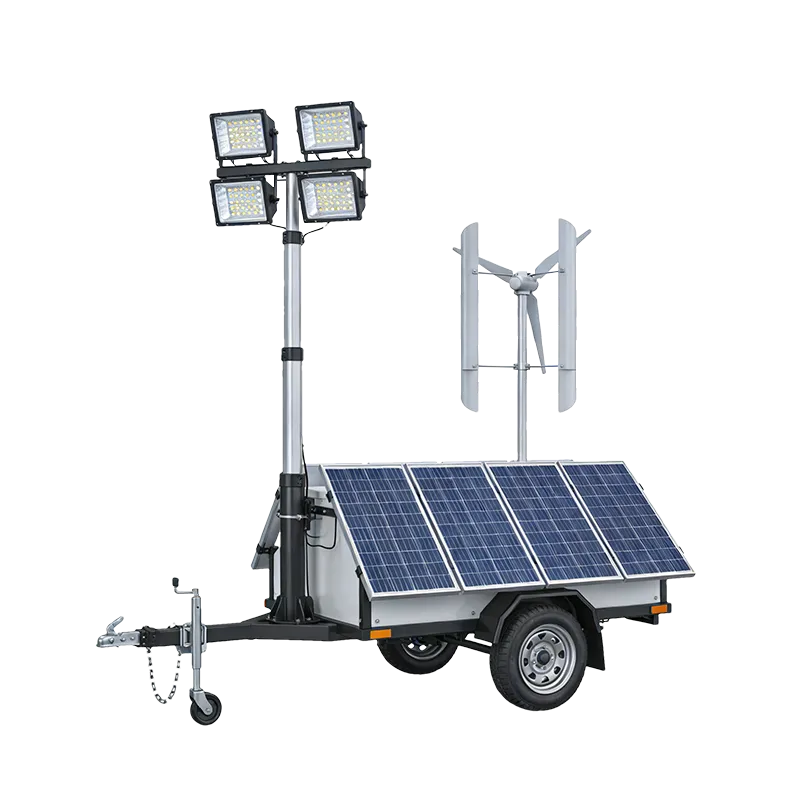
Product recommendation: when the application matches a trailer-based solar configuration, the public listed trailer solar light-tower configuration is a legitimate starting point because it lists solar panels, lithium battery storage, smart control, and trailer construction.
Confirm the exact supplied version, obtain its specification, and map your load table to that document before treating any marketing label as project proof. For broader browsing, see solar and hybrid mobile-lighting options.
Fit Boundary
This estimation method is suitable for early project planning, RFQ preparation, and comparing documented configurations.
It is not suitable as a substitute for the selected unit’s manual, a certified electrical design, an OSHA or local code compliance review, or an unsupported performance guarantee. Named industry examples—such as an Atlas Copco light-tower selection guide comparing LED and metal-halide wattage—illustrate how manufacturers discuss lamp demand; those figures apply only to the referenced products.
For a Keyyou configuration review, send the load profile and site context.
Part 7. What common mistakes distort a temporary-site load estimate?
Avoid these errors when reviewers compare quotes or audit a site plan.
- Using generator kW as the lighting load — nameplate output does not equal lamp demand; build the fixture table first.
- Ignoring auxiliary draw — mast motors, controllers, and outlet loads change nightly Wh even when lamps dominate visually.
- Mixing illumination level with watts — foot-candles define how much light is needed; fixture efficacy and mounting height define watts required to deliver it.
- Applying one industry wattage range to every tower — LED and legacy fixtures, dimming schedules, and head counts vary by configuration.
- Skipping operating hours — 400 W for eight hours is not the same planning problem as 400 W for fourteen hours on a winter shift.
- Collapsing load and storage math — battery sizing requires the Wh subtotal plus DoD, voltage, and losses; do not stop at the load table.
- Copying a competitor runtime line — runtime belongs to a stated mode, fixture set, and weather assumption on a named product.
When a deployed tower draws more than planned, collect brightness setting, operating hours, auxiliary devices connected, and layout changes before requesting a configuration review. That record supports an auditable correction rather than a guess about “underpowered equipment.”
FAQs
How do you calculate lighting load for a construction site?
List each temporary luminaire or tower fixture group, record average watts at the planned mode, multiply by operating hours, and sum the watt-hours. Add auxiliary tower loads and any concurrent site loads assigned to the same off-grid source. Apply documented margins required by the project or electrical design path.
How many watts does a light tower use?
Lamp-side demand depends on fixture type, head count, and brightness setting. Planning references often cite LED mobile towers in roughly 400–1,500 W total lamp demand and higher demand for legacy metal-halide fixtures. Request the supplier’s documented watts per mode for the selected configuration rather than using a generic range.
What is the lighting load for temporary power?
It is the sum of lighting fixture watts operating simultaneously plus auxiliary items on the lighting circuit, expressed over the required operating time. For distribution design, lighting may be treated as continuous load with applicable code margins. The exact treatment depends on jurisdiction and design basis.
How much power does an off-grid construction site need?
Total site demand includes lighting Wh, non-lighting continuous loads such as security or communications, intermittent tool loads if they share the source, and documented margins. Start with a categorized load inventory; do not answer from a single tower brochure rating.
How do you size solar for a construction site?
After daily load is defined in Wh, array sizing uses solar-resource inputs, system efficiency assumptions, and the recharge window the project accepts. PV sizing is downstream of load estimation. Use preliminary tools such as NREL PVWatts only with documented inputs, not as a substitute for supplier validation.
What is the difference between continuous and intermittent load on a job site?
Continuous loads run for three hours or more in a sustained pattern—lighting, HVAC on a site trailer, or security equipment. Intermittent loads such as hand tools run in shorter bursts. Planning totals should show which category each item belongs to because margin and demand-factor rules differ.
How many foot-candles are required for construction site lighting?
Under OSHA 1926.56, general construction areas require a minimum average of 5 foot-candles; other areas such as corridors, warehouses, and refueling have stated minimums. Foot-candles define illumination level; electrical watts still require fixture output data and layout.