
Industrial Tower Light: Complete Guide for Buyers
A practical buyer’s guide to industrial tower light, covering selection, verified lighting performance, power and runtime, safe deployment, maintenance, and RFQ requirements.
industrial tower light procurement should begin with the work requirement, not a model name or a single headline specification. For a defensible decision, buyers should compare rugged deployment, dust and weather exposure, long shifts, serviceability, and site-specific safety controls. The equipment must fit the site layout, shift pattern, transport plan, environmental conditions, and maintenance capability as one system.
This guide is written for contractors, rental fleets, distributors, and project procurement teams. It explains which information to collect, how to compare proposals for industrial tower light, and where a site-specific engineering or safety review is still required. It does not assign a product rating that has not been confirmed by a manufacturer data sheet, photometric report, or project authority.

What does industrial tower light mean for a buyer?
In a procurement context, industrial tower light is not only a search label. It represents a particular combination of application, equipment format, and purchasing intent. The first task is to translate that phrase into measurable requirements: the area to illuminate, maintained light level, hours of operation, available energy, relocation frequency, site access, noise and emissions constraints, and the people responsible for inspection and service.
SERP research for this article retained 20 Google organic results and successfully read 16 page outlines. The ranking set mixes product pages, rental or sales listings, and educational guides. The useful common ground is the need to connect equipment choices with application conditions; brand navigation, unrelated consumer lights, and unsupported model claims were excluded.
Where industrial tower light is used
- Open-Pit Operations: define the active zone, operating hours, mobility requirement, and nearby hazards before selecting equipment.
- Haul-Road Maintenance: define the active zone, operating hours, mobility requirement, and nearby hazards before selecting equipment.
- Industrial Shutdowns: define the active zone, operating hours, mobility requirement, and nearby hazards before selecting equipment.
- Remote Maintenance Areas: define the active zone, operating hours, mobility requirement, and nearby hazards before selecting equipment.
The same unit can perform differently when moved between these applications. Dust, ambient temperature, wind, surface condition, shift length, nearby residents, vehicle movement, and charging or refueling access can change the appropriate configuration. Record these variables before requesting a quote.

A five-step selection method
1. Define the work zones and lighting objective
Divide the drawing into task areas, pedestrian routes, vehicle paths, storage, boundaries, and transition zones. State the maintained illuminance target and measurement plane for each active area. In the United States, OSHA 29 CFR 1926.56 lists minimum illumination intensities for several construction areas and operations. Project specifications or the risk assessment may require more than a regulatory minimum.
2. Describe the duty cycle
Provide hours per shift, shifts between refueling or charging, standby expectations, seasonal temperature, expected dimming, and any auxiliary electrical load. Ask every supplier to state the conditions behind runtime. “Up to” figures without load, operating mode, and environmental assumptions should not be used for direct comparison.
3. Confirm movement and setup
Record the delivery route, gate width, towing or lifting method, ground clearance, transport dimensions, stabilizer footprint, permitted slope, and frequency of relocation. The setup must remain outside vehicle paths and protected from impact while preserving emergency access.
4. Compare verified performance
Request complete-luminaire photometry, electrical data, mast and wind instructions, sound-test conditions, environmental ratings, service intervals, and warranty terms. The U.S. Department of Energy’s LED guidance explains why complete-fixture performance and power-supply efficiency matter; LED-chip claims alone do not establish site performance.
5. Plan acceptance and handover
Agree who will inspect the equipment, verify light levels, document aiming, train operators, record defects, and authorize changes. A strong submittal is only the start: field conditions and the work layout must be checked after installation and whenever the site changes.
Buyer comparison table
| # | Decision area | Evidence to request |
|---|---|---|
| 1 | Environmental And Ingress Ratings | Request a stated value, test condition, drawing, or procedure that can be checked during bid review and handover. |
| 2 | Wind And Terrain Limits | Request a stated value, test condition, drawing, or procedure that can be checked during bid review and handover. |
| 3 | Runtime And Refueling Access | Request a stated value, test condition, drawing, or procedure that can be checked during bid review and handover. |
| 4 | Visibility Around Mobile Plant | Request a stated value, test condition, drawing, or procedure that can be checked during bid review and handover. |
| 5 | Maintenance Support In Remote Locations | Request a stated value, test condition, drawing, or procedure that can be checked during bid review and handover. |
Placement and safe operation

- Walk the site and identify soft ground, slopes, excavations, overhead hazards, traffic, and public interfaces.
- Position the base on an approved surface and deploy stabilizers, chocks, or supports exactly as instructed.
- Inspect the mast, cables, luminaires, fasteners, controls, guards, power system, tires, coupling, and emergency functions.
- Orient the chassis and light heads before raising the mast; maintain the required overhead and surrounding clearances.
- Raise and aim gradually, directing light toward the task while controlling direct glare and hard shadow zones.
- Measure representative points, including edges and transitions, then document the final arrangement.
- Lower and secure the mast before relocation and reassess the plan after any material change to the site.
Road and infrastructure work also requires coordination between lighting and traffic control. NIOSH guidance on internal traffic control plans emphasizes separating workers from construction vehicles and equipment as far as practicable. Equipment instructions, local rules, electrical requirements, and the project safety plan remain controlling.
Operating cost and maintenance
Compare purchase or rental cost together with transport, setup labor, fuel or electricity, inspections, scheduled service, consumables, replacement components, downtime, training, and residual value. The least expensive unit at delivery may not be the least expensive across the project. Use the same operating hours and energy assumptions for every proposal.
Maintenance planning should identify daily checks, service intervals, cleaning, cable and mast inspection, battery or engine care, functional testing, and the trigger for escalation to a qualified technician. Keep a service record for each asset. Do not bypass protective devices or substitute parts without confirming compatibility and approval.
What to include in the RFQ
- Project location, application, quantity, and required delivery date
- Site drawing, work zones, obstructions, access, and proposed positions
- Maintained lux or foot-candle target and measurement plane
- Operating hours, autonomy, standby, and environmental conditions
- Permitted power sources, noise, local-emissions, and spill restrictions
- Transport, towing, lifting, footprint, and relocation requirements
- Photometric evidence, manuals, compliance documents, inspection records, and training
- Warranty, service response, recommended spares, and commercial terms
Common mistakes to avoid
- Buying by one number: lumens, wattage, mast height, runtime, or price cannot describe the complete result.
- Comparing different assumptions: require the same load, test condition, and scope across bids.
- Ignoring deployed dimensions: transport size and operating footprint are different.
- Skipping field verification: obstructions, aiming, ground condition, and changing work phases affect performance.
- Leaving service undefined: identify parts, skills, response time, and escalation responsibilities before delivery.
Related guides
Related light tower resources
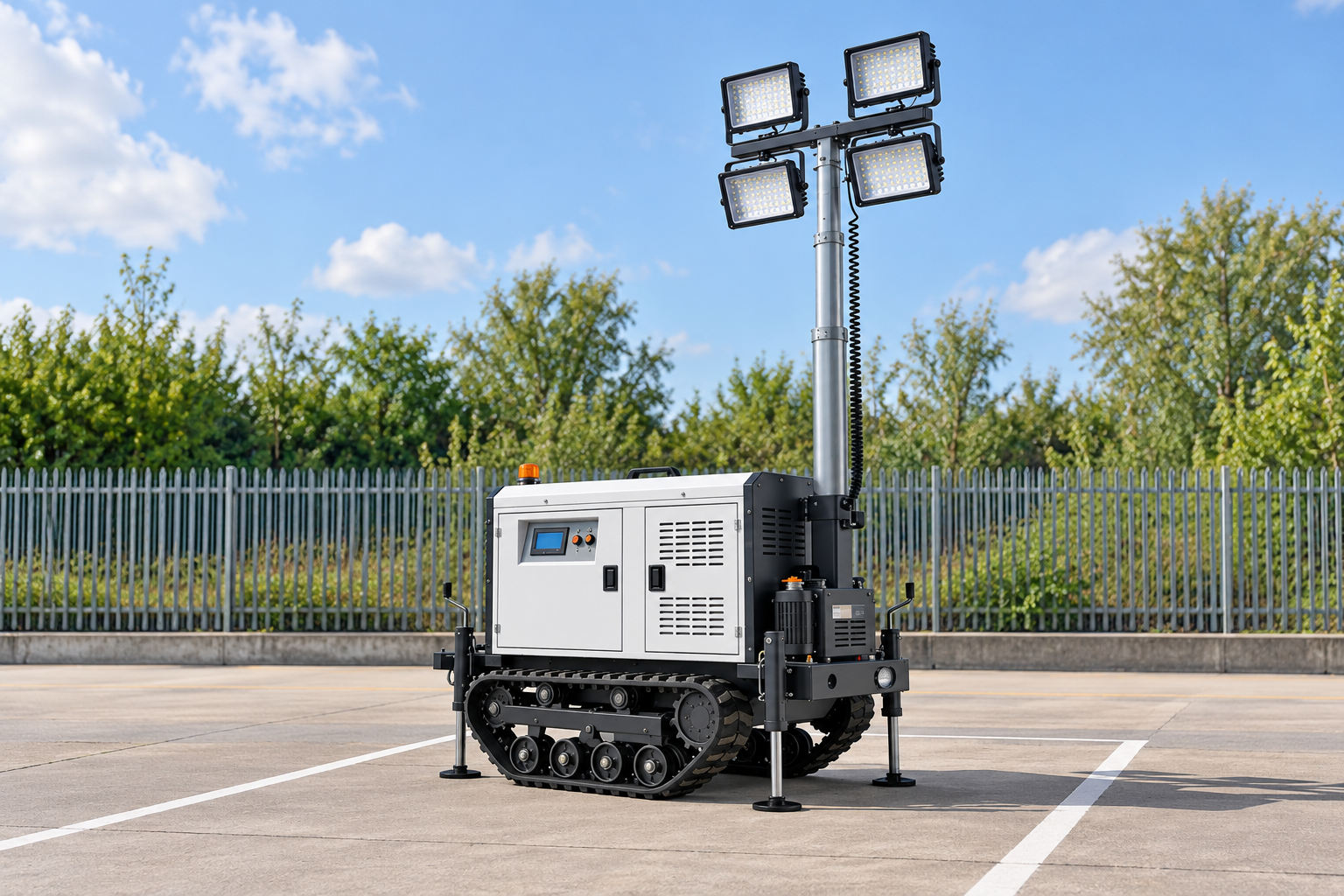
For related equipment, review the crawler-type light tower range and the complete mobile lighting product catalog.
Frequently asked questions
How should buyers compare industrial tower light quotations?
Normalize the work area, light target, operating hours, power assumptions, transport scope, included accessories, warranty, and service support. Reject comparisons based only on a headline specification or initial price.
Can a supplier guarantee coverage from lumens alone?
No. Coverage depends on optics, mast height, aiming, distance, overlap, obstructions, reflectance, and maintained output. Request a photometric layout and verify the installed result.
What determines the required quantity?
Quantity follows the zone-by-zone lighting plan, equipment distribution, shadow control, redundancy, and relocation strategy. Site area alone is not enough.
Which safety document should control setup?
Use the current manufacturer instructions together with the project safety plan, applicable law, electrical requirements, traffic controls, and a site-specific competent-person review.
Final procurement takeaway
The most reliable industrial tower light decision is traceable from site inputs to a documented configuration. Define the lighting task, duty cycle, environment, logistics, and safety constraints; compare evidence under common assumptions; then verify the installed result. That process produces clearer quotations, fewer change orders, and equipment that is easier to operate and maintain responsibly.