
Hybrid Light Tower Battery Reserve: Budget Energy for the Actual Shift
Plan hybrid light tower battery reserve using usable storage, task demand, bounded renewable input, contingency requirements, review triggers, and verified handover.
Hybrid light tower battery reserve is the usable stored energy deliberately kept beyond the planned lighting task to cover an identified uncertainty or contingency. Define that task, estimate its demand, verify the battery's permitted usable energy under the actual conditions, and state what event the reserve is intended to cover. Do not treat the battery nameplate, a dashboard percentage, or an optimistic renewable-energy forecast as guaranteed reserve. The illustrated wind-solar-battery trailer shows a product category; its actual battery chemistry, capacity, control settings, and approved operating limits must come from the supplied configuration documents.
Define what the reserve must protect
Begin with an operational question: what should happen if renewable input is lower than expected, the shift lasts longer, or another approved task starts? Record the lighting requirement and the contingency separately. A reserve intended to support an orderly shutdown is different from one intended to maintain a critical route through a delayed handover. The responsible site team should define the required response, duration, and acceptance method rather than leaving them implied by a battery percentage.
Also decide what the battery is not expected to support. Additional equipment, increased lamp output, changed lighting locations, or an extended shift can alter the original demand. Require those changes to be reviewed before promising the same reserve. If the lighting duty is critical, the plan needs an appropriate fallback and a named decision owner. Stored energy alone does not create redundancy, qualified supervision, or an approved emergency lighting system.
Read the delivered battery and control documents
Connect the battery identity and equipment configuration to the supplied operating instructions. Obtain the energy or capacity information, permitted operating range, charging requirements, temperature limits, state-of-charge guidance, and any restrictions affecting availability. Identify whether the displayed percentage represents an estimate and how the supplier expects it to be used. A generic battery data sheet may not describe the usable energy of the installed system after its configured protections and operating constraints.
The referenced Keyyou trailer combines visible solar panels, a wind turbine, a battery enclosure, a mast, and four lamp heads. This arrangement does not prove a particular battery capacity, chemistry, automatic generator starting function, or reserve setting. The product's visible configuration is useful for discussing energy planning, but quantitative commitments need the exact order documents and verification. Do not add a combustion backup to the illustration or assume one is integrated into the delivered machine.
Establish demand on a consistent energy basis
Estimate energy for the specified lighting mode and duration, including relevant control and conversion demand within a clearly stated measurement boundary. Power multiplied by time gives energy when compatible units are used. For an illustrative arithmetic example, a constant total input of five hundred watts for eight hours is four thousand watt-hours, or four kilowatt-hours. These hypothetical values are not the consumption or runtime of the pictured tower and should never be copied into a quotation as product data.
Clarify where power is measured. Lamp ratings, battery output, controller input, and complete-system demand can refer to different boundaries. Do not add a separate efficiency loss if the measured total already includes it. Equally, do not calculate a battery requirement from lamp output alone while ignoring documented supporting loads. Keep the calculation traceable to the actual configuration and operating mode, and label estimates as estimates until suitable measurements or supplier evidence support them.
Distinguish nominal storage from usable energy
A nameplate figure describes a stated rating under stated conditions; it does not automatically equal energy available for every assignment. The permitted operating range, system controls, temperature, condition, and rate of use may affect the usable result. Follow the supplied guidance and obtain qualified clarification where the documentation is unclear. Do not defeat a protective limit to recover an advertised runtime or to preserve an arbitrary reserve target.
State usable energy at the relevant starting condition rather than assuming every shift begins fully charged. If a system has six hypothetical kilowatt-hours available within its approved operating limits and the planned task requires four, the simple difference is two. That subtraction is only an energy budget before the identified uncertainty is assessed. It does not prove the actual battery can deliver that difference under all conditions, nor does it account for an unmeasured change in task demand.
Treat renewable input as a scenario rather than a promise
Wind and solar input vary with location, weather, shading, orientation, equipment limits, and the actual energy-management arrangement. For an overnight decision, distinguish energy already stored from energy expected later. A forecast can support planning, but it is not energy already in the battery. Build a conservative case for the defined contingency and explain what observation would require the plan to change.
Avoid adding nameplate solar and wind ratings as if those values were continuous charging power. The supplied system's constraints and real operating conditions determine what is available. Keep generation, charging, storage, and load records on compatible time intervals. A high generation reading during one short period cannot establish sufficient recovery before the next assignment. Where no reliable generation evidence exists, identify that gap rather than filling it with a favorable average from another site.
Use an energy-budget table before approving the shift
| Budget item | Evidence or assumption to retain | Decision it supports |
|---|---|---|
| Defined lighting task | Required location, operating mode, duration and acceptance criteria | Establish the demand that the assignment must satisfy |
| Starting usable storage | Actual system condition and supplied interpretation of battery information | Determine the verified starting point rather than assuming full charge |
| Planned consumption | Compatible input power and time, with measurement boundary explained | Estimate task energy without double-counting losses |
| Renewable contribution | Site-specific observations or explicitly bounded scenario | Distinguish expected recovery from stored reserve |
| Contingency requirement | Named event, duration and agreed response | Explain why energy is being reserved |
| Review trigger | Changing load, delayed recharge, warning or environmental restriction | Require reassessment before the original plan becomes unreliable |
The table is a planning method rather than a universal battery-sizing standard. The arithmetic examples in this article demonstrate units only. The cited electrical-safety sources support safe work boundaries; they do not establish battery capacity, reserve percentages, charge settings, or performance for a particular Keyyou configuration.
Confirm the actual arrangement before deployment
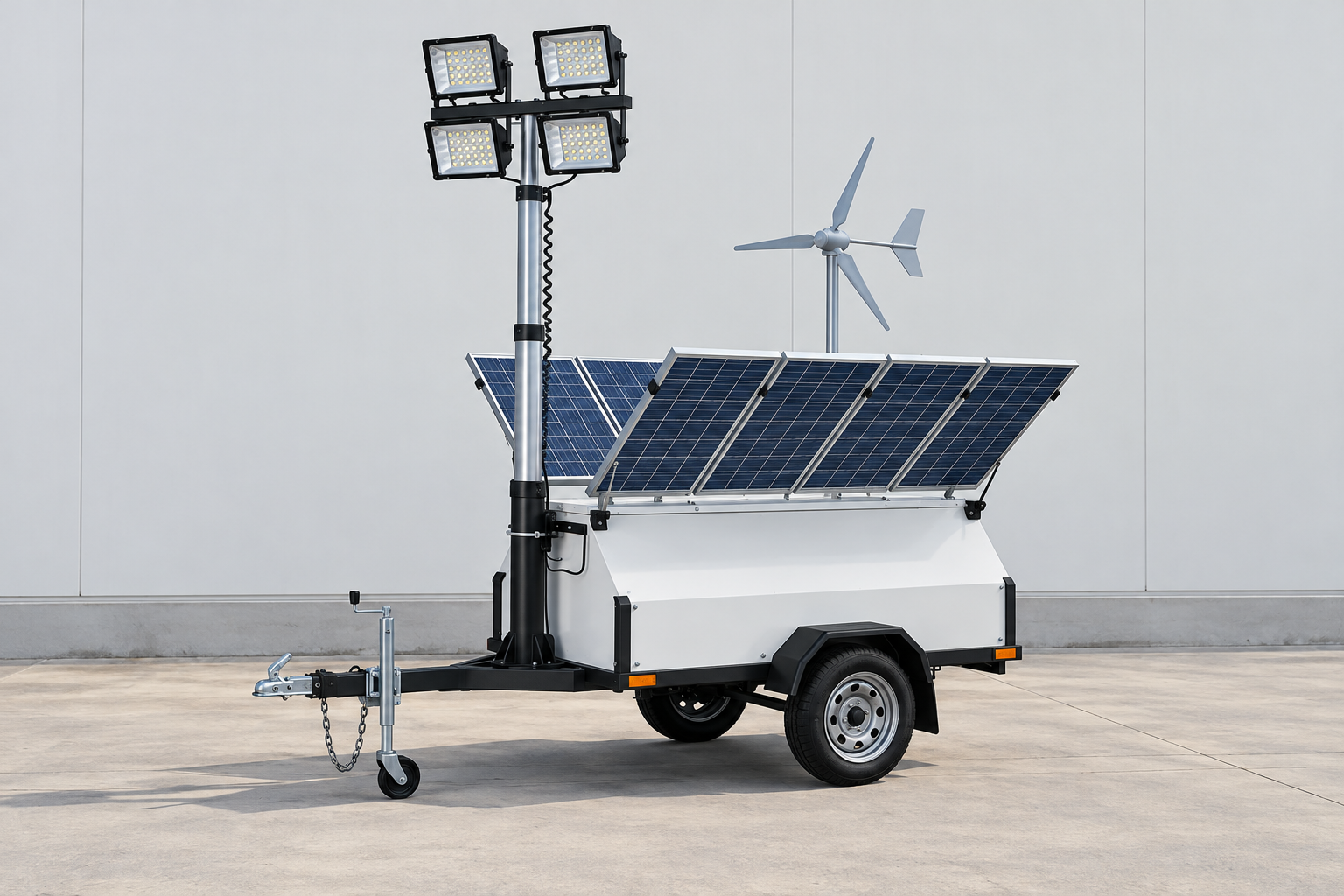
Check equipment identity, visible condition, supplied components, unresolved defects, and the applicable instructions before releasing the trailer. Review the proposed location and deployment conditions, including the energy equipment as well as the lighting mast. The presence of a turbine or solar array creates its own supplied operating requirements. Do not alter panel arrangements, turbine components, support geometry, controls, or electrical connections to increase an estimated energy margin.
The receiving team should know which battery information is available, who can interpret it, and what actions are permitted. Electrical work belongs to authorized personnel using the applicable procedures. A small energy budget error is not a reason to improvise a cable, connect an undocumented charger, or bypass a protection device. Resolve configuration questions before the assignment rather than treating the first night of operation as an uncontrolled experiment.
Verify the lighting task independently of the battery display
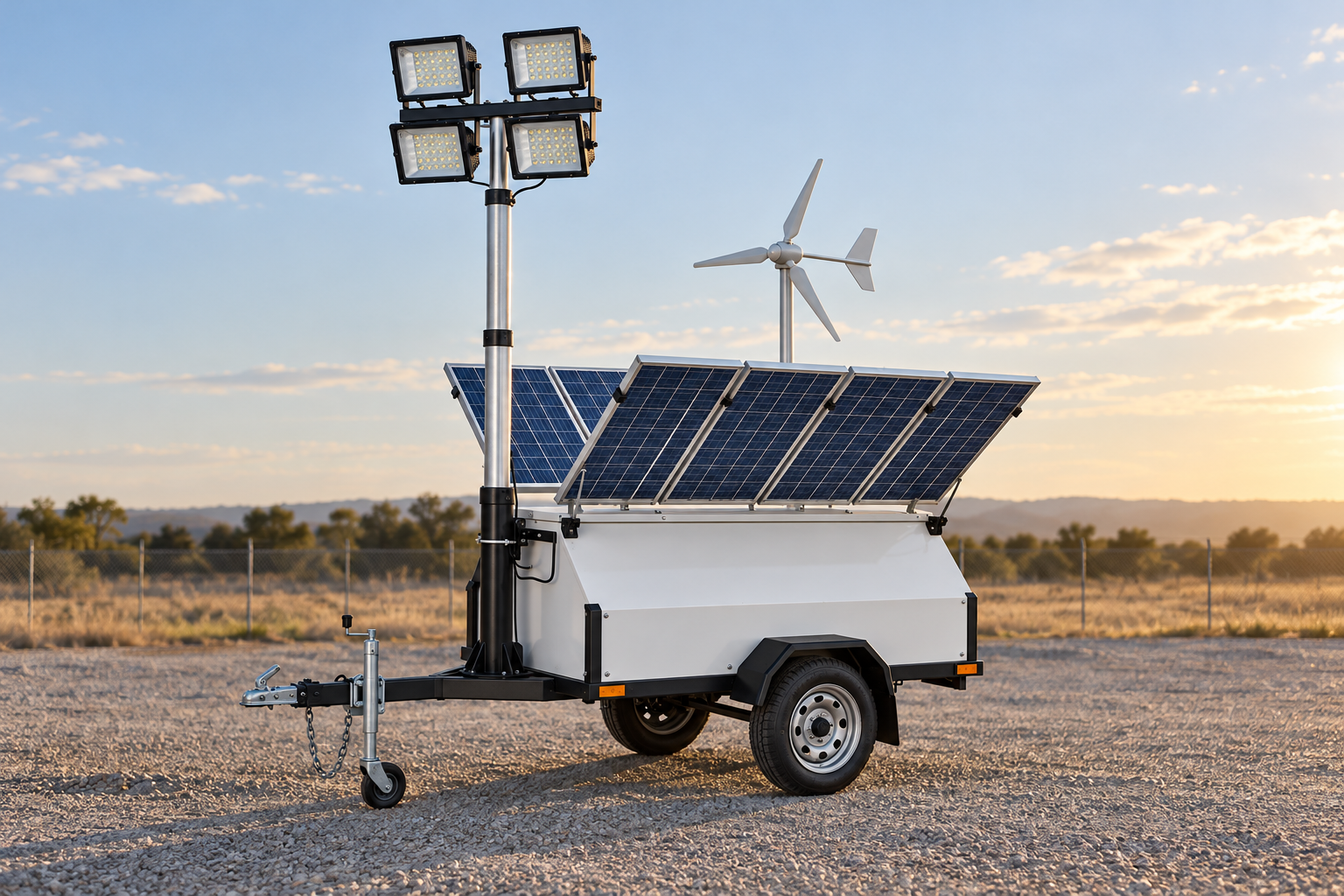
Enough stored energy does not guarantee suitable lighting. Verify the agreed work areas, coverage, shadows, glare, access, and changing task layout using the appropriate site method. A tower operating for the planned duration may still fail to illuminate an important location. Keep lighting acceptance and energy sufficiency as related but separate decisions. Neither a bright photograph nor a favorable state-of-charge estimate establishes the other.
If the work area changes, reassess both decisions. Moving the trailer may change renewable input, site suitability, lamp aiming, and the lighting task at the same time. Increasing output or extending the shift changes energy demand. Record the approved configuration and operating mode so the next shift can understand what the energy estimate actually covers. Without that connection, the reserve number quickly becomes detached from the service it was meant to protect.
Set review triggers before the reserve is needed
Agree when operators should escalate a warning, unexpected decline, delayed charging, changed weather condition, or extended work request. Use the supplied control meanings and limits. Do not invent a universal low-battery percentage or describe a setting as safe across different chemistries and equipment configurations. A useful trigger gives the responsible person time to take an approved action while the remaining service and fallback options are still understood.
Keep response options concrete: review the task, arrange authorized replacement equipment, end an approved noncritical activity, or follow the site's planned shutdown procedure. The choice depends on the actual assignment and safety assessment. Operators should not be asked to decide which critical lights to remove merely to make an energy calculation balance. Identify responsibility and communication arrangements in advance, particularly where several contractors or shifts share the same equipment.
Plan the next charging opportunity and handover
The end of one shift is the starting condition for the next. Record remaining battery information, operating duration, observed generation or charging evidence, warnings, and any change in configuration. State whether the next assignment's energy plan has been reassessed. A tower can complete tonight's task while being unready for tomorrow; reporting only the successful shift would hide that constraint from dispatch and the receiving team.
Review whether the available recovery period and approved charging arrangement can restore the required starting condition. Avoid assuming uninterrupted sunshine, useful wind, or an undocumented external power source. If recovery is uncertain, keep the next assignment provisional and arrange an appropriate alternative. Maintain the battery and charging system according to the supplied procedures. Increasing an operating target does not remove service requirements or make a restricted unit available.
Keep a combustion fallback separate when one is proposed
Some sites consider a separate generator as a contingency, but the illustrated renewable trailer does not establish that such equipment is supplied or compatible. Any proposed external arrangement needs its own authorization, suitable connection method, and applicable electrical and operating assessment. Do not present it as an integrated product feature or automatically subtract its assumed contribution from the battery reserve requirement.
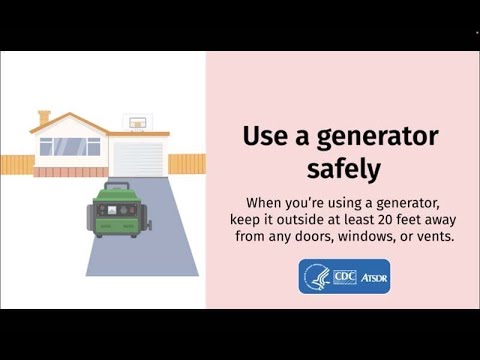
Where combustion generation is actually used, exhaust safety remains essential. CDC guidance and its accompanying educational video explain carbon-monoxide hazards and safe generator use. Apply the supplied instructions and site assessment for the actual equipment and location. That learning resource does not approve charging compatibility or a deployment bay. Keep energy planning, electrical safety, and exhaust placement connected through responsible decisions rather than treating extra power as an unconditional solution.
Equipment and complementary planning
Identify the visible renewable arrangement on the Keyyou wind-solar hybrid trailer product page. Begin with the mobile light tower planning guide, then review pre-operation equipment checks and shift handover records.
Carbon monoxide precautions for a separately approved fallback
CDC explains safe combustion-generator operation and carbon-monoxide hazards. This supports the final section only when a separately approved combustion fallback is actually proposed. The video does not establish an integrated generator, battery capacity, charging compatibility or product reserve setting.
Frequently asked questions
Is nominal battery capacity the available reserve?
No. Reserve depends on the actual permitted usable energy, starting condition, task demand and defined contingency. Verify the delivered configuration and supplied limits before making a runtime commitment.
Can expected wind and solar generation count as stored energy?
No. Keep measured stored energy separate from expected future generation. Use explicitly bounded scenarios and review triggers for uncertain recovery.
Does the pictured trailer include an automatic generator backup?
No such feature is established by the illustration. It shows the reference wind-solar-battery product arrangement. Any external generator or charging arrangement needs separate compatibility and safety review.
Sources and scope
The energy examples are illustrative arithmetic, not product ratings or battery settings. The official electrical and generator-safety sources support the relevant safety boundaries only. Use the actual supplied battery, controller and equipment instructions for configuration-specific decisions.