
MLT3060 Light Tower: Used Equipment Inspection and Buyer Guide
Evaluate a used MLT3060 light tower by exact model, mast, generator, lamps, trailer, service history, safety documentation, and a controlled operating test.
An MLT3060 light tower should be evaluated as a used, configuration-specific machine—not from the model name or seller’s headline alone. Confirm the full serial plate and suffix, then match the correct operator, parts, engine and generator documents. Inspect the mast, winch, cables, lights, electrical protection, engine, alternator, trailer, tires and stabilizers before running a controlled test. Because age, regional variants and later repairs can change the delivered configuration, do not transfer specifications from another listing. The safest purchase decision combines identity, records, physical condition and measured performance.
What buyers usually mean by MLT3060
Search results for “MLT3060 light tower” mix used-equipment listings, rental descriptions, parts manuals and several model suffixes. That creates a practical risk: two units advertised under the same family name may have different engines, lamp systems, electrical outputs, trailer details or compliance labels. Treat MLT3060 as the start of identification, not the end. Photograph every plate and compare the serial number with the manufacturer’s document lookup or an authorized service source.
This guide does not claim that a Keyyou model is an MLT3060 or a direct replacement. It gives fleet buyers a repeatable inspection method and shows how to convert an old model search into a current performance specification when replacement equipment is being considered.
Start with the exact identity and configuration
Record manufacturer, family, complete model suffix, product serial number, engine model and serial number, generator or alternator identification, lamp or LED conversion details, voltage and frequency labels, tire information and hour-meter reading. Confirm whether the hour meter is original and functional. A fresh meter on a weathered machine is not proof of low hours. Ask whether the unit was originally sold in the destination market and whether its present configuration matches its labels.
Obtain the operator manual and the correct parts manual before inspection. A parts book can help identify assemblies, but it is not a substitute for operating limits or maintenance instructions. If documentation cannot be matched confidently, price the machine as an unknown configuration and require qualified review before service.
MLT3060 inspection priorities
| Inspection area | Evidence to request | Reason it matters |
|---|---|---|
| Identity | Complete plates, serials and correct manuals | Prevents specifications from a different variant being applied |
| Mast system | Cable, winch, sheaves, locks and service record | Hidden wear can create a drop or uncontrolled movement hazard |
| Lighting | Lamp/fixture identity, wiring condition and measured operation | Conversions can change load, aiming, protection and service parts |
| Power package | Engine, generator, protection and loaded test results | No-load running does not prove stable output under demand |
| Trailer | Coupler, chains, tires, bearings, brakes and road documents | Worksite operation and public-road towing are separate decisions |
| Support | Parts availability, technician access and warranty terms | Downtime can outweigh a low auction or listing price |
Inspect the mast before operating it
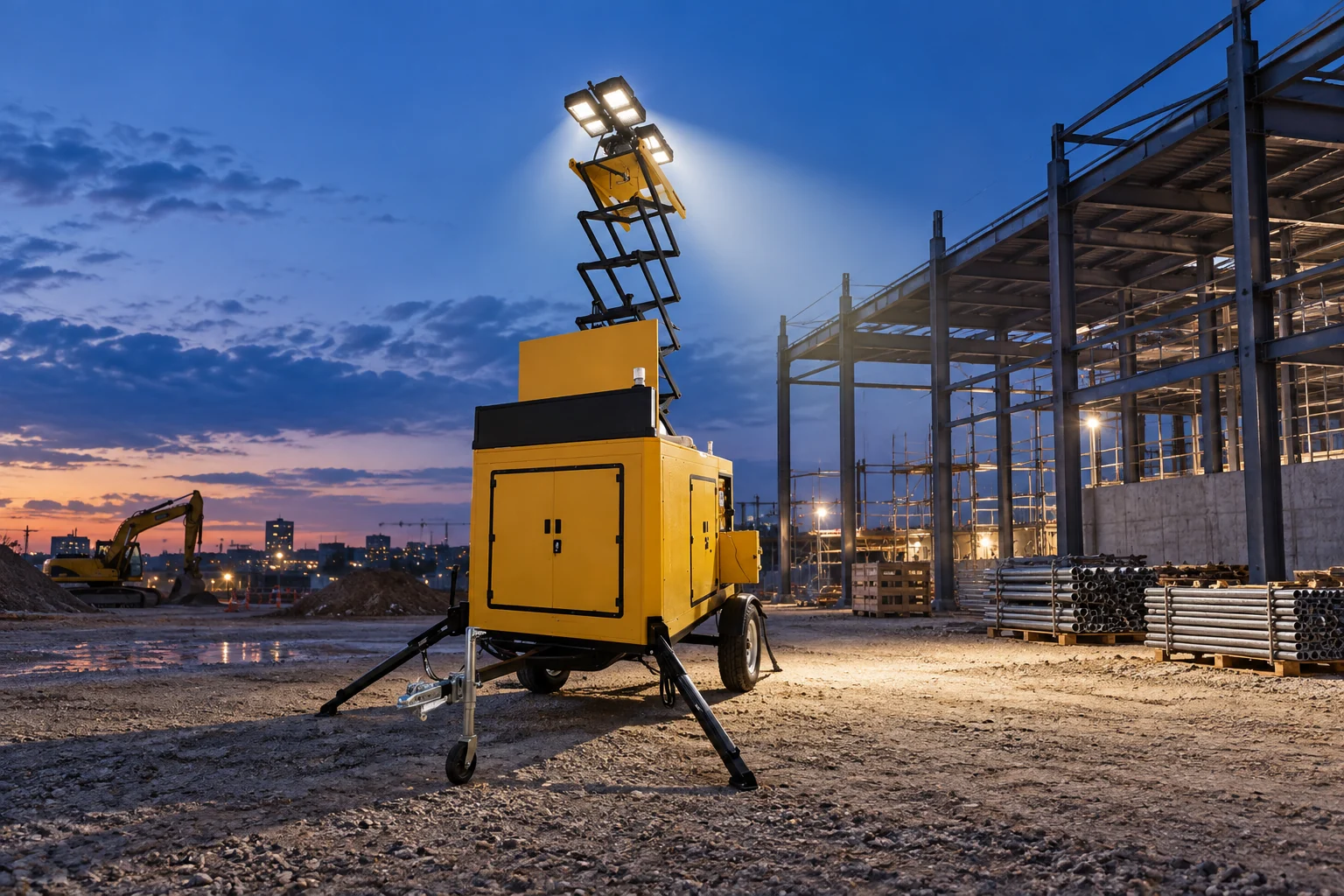
Keep the mast fully lowered while examining sections, welds, pivots, guides, cables, winch drum, sheaves, fasteners, rotation lock and fixture support. Look for bent tubes, flattened cable strands, corrosion, displaced cable, makeshift pins, damaged stops, cracked weld repairs or evidence of impact. Do not raise a mast with an uncertain cable path, missing guard or unstable base. A qualified technician should decide whether wear is within the controlling manual’s limit.
Set the unit on firm, level ground and deploy stabilizers exactly as the manual requires. Check overhead lines, structures, trees, traffic and the full fall zone. Test movement in small increments from a safe position. The mast must extend, lock, rotate and lower without binding or uncontrolled motion. Never stand beneath fixtures or use a person’s body weight to force a jammed section.
Check the engine and generator as a system
Inspect fluid levels and condition, filters, hoses, belts, mounts, wiring, battery, exhaust, enclosure, leaks and signs of overheating. Start only under the correct procedure with doors, guards and ventilation arranged as specified. Listen for unstable speed, abnormal vibration or exhaust leakage. Confirm warning lamps and shutdowns without deliberately defeating protection.
Measure electrical output with instruments and procedures suitable for the circuit. Check voltage and frequency unloaded and with the actual lighting load applied in stages. Observe warm-up, load pickup and recovery. Verify outlets and breakers only within documented ratings. A unit that starts easily but cannot hold stable output with all fixtures operating is not ready for deployment.
Evaluate original lamps and LED conversions separately
Older units may retain discharge lamps or may have been converted to LED. Record the exact fixture and driver, not merely “LED upgraded.” Ask who designed the conversion, how circuit loading and protection were checked, whether fixtures are listed for the environment, and whether aiming, cable strain relief and thermal clearances remain acceptable. A lower wattage does not automatically prove safe compatibility.
Operate each fixture, verify reliable restart behavior and compare beam distribution rather than staring into the light. Inspect lenses, seals, brackets, cords and junctions. Confirm that fixture aiming can be secured and that replacement parts are obtainable. For actual work, measure illumination at representative task and boundary points after installation.
Trailer condition determines transport suitability
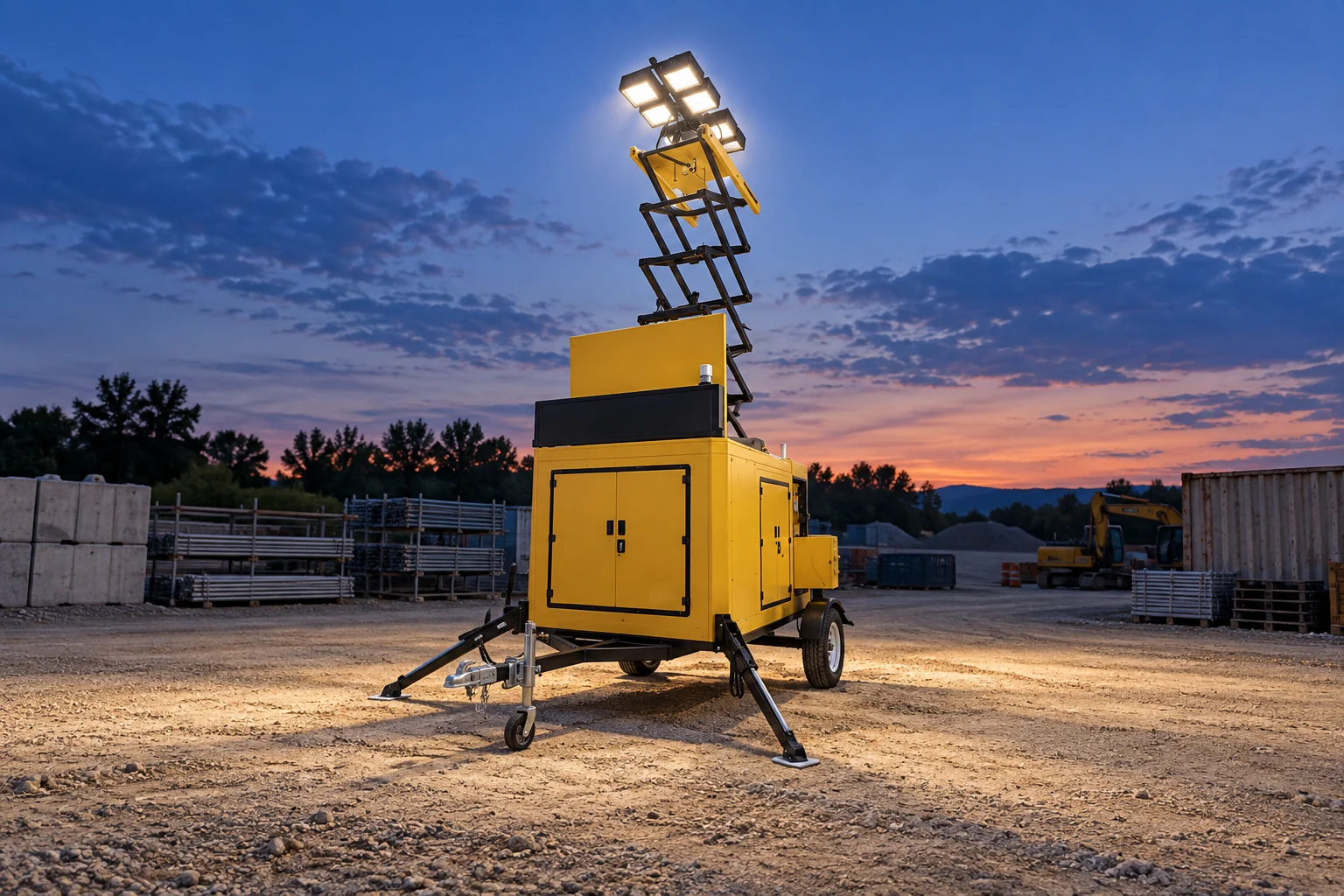
Inspect coupler, safety chains, jack, frame, drawbar, stabilizers, wheel bearings, hubs, tires, fenders, lamps and any braking equipment. Tire sidewall condition and date matter even when tread looks deep. Confirm rated capacities and the legal requirements that apply to the towing vehicle, speed, brakes, registration and lighting. A yard-movable unit is not automatically roadworthy.
Check transport height, width, length and mass from configuration-specific evidence. Secure the mast, fixtures, doors, cables and loose accessories. Perform the towing vehicle and trailer checks required by local rules; do not improvise with an incompatible coupler or electrical adapter.
Run a controlled acceptance test
- Document cold condition, fluids, ambient conditions and fuel level.
- Start and warm the unit using the current instructions.
- Operate controls and lights in a planned sequence.
- Record voltage, frequency, warning indications and visible defects.
- Run long enough to reach stable temperature and expose intermittent faults.
- Shut down, lower the mast and inspect again for leaks, heat damage or loose parts.
Agree acceptance criteria before the test. “Runs well” is not measurable. The record should show which configuration was tested, which loads operated, the duration, instruments, defects, repairs and final disposition.
Replacement versus repair
Repair can make sense when the frame and mast are sound, documentation is available and major parts have predictable support. Replacement becomes more attractive when several expensive systems are uncertain, road compliance is unclear, corrosion is structural, the mast lacks trustworthy history or downtime is critical. Compare delivered cost, refurbishment, transport, inspections, consumables, fuel, planned service, expected downtime and residual value on the same operating hours.
When specifying a current alternative, write the requirement in outcomes: work-zone dimensions, target measurement plane, operating hours, deployment frequency, terrain, towing limits, sound restrictions, energy access, environmental exposure, outlets, documents and service response. Keyyou’s trailer-style mobile light tower range can be evaluated against that requirement without presenting it as the same machine.
Related planning guides
- Compare light tower types and power architectures
- Use a pre-use light tower inspection checklist
- Follow a safe generator troubleshooting sequence
- Estimate fuel consumption under a defined duty cycle
Authoritative safety references
- OSHA construction illumination requirements
- OSHA guidance on carbon monoxide from portable generators
- NHTSA towing safety guidance
Video: portable engine carbon-monoxide safety
The U.S. Department of Labor video below explains why fuel-powered equipment must not be treated as safe merely because exhaust is not visible or strongly smelled.

Frequently asked questions
Is every MLT3060 configured the same?
No. Confirm the complete suffix, serial-linked documents, engine, generator, lamps and regional configuration for the individual unit.
Can an LED conversion be judged by lower wattage alone?
No. Verify fixtures, drivers, wiring, protection, environmental suitability, aiming and documentation as a complete conversion.
Does a successful engine start prove the light tower is good?
No. A controlled loaded test must also confirm lighting, generator output, mast operation, protection and stable operating temperature.
Can an older light tower be towed immediately after purchase?
Only after the trailer, tires, bearings, coupler, brakes, lights, ratings and destination road requirements have been checked.
Questions to resolve before releasing a purchase order
Ask the seller to identify every unresolved defect, recent repair and non-original component in writing. Confirm whether the quoted price includes loading, transport preparation, manuals, keys, loose outriggers, spare lamps or fixtures, batteries and road documents. State who carries the risk if the unit fails the agreed acceptance test. If the machine will enter a managed fleet, confirm that its fuel, filters, connectors, tires and service procedures can be supported without creating a one-off maintenance burden.
Define the first-service plan as part of acceptance. A newly acquired used unit may require fluids, filters, belts, battery testing, torque checks and a detailed mast inspection before deployment, even when the seller reports recent maintenance. Use actual service evidence and the controlling manual to set that scope. Record baseline photographs, readings and deficiencies so future inspections can distinguish old damage from new deterioration.
Final takeaway
Buy the condition and evidence of the individual MLT3060 light tower, not the reputation of a model name. Verify identity first, inspect safety-critical systems while de-energized and lowered, then perform a documented loaded test. If configuration, mast integrity or roadworthiness cannot be established, pause the purchase or budget a qualified inspection before use.