
How to Choose Battery Capacity for a Mobile Solar Light Tower
A practical sizing method for mobile solar light tower batteries, covering nightly load, usable capacity, inverter losses, autonomy, recharge, temperature, and aging.
To choose the right mobile solar light tower battery capacity, calculate the nightly energy load first, then divide by the permitted depth of discharge and total conversion efficiency. An 800 W lighting load running for 10 hours needs 8 kWh of delivered energy. If the design allows 80% depth of discharge and assumes 90% discharge-path efficiency, the minimum nominal battery is about 11.1 kWh before adding cold-weather, aging, or autonomy margin. Capacity in kWh determines runtime; inverter power in kW determines whether all connected loads can operate or start. Both ratings must be checked.
“A 10 kWh battery pack running 800 W of LED lighting—will it last a full night shift?” We hear this question from contractors, rental fleets, and project managers who need a dependable answer before equipment reaches a remote site.
The honest answer is: it depends on what “10 kWh” means. If it is 10 kWh of usable output energy, the simple theoretical runtime is 12.5 hours. If it is 10 kWh of nominal battery capacity, real runtime is shorter after depth-of-discharge limits, inverter and wiring losses, temperature, battery condition, and auxiliary loads are included.

The battery-sizing formula
Start with energy, not a supplier’s standard battery option. Use the following planning equation:
Nominal battery capacity (kWh) = daily load (kWh) × autonomy days ÷ depth of discharge ÷ discharge-path efficiency
Daily load is the sum of each device’s power multiplied by its operating time. Autonomy days represent how long the tower must run without adequate solar input or another charging source. Depth of discharge is the share of nominal battery energy the approved control strategy permits. Discharge-path efficiency accounts for losses between the battery and the loads.
The U.S. Department of Energy explains that storage is not 100% efficient and distinguishes energy capacity in kWh from power capacity in kW. Use the battery, inverter, and system manufacturer’s configuration-specific values in a final design; the examples below are planning estimates.
Step 1: list every load
Do not count only the LED heads. List every item drawing energy from the battery: lamps, controls, telemetry, cameras, communications, battery heating or cooling, mast controls, auxiliary sockets, and any permitted tools. Record both watts and hours. Loads that cycle on and off need a realistic duty cycle.
| Load | Quantity | Input per item | Operating time | Daily energy |
|---|---|---|---|---|
| LED floodlights | 4 | 200 W | 10 h | 8.0 kWh |
| Controls and communications | 1 system | Use measured or supplier value | Actual duty period | Calculate separately |
| Battery thermal management | 1 system | Use climate-specific value | Expected duty cycle | Calculate separately |
| Auxiliary outlet loads | As specified | Use maximum planned load | Expected use | Calculate separately |
The 8.0 kWh lighting result is an estimate based on four 200 W heads operating continuously for 10 hours. It is not the complete tower load until controls and auxiliaries are added. If the luminaires dim during parts of the shift, calculate each operating period separately rather than assuming full output all night.
Step 2: convert daily use into nominal capacity
Suppose the total delivered load remains 8 kWh for one night. With a design depth of discharge of 80% and a discharge-path efficiency of 90%, the calculation is:
8 kWh ÷ 0.80 ÷ 0.90 = 11.1 kWh nominal battery capacity
This is why an 8 kWh load does not automatically mean an 8 kWh battery. A nominal 10 kWh pack under the same assumptions delivers approximately 7.2 kWh to the load, equal to about nine hours at 800 W before other loads and margins. Conversely, if a supplier states “10 kWh usable,” ask where that usable energy is measured and which operating limits are already included.
National laboratory storage-sizing guidance uses hours of autonomy as a useful metric and emphasizes checking whether discharge power in kW meets the required load. Its facility-scale solar guidance also describes estimating storage from daily load, autonomy, conversion efficiency, and the usable capacity of the selected storage technology.
Step 3: decide how much autonomy is required
A pure solar-plus-storage tower cannot be sized for a single clear day. Review the site’s seasonal solar resource, consecutive overcast periods, dust, snow, shading, panel orientation, and cleaning schedule. A requirement for two nights of autonomy approximately doubles the energy term before other margins are considered.
Hybrid designs change the decision. A correctly integrated diesel generator or shore-power charger can reduce the battery autonomy requirement, but the controls must define when charging starts, the permitted state-of-charge window, generator loading, and what happens after a failed start. The related hybrid lighting tower guide explains how energy sources should be compared under one duty cycle.
Step 4: verify solar recharge
Battery capacity answers how much energy can be stored; it does not prove the solar array can replace that energy each day. Estimate daily solar generation from array power, site-specific peak-sun hours, orientation, temperature, shading, soiling, and charging losses:
Daily solar energy (kWh) = array rating (kW) × site peak-sun hours × system derating factor
For example, a 2 kW array receiving five equivalent peak-sun hours produces 10 kWh before derating. The amount reaching the battery will be lower. Do not use this illustration as a site forecast; obtain appropriate solar-resource data and document the chosen derating assumptions. DOE notes that cloud, dust, haze, shade, rain, snow, season, and time of day all affect solar production.
Read our solar charging-time guide for a closer look at recharge inputs and operating conditions.

Energy capacity and inverter power are different
Capacity in kWh determines how long the system can supply energy. Inverter continuous power in kW determines how much load it can support at one time. Surge power and duration determine whether motors, pumps, compressors, or other permitted loads can start without tripping protection.
A tower may have enough stored energy for an entire shift but still fail when a high-starting-current load turns on. Request the inverter’s continuous rating, surge rating and duration, output voltage and frequency, overload behavior, environmental derating, and compatibility with the planned loads. Do not connect welders, pumps, or tools unless the complete system is designed and approved for them.
Cold weather, heat, and battery aging
Temperature changes usable energy, charging limits, resistance, and service life. Cold batteries may deliver less energy and some lithium systems restrict charging below a defined cell temperature. High temperature can accelerate aging. The battery enclosure, heating or cooling equipment, insulation, ventilation, and control logic must therefore be selected together.
Aging margin should be tied to an end-of-life requirement rather than a vague percentage. Ask the supplier to state the warranted capacity retention, cycle definition, temperature range, depth of discharge, calendar period, and test method. “Grade A cells” is not a complete performance specification by itself.
Battery chemistry and enclosure checks
Lithium iron phosphate and lead-acid or gel batteries differ in usable depth of discharge, mass, charging behavior, temperature response, maintenance, cycle life, protection, and transport requirements. The correct choice depends on the approved system design and destination rules.
Review the enclosure as part of the battery system. Confirm ingress protection, corrosion resistance, drainage, ventilation, thermal management, isolation, service access, cable protection, emergency shutdown, labels, lifting or handling instructions, and fire-risk controls. Electrical and battery work must follow the manufacturer’s manual and be performed by qualified personnel.
Common sizing mistakes
- Using lamp-nameplate power while ignoring controls, communications, thermal management, and outlet loads.
- Treating nominal battery capacity as fully usable energy.
- Quoting runtime without the light output, load, temperature, battery condition, and cutoff setting.
- Sizing for one clear day instead of the site’s required autonomy and seasonal solar conditions.
- Checking kWh but ignoring inverter continuous and surge power.
- Adding an arbitrary margin without defining end-of-life capacity or operating conditions.
- Comparing amp-hours without confirming battery voltage and usable energy.
Information to send the supplier
Capacity is math, not inventory. Send the supplier a load list, nightly operating schedule, required light level, site location, seasonal operating period, autonomy requirement, minimum and maximum temperature, permitted backup source, voltage and frequency, auxiliary loads, transport constraints, and expected service life.
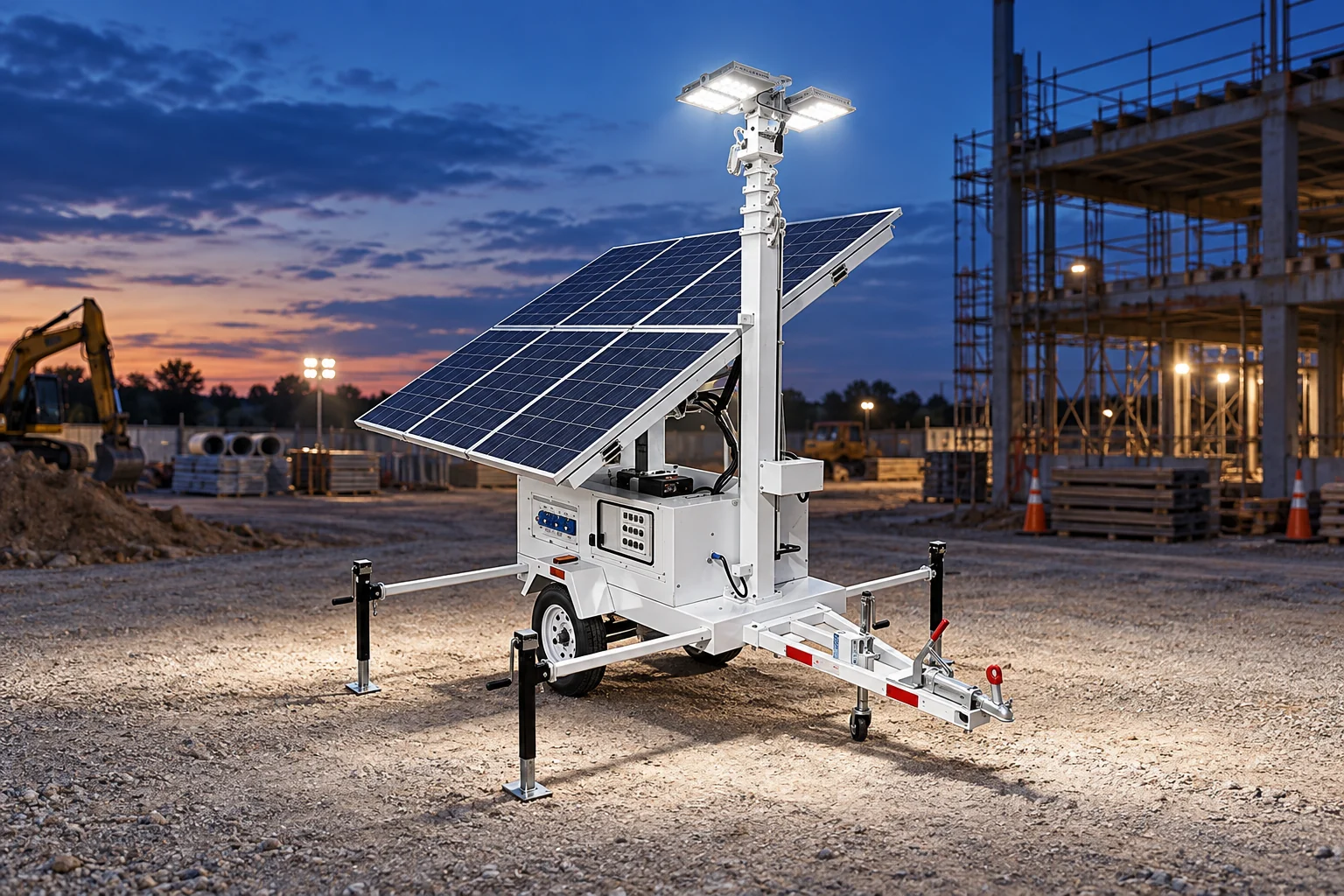
Ask for the calculation in writing, including nominal and usable battery energy, allowed depth of discharge, conversion efficiencies, inverter continuous and surge ratings, solar-energy assumptions, end-of-life margin, thermal-management load, recharge time, and the conditions behind every runtime claim. Buyers can also review the Keyyou solar-powered mobile lighting tower range and our solar light tower manufacturer evaluation guide.
Authoritative references
- U.S. Department of Energy: Solar Energy and Storage Basics
- National Laboratory of the Rockies: Technology Tips for Solar Plus Storage
- National Laboratory of the Rockies: Facility-Scale Solar Photovoltaic Guidebook
- OSHA 29 CFR 1926.56: Construction Illumination
Video: sizing a PV-plus-battery system
This System Advisor Model video from a U.S. Department of Energy national laboratory demonstrates how PV and battery sizing inputs work together. It supports the calculation method but does not replace a configuration-specific engineering review.

Watch “Sizing a PV plus battery system in SAM” on YouTube.
Frequently asked questions
Will a 10 kWh battery run 800 W of lights for 12 hours?
The theoretical result is 12.5 hours only if all 10 kWh is usable at the load. With an 80% depth-of-discharge limit and 90% discharge-path efficiency, a nominal 10 kWh battery delivers about 7.2 kWh, or roughly nine hours at 800 W before auxiliary loads and other margins.
How do I calculate mobile solar light tower battery capacity?
Add each load’s watts multiplied by operating hours, multiply by required autonomy days, then divide by the permitted depth of discharge and discharge-path efficiency. Add documented end-of-life and climate requirements rather than an unexplained margin.
Is a larger battery always better?
No. A larger battery adds cost, mass, charging demand, transport considerations, and potentially unused capacity. The complete solar array, charger, controls, enclosure, and duty cycle must support it.
Why must inverter power be checked separately?
Battery energy in kWh determines runtime, while inverter power in kW determines whether simultaneous and starting loads can be supplied without overload or protective shutdown.
Final takeaway
Choose mobile solar light tower battery capacity from a documented load and operating profile. Calculate delivered nightly energy, convert it to nominal battery capacity using the approved depth of discharge and losses, verify solar recharge and autonomy, then check inverter power, temperature, aging, enclosure, and backup strategy. Ask the supplier to show the assumptions behind the result. A transparent calculation is more useful than a claim that one battery is simply “bigger.”
Note: All figures above are planning examples and estimates. Actual specifications depend on manufacturer drawings, verified component data, the final configuration, and site conditions. Refer to the product selection manual and responsible engineering review for model-specific parameters.