
Solar Light Tower Battery Capacity: Estimation Guide
Estimate required battery storage from the energy your lights and related loads will use over the planned operating period, then adjust for usable depth of discharge, conversion losses, and any project-defined reserve. A datasheet Ah or kWh figure is not a substitute for that calculation until load, voltage, and the permitted operating window are defined.
This guide is for contractors, site managers, and distributors who need an auditable sizing path rather than a generic runtime promise. For array context, see the site’s solar-panel sizing discussion. Browse the Blog archive for related Solar & Hybrid topics.

Contents
- Part 1. What does battery capacity estimation actually decide?
- Part 2. Which project inputs must be defined before sizing storage?
- Part 3. How do you convert lighting demand into required energy?
- Part 4. How should teams translate Wh into Ah and usable storage?
- Part 5. What losses and reserve margins belong in the estimate?
- Part 6. Which RFQ questions help verify the selected configuration?
- Part 7. What common mistakes distort a capacity estimate?
Part 1. What does battery capacity estimation actually decide?
Battery capacity estimation decides whether the selected configuration can deliver the required lighting period with the reserve the project accepts. It is not the same question as “how bright is the tower” or “how large are the panels.” Storage answers whether enough energy is available after charging, losses, and any concurrent daytime load.
Search results for this topic are often product-specification pages that list nominal amp-hour or kilowatt-hour values for a named model. Those numbers are useful only when tied to that model’s voltage, operating modes, test conditions, and stated usable fraction. They cannot be transferred to another brand or configuration without independent documentation.
The IEEE recommended practice for sizing stand-alone PV systems treats battery sizing as part of a load-and-resource problem. Its scope is PV-only stand-alone systems with lead-acid batteries, so hybrid towers, alternate chemistries, or grid-assisted charging need their own documented inputs. The principle still holds: define the load and availability requirement before comparing storage labels.
| Label on a spec sheet | What it may mean | What it does not prove by itself |
|---|---|---|
| Nominal Ah | Charge capacity at the stated battery-bank voltage | Required nightly energy for your fixtures and hours |
| Usable kWh | Energy the manufacturer permits for routine operation | That your site’s shade, dust, or winter conditions match the example |
| “Runtime” hours | Operating time under the manufacturer’s stated mode and conditions | Runtime for your fixture count, dimming schedule, or reserve rule |
Part 2. Which project inputs must be defined before sizing storage?
Start with inputs the project team can defend in an RFQ or site record. Without them, any capacity number is a guess dressed as precision.
Input checklist
| Input | Why it matters | Example record |
|---|---|---|
| Fixture count and wattage or lumen setting | Defines lighting load | Four heads at full output vs dimmed schedule |
| Required operating hours per night | Sets the discharge window | 10 h continuous vs split shifts |
| Autonomy or reserve days | Adds storage beyond one discharge cycle | One cloudy-day reserve vs same-day recharge only |
| Battery chemistry and permitted DoD | Sets usable fraction | Manufacturer maximum DoD, not a generic 100% |
| Nominal battery-bank voltage | Converts Ah to Wh | 24 V, 48 V, or other documented bank voltage |
| Concurrent daytime loads | Reduces energy available for recovery | Controller, communications, inverter idle draw |
| Site solar resource and shade | Affects recharge, not Ah label | Winter angle, dust, new obstruction |
Forum discussions often show buyers trying to compare one Ah value across unlike systems. A DIY Solar Power Forum runtime thread frames the daily balance as stored energy plus daytime charging minus daily loads. That language is useful for planning; it is not a substitute for the selected equipment’s verified data.
Part 3. How do you convert lighting demand into required energy?
Convert demand into watt-hours (Wh) before discussing amp-hours (Ah) or kilowatt-hours (kWh). Wh links power and time directly; Ah requires voltage.
Calculation sequence
- List each load that draws from the battery bank during the required operating period: fixtures at each brightness setting, any control electronics assigned to that period, and other documented loads.
- Estimate average power (W) for each item under the planned mode. Use manufacturer lamp or driver data for the selected fixture, not a generic LED guess.
- Multiply by operating hours to obtain Wh per item:
Wh = W × h. - Sum the items for total required energy per operating period.
- Extend by autonomy days if the project requires more than one discharge cycle before recharge:
Total Wh = daily Wh × autonomy days.
Example (illustrative only, not a product recommendation):
| Load item | Average power (W) | Hours per night | Energy (Wh) |
|---|---|---|---|
| Fixture group A | 400 | 10 | 4,000 |
| Fixture group B | 200 | 10 | 2,000 |
| Control/auxiliary | 25 | 10 | 250 |
| Subtotal per night | 6,250 |
If the project requires one full night of reserve before recharge, the planning subtotal becomes 12,500 Wh before DoD and loss adjustments.
NREL PVWatts system-design documentation supports preliminary PV and simplified battery modeling from physical inputs. It is appropriate for early estimation, not a replacement for the tower supplier’s validated specification.
Part 4. How should teams translate Wh into Ah and usable storage?
After required Wh is known, translate to nominal storage using usable depth of discharge (DoD) and the battery-bank voltage.
Relationships to keep explicit:
Wh = V × Ah(nominal battery-bank voltage × amp-hours)Required nominal Wh ≈ Required usable Wh ÷ permitted usable fractionRequired Ah ≈ Required nominal Wh ÷ V
The Battery University depth-of-discharge reference explains that deeper discharge increases cycle stress for lithium batteries. Use the battery or system manufacturer’s permitted operating window in the calculation—not an assumed 100% of nameplate capacity.
| Planning value | Typical source | Common error |
|---|---|---|
| Required usable Wh | Load table from Part 3 | Using nameplate lamp wattage at a brightness level not used on site |
| Permitted usable fraction | Manufacturer DoD limit | Treating “100 Ah” as 100 Ah of usable energy |
| Bank voltage | System documentation | Comparing 12 V and 48 V banks by Ah alone |
| Temperature derating | Battery datasheet or supplier | Ignoring cold-site performance without review |
IEC 61427-1 addresses PV battery requirements and test methods but does not provide universal sizing formulas. Treat it as a boundary reference: verified supplier data still defines the usable fraction for the selected product.
Part 5. What losses and reserve margins belong in the estimate?
Add margins for conversion and distribution losses between the battery and the load, and for any reserve the contract or site manager requires beyond the base operating period.
Loss categories to document:
- Inverter or driver conversion — if the load path includes conversion, apply the efficiency stated for that component or path.
- Cable and connection losses — usually small but should not be hidden inside an unexplained “safety factor.”
- Battery internal resistance and temperature — may reduce usable energy versus a laboratory rating; defer to supplier guidance.
- Concurrent daytime consumption — controllers, communications, or idle inverter draw reduce energy that would otherwise recharge storage. A Northern Arizona Wind & Sun sizing discussion emphasizes starting from daily load and efficiency rather than a single headline number.
Reserve decisions should be project-specific. Reduced winter solar availability, dust, or recurring shade may require more stored energy or an alternate charging path. The site’s winter operation guidance discusses seasonal operating context; it does not replace a storage calculation for your fixtures and hours.
| Margin type | Question to answer | Documentation |
|---|---|---|
| Conversion loss | What efficiency is assumed on the load path? | Component or system spec |
| Autonomy reserve | How many discharge cycles must storage cover? | Contract or site plan |
| Weather reserve | Is same-day recharge guaranteed? | Site survey and season |
| Service reserve | Is partial operation acceptable during service? | Operating policy |
This article describes PV-led storage planning. Projects that rely primarily on diesel supply follow a different decision path; see the solar-versus-diesel comparison for architecture context, not as a battery-sizing substitute.
Part 6. Which RFQ questions help verify the selected configuration?
Use RFQ questions to convert the estimate into verifiable supplier data. A capacity calculation is only as good as the answers that confirm voltage, usable energy, and permitted operating modes.
RFQ input list
- Intended location, season, and known shade or dust exposure.
- Fixture count, brightness settings, and required hours per night.
- Required reserve or autonomy days and acceptable partial-lighting policy.
- Whether daytime loads beyond lighting must remain energized.
- Alternate charging options the site allows (grid, generator, swap battery).
- Request for nominal and usable storage at the documented bank voltage.
- Request for efficiency or loss assumptions used in the supplier’s runtime statement.
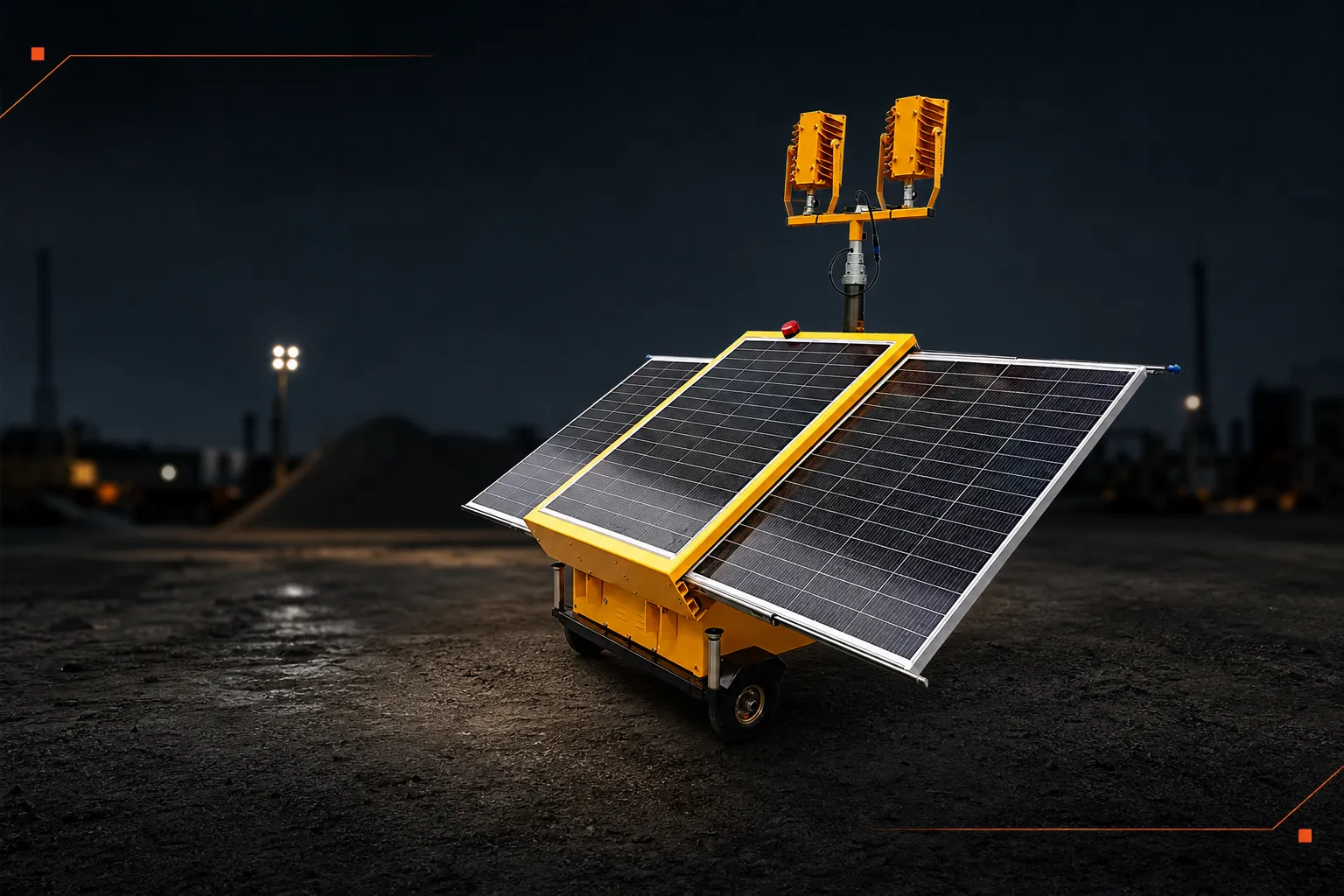
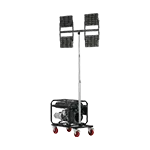
Product recommendation: when the application matches a trailer-based solar configuration, the public listed trailer solar light-tower configuration is a legitimate starting point because it lists solar panels, lithium battery storage, smart control, and trailer construction.
Confirm the exact supplied version, obtain its specification, and map your load table to that document before treating any marketing label as project proof. For broader browsing, see solar and hybrid mobile-lighting options.
Fit Boundary
This estimation method is suitable for early project planning, RFQ preparation, and comparing documented configurations.
It is not suitable as a substitute for the selected unit’s manual, a certified electrical design, or an unsupported performance guarantee. A named competitor specification—such as the Generac VT-Solar product page—illustrates how manufacturers separate nominal and usable values; those figures apply only to that named product.
For a Keyyou configuration review, send the load profile and site context.
Part 7. What common mistakes distort a capacity estimate?
Avoid these errors when reviewers compare quotes or audit a site plan.
- Comparing Ah without voltage — 200 Ah at 24 V is not equivalent to 200 Ah at 48 V in stored energy.
- Treating nameplate capacity as usable energy — permitted DoD and manufacturer limits reduce the working fraction.
- Omitting inverter or controller idle load — a DIY Solar Power Forum mobile-system thread highlights that “what the battery powers” includes more than the lamps.
- Using garden-light or small-cell examples for industrial towers — milliamp-hour cells do not scale to mobile lighting loads without a full load table.
- Copying one manufacturer’s runtime line — runtime belongs to a stated mode, fixture set, and weather assumption.
- Skipping seasonal recharge reality — storage sizing and array sizing must align; low-sunlight sites may need more reserve or another charging path.
- Replacing documentation with marketing superlatives — “maintenance-free” or “long-lasting battery” language does not define Wh available on night three of a dusty job site.
When a mistake is suspected after deployment, collect operating hours, brightness setting, alert history, and exposure notes before requesting service. That record supports a configuration review rather than a guess about “bad batteries.”
FAQs
What size battery do I need for a solar light tower?
Define nightly fixture load in Wh, multiply by required autonomy days, divide by the permitted usable DoD fraction, then convert to Ah using the documented battery-bank voltage. Request the supplier’s verified nominal and usable values for comparison.
How do you calculate the size of the battery in a solar street light?
The same sequence applies: daily load in Wh, autonomy requirement, usable fraction, losses, and voltage conversion. Street-light examples in search results use smaller loads, but the math structure is identical. Always use the actual fixture and control data for the selected tower.
How many kWh does a solar battery hold?
Nameplate kWh or Ah states stored energy at the rated voltage within the manufacturer’s definition. Usable kWh is lower once permitted DoD, temperature, and system limits are applied. Convert with kWh = (V × Ah) ÷ 1000 only after confirming the bank voltage.
How long does a battery last in a solar light?
Operating duration depends on stored usable energy, actual load, brightness setting, concurrent auxiliary draw, and recharge during the day—not the headline capacity label alone. Document the mode used when any runtime figure is quoted.
Can I use a 1000 mAh battery in solar lights?
A 1000 mAh cell belongs to small consumer solar products, not a mobile industrial light tower. Industrial sizing uses Wh based on fixture power and operating hours at the system voltage. Do not scale consumer mAh examples to site lighting.
What is the difference between nominal and usable battery capacity?
Nominal capacity is the nameplate rating. Usable capacity is the energy the manufacturer or system design permits for routine cycling. Planning should use usable capacity aligned with permitted DoD.
Does amp-hour rating alone define storage for a solar light tower?
No. Ah must be paired with bank voltage to express Wh or kWh, and then adjusted for usable fraction and losses. Two towers with the same Ah label can differ in voltage, DoD, load path, and permitted operating modes.