
When does a wind-solar-diesel hybrid lighting system make sense?
A wind-solar-diesel hybrid lighting system makes sense only when verified solar, verified wind, and an approved storage design cannot meet the project’s required lighting continuity on their own, and when diesel backup, fuel logistics, controls, and site constraints are acceptable for that specific load. The decision is a fit-boundary question, not a catalogue label.
This guide is for temporary off-grid lighting projects that need a documented architecture decision rather than a universal fuel-savings promise. For a simpler two-way comparison between renewable towers and conventional diesel units, see the site’s solar-versus-diesel light-tower comparison.
Part 1. When does a wind-solar-diesel hybrid lighting system make sense?
A wind-solar-diesel hybrid lighting system is worth evaluating when the site needs more than a solar-only tower can credibly support, when wind may add energy at times PV output is lower, and when a diesel generator is an acceptable contingency for the remaining gap. It does not make sense as a default label for every remote project.
The U.S. Department of Energy Small Wind guide treats wind and PV as potentially complementary resources, while batteries or an engine-generator can cover periods when renewable input is insufficient. The NREL hybrid power resilience study shows that critical-load definition, battery duration, and dispatch strategy change how much a project depends on diesel. Those sources support a conditional answer, not a universal recommendation.
For mobile lighting, the practical test is narrower than a village microgrid study. Ask whether the lighting schedule is truly critical, whether solar and wind data for the deployment window are documented, whether storage can cover the agreed reserve, and whether diesel backup is permitted and practical at the site. If any of those inputs are missing, the team is not ready to treat “hybrid” as a solution category.
Important: Do not replace a site-specific review with a headline hybrid claim. Peer-reviewed case studies such as the MDPI wind-solar-diesel-battery study show that outcomes depend on local resource, demand, and sensitivity assumptions. They cannot be copied to a job-site lighting tower without project data.
Part 2. What problem does each energy source solve?
Each source solves a different part of the energy-balance problem. Treating them as interchangeable leads to oversized diesel run hours, undersized storage, or wind hardware deployed where the resource cannot support it.
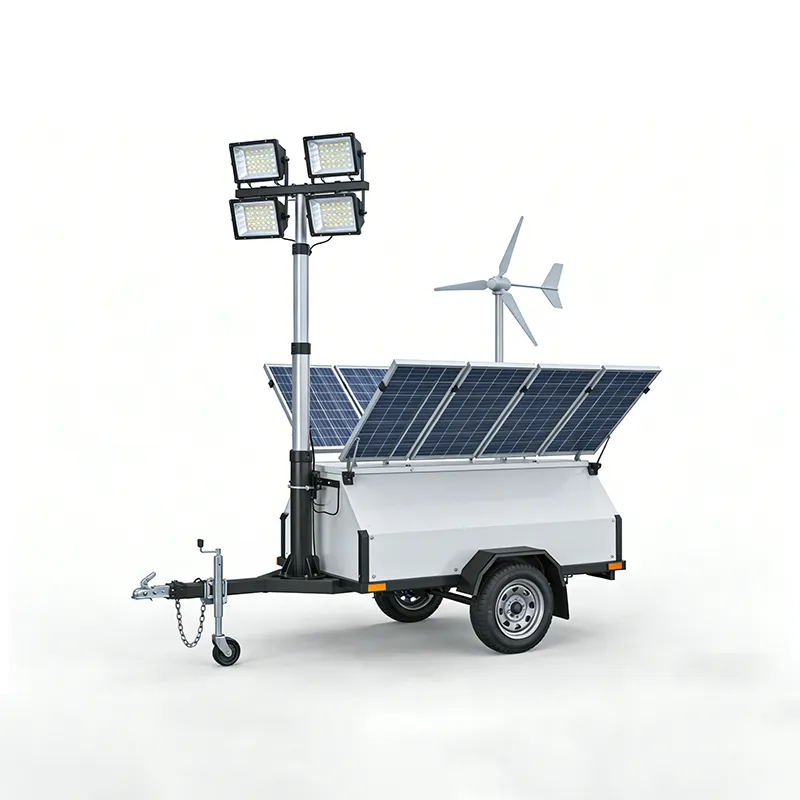
Photovoltaic panels convert available sunlight into electrical energy during daylight hours. Their value depends on orientation, shade, soiling, and seasonal irradiance. For seasonal context on reduced solar availability, see the site’s winter operation guidance for solar LED light towers.
Wind generation can add energy when wind speed at the usable turbine height is sufficient and sustained enough to matter for the project schedule. The DOE Small Wind guide emphasizes that wind must be evaluated on its own merits; a breezy afternoon at ground level is not proof of useful turbine output.
Battery storage buffers short gaps between generation and load, supports LED startup behavior, and can cover part of the nightly lighting window if the stored energy and recharge path are adequate. Storage does not create energy; it only shifts it.
Diesel backup provides dispatchable energy when renewable input and stored reserve are insufficient for the required continuity. In a lighting context, diesel is usually a contingency layer, not the primary operating mode, but fuel delivery, noise, emissions, and automatic start/stop logic still need to be defined.
| Energy source | Primary role in mobile lighting | Main planning risk if assumed without evidence |
|---|---|---|
| Solar PV | Daytime charging and baseline renewable input | Treating catalogue panel wattage as proof of site yield |
| Wind | Supplemental generation when the wind profile adds useful energy | Installing wind hardware without credible resource data |
| Battery storage | Reserve and load buffering between generation periods | Oversizing battery labels without usable energy and recharge proof |
| Diesel generator | Dispatchable backup for continuity gaps | Assuming auto-start, silent operation, or direct-to-load wiring without a verified design |
The DOE FEMP wind technology focus and Scientific Reports hybrid power-management research both describe a supervisory controller as the layer that coordinates these sources around the actual load. For buyers, that means the control strategy is part of the decision, not an afterthought.
Part 3. What load and operating-continuity requirement should buyers define first?
Before comparing architectures, define the lighting load and the continuity the project will accept. A hybrid discussion that starts with product categories instead of operating requirements usually ends with the wrong backup boundary.
Record the continuity inputs
- Required lighted hours per night and the number of consecutive operating nights.
- Whether any dimming, zone switching, or reduced output is acceptable during a deficit.
- Peak and startup behavior of the selected fixtures and any auxiliary loads on the same unit.
- Maximum tolerable interruption, if any, before work must stop or relocate.
- Whether the lighting period is safety-critical, production-critical, or convenience lighting.
The NREL resilience study treats critical loads and dispatch timing as variables that change backup dependence. For a mobile tower, “critical” should be written down in hours and zones, not implied from the job title.
| Continuity input | Why it changes the hybrid decision | Common mistake |
|---|---|---|
| Nightly lighting window | Sets the energy demand the system must support | Quoting only “all night” without shift timing |
| Consecutive low-resource days | Defines reserve and diesel-start criteria | Planning for one cloudy evening only |
| Acceptable output reduction | May avoid unnecessary diesel hours | Treating dimming as failure rather than a defined mode |
| Surge or startup loads | Affects inverter, battery, and generator sizing evidence | Counting only steady-state LED wattage |
If the project can tolerate a documented stop-or-fallback procedure, a solar-plus-storage or solar-plus-wind configuration may be sufficient. If it cannot, the team must verify whether approved storage and renewable input can meet that stricter boundary before adding diesel to the architecture conversation.
Part 4. Is wind a verified resource or only an assumption?
Wind should be treated as a separate engineering input, not as an automatic upgrade to a solar tower. Community discussions on hybrid builds repeatedly warn that wind expectations must be researched before hardware is specified. That caution applies equally to temporary job sites.
Useful wind evidence includes measured or credible wind data at or near the intended turbine hub height, seasonal variability during the deployment period, turbulence and obstructions from plant movement, containers, berms, or structures, and the project’s tolerance for mechanical complexity and maintenance access. The DOE Small Wind guide is clear that wind and solar can complement each other only where both resources are actually usable.
A site that is strong for solar but weak for wind may still justify a solar-led tower with storage and, if needed, diesel backup. A site with credible wind may justify adding wind input to reduce diesel dependence, but only after the wind contribution is expressed in project terms rather than marketing terms.
Do not assume that a published solar tower with optional wind input equals a validated wind-solar-diesel design. Optional wind wording on a product page is a configuration starting point, not proof that wind will perform at the reader’s site or that diesel is included.
Part 5. When does storage cover the gap, and when does diesel backup become relevant?
Storage is the first backup layer to evaluate because it is silent, has no fuel logistics, and can cover many short gaps if sized and operated within approved limits. Diesel becomes relevant when the documented reserve requirement exceeds what storage can provide within the project’s weight, space, recharge, and maintenance constraints.
The MDPI remote-building case study illustrates a broader energy-system truth: diesel may remain in an optimized hybrid mix for some resource and demand combinations, while other sensitivity cases reduce diesel dependence when renewables and storage are sufficient. Those results are site-specific and must not be turned into a fixed rule for every light tower.
| Decision question | If the evidence supports “yes” | If the evidence supports “no” |
|---|---|---|
| Can storage cover the agreed nightly window after realistic solar and wind input? | Keep the discussion at solar/wind/storage first | Move diesel backup into the architecture review |
| Can storage recharge within the next available generation period? | Diesel may remain a rare contingency | Diesel becomes part of routine deficit planning |
| Are fuel delivery, noise, and emissions acceptable at the site? | Diesel backup can be considered | Choose a different fallback or reduce the continuity requirement |
| Is there a verified control path for generator start/stop and battery protection? | Diesel can be integrated safely in principle | Resolve controls before selecting hardware |
Diesel backup makes sense when the project’s required continuity cannot be met by the verified renewable-and-storage design alone and when the operating team can manage fuel, maintenance, and dispatch responsibly. It does not make sense when buyers hope to avoid doing a load and resource audit by adding a generator nameplate to the RFQ.
Part 6. Which control, fuel, site, and maintenance constraints can change the decision?
Even a well-sized hybrid architecture can fail operationally if controls, fuel handling, or site constraints are ignored. Buyers on DIY forums often discover late that generator auto-start, battery protection, and load paths are design decisions, not implied features.
Control logic should coordinate PV input, wind input, battery state-of-charge limits, lighting load demand, and diesel start/stop criteria. The Scientific Reports hybrid-management study describes this as a supervisory coordination problem across variable sources and storage. For mobile lighting, buyers should ask how alarms, remote monitoring, manual override, and safe shutdown are handled on the selected configuration.
Fuel constraints matter because diesel backup is not only a hardware question. Storage tanks, delivery access, runtime expectations, refueling intervals, spill containment, and local operating rules can make generator backup impractical even when the electrical logic says diesel is useful.
Site and maintenance constraints include trailer stability for wind hardware, mast and turbine access, noise limits near housing or hospitals, emissions restrictions, transport dimensions, and the ability to inspect panels, batteries, turbines, and filters on schedule. A hybrid that cannot be maintained on site becomes a diesel-dependent tower with unused renewable hardware.
Fit Boundary
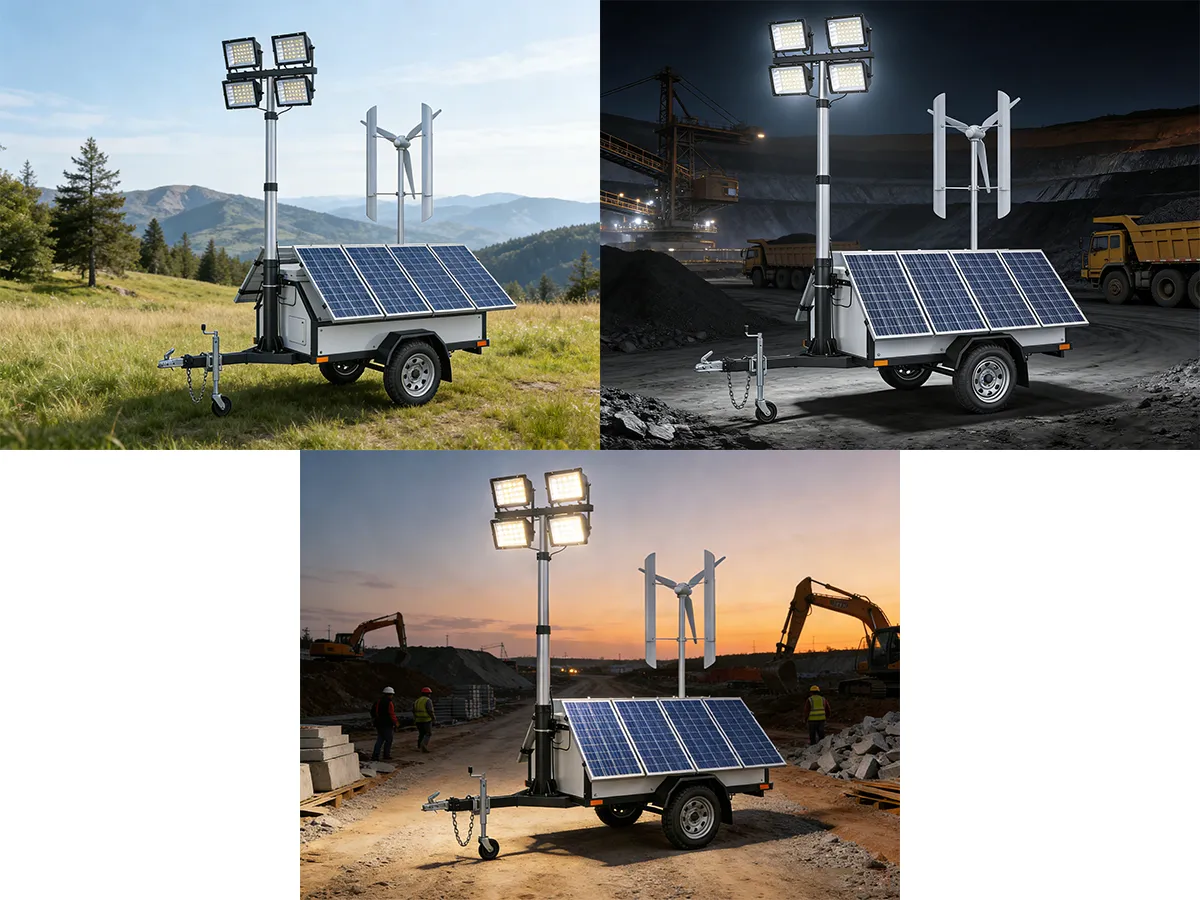
This architecture review is suitable for teams that can document load continuity, solar and wind resource assumptions, storage reserve needs, and diesel logistics before RFQ. It is not suitable when the project needs an unverified all-weather runtime guarantee, cannot obtain credible wind data but still wants wind hardware by default, or expects a supplier to confirm a wind-solar-diesel integrated Keyyou tower without model-specific evidence. Keyyou’s published solar-tower page describes optional wind input on a listed trailer product; it does not establish a verified wind-solar-diesel integrated lighting system from Keyyou.
Part 7. What should a buyer send Keyyou for a configuration review?
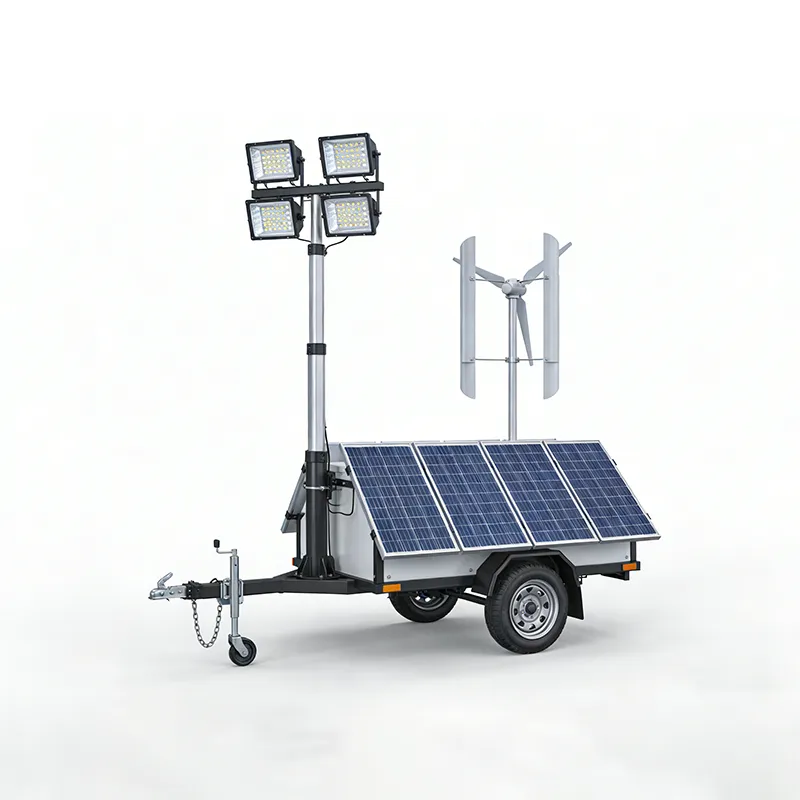
Use the RFQ to test whether a renewable-heavy configuration can meet the project before assuming a three-source-plus-diesel architecture is necessary. The listed Trailer Model Solar-Powered Mobile Lifting Light Tower describes solar panels, lithium battery storage, smart control, and optional wind input. Confirm the exact supplied configuration and its documents before treating any of those features as a project solution. Keyyou does not offer a verified wind-solar-diesel integrated lighting tower in the material reviewed for this article.
Buyer should provide
| Buyer input | Why it matters | Common mistake |
|---|---|---|
| Location and deployment dates | Solar and wind resources vary by place and season | Sending only a country name |
| Required nightly lighting hours and zones | Defines the real load | Describing the job type without hours |
| Continuity tolerance and fallback rules | Sets the reserve and diesel boundary | Omitting whether any interruption is acceptable |
| Credible solar and wind notes | Tests whether wind is a real complement | Assuming wind because the site is open |
| Fuel, noise, and maintenance constraints | Determines whether diesel backup is practical | Adding diesel after mobilization |
Product recommendation: begin with the listed trailer solar light-tower configuration when the project needs a documented solar-led mobile tower with optional wind input and can accept a configuration review against site data. It is less suitable when the buyer requires a confirmed diesel-integrated wind-solar tower from Keyyou without approved model evidence, or when the site cannot support the maintenance and resource validation steps described above.
For panel-sizing context before RFQ, see the site’s solar-panel sizing discussion. To compare simpler alternatives first, use the solar-versus-diesel light-tower comparison.
To discuss a configuration against a real project, send the site data for configuration review: location, dates, nightly operating hours, lighting priorities, wind and solar notes, continuity requirements, and any fuel or noise constraints. You can also review solar and hybrid mobile-lighting options after those inputs are defined.
FAQs
What is a wind-solar-diesel hybrid lighting system?
It is a mobile or temporary lighting architecture that combines photovoltaic input, wind input where credibly useful, battery storage, supervisory control, and a diesel generator used as dispatchable backup when renewable generation and stored reserve are insufficient for the required lighting continuity.
Is diesel backup necessary for every off-grid lighting tower?
No. Diesel backup is a project-dependent contingency layer. Many sites can be planned around solar, storage, and operating discipline first. Diesel enters the discussion when documented load continuity cannot be met by verified renewable and storage design alone.
What site data is needed before selecting a hybrid system?
Provide location, deployment dates, nightly lighting hours, zone priorities, credible solar-resource notes, wind data or an explicit statement that wind is not yet validated, required reserve or interruption tolerance, and any fuel, noise, or maintenance constraints. Without those inputs, a hybrid label is not a design.
Why is wind-resource validation important?
Wind output depends on height, turbulence, seasonality, and obstructions. A site that looks open at ground level may still be a weak wind location for a turbine. Validating wind separately prevents paying for hardware that does not change the energy balance materially.
What should control logic manage in a hybrid system?
At minimum, PV charging, wind input, battery state-of-charge limits, lighting load demand, diesel start/stop criteria, alarms, and safe shutdown behavior. Buyers should confirm these functions on the selected configuration rather than assuming automatic generator dispatch.
Can a solar product page be treated as proof of a diesel-capable hybrid model?
No. A published solar-tower page may describe solar, storage, control, and optional wind input, but that is not proof of an integrated diesel backup, automatic generator dispatch, or a verified wind-solar-diesel tower from the same supplier.
How does this decision relate to a solar-only or diesel-only light tower?
A solar-only or solar-plus-storage tower is often the right starting point when continuity requirements are documented and a reserve process is acceptable. A diesel-only tower may be simpler when renewable evidence is weak or maintenance capacity is limited. The wind-solar-diesel hybrid sits between those paths for projects that need renewable input plus a defined generator contingency. The site’s solar-versus-diesel light-tower comparison covers the two-source decision in more detail.
References
- U.S. Department of Energy — Small Wind Electric Systems guide
- U.S. Department of Energy FEMP — wind technology focus
- National Renewable Energy Laboratory — Hybrid Power Plants for Energy Resilience
- Scientific Reports — optimization and intelligent power management for wind/PV/diesel/batteries
- MDPI Sustainability — wind-solar-diesel-battery case study