

What Does It Mean When the Traction Control Light Comes On?
A practical guide to flashing versus steady illumination, what traction control actually does, and why a warning may stay on, with decision checks, sources, and FAQs.
A flashing traction-control light usually means the system is actively limiting wheelspin; a steady light may mean the system was switched off or detected a fault. Symbols and behavior vary, so check the exact owner’s manual. Slow down when grip is poor. If the light remains on, appears with ABS or brake warnings, or the vehicle behaves abnormally, arrange diagnosis rather than assuming traction support is available.
Flashing versus steady illumination

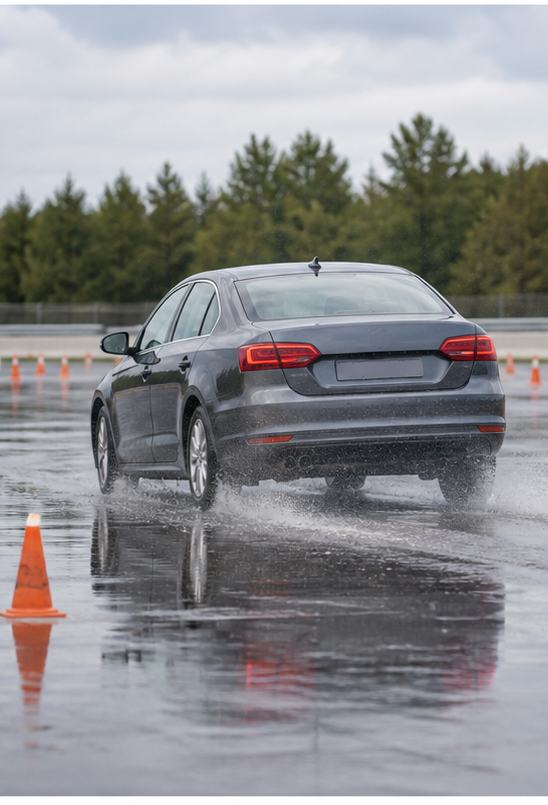
When the skidding-car symbol flashes during acceleration on rain, snow, gravel or another low-grip surface, the controller may be reducing engine torque or applying individual brakes. That brief intervention is normally expected. A solid symbol can instead indicate that the driver disabled the system, that a startup self-check did not complete, or that the control unit stored a fault. Some vehicles use separate TRAC OFF, ESC, VSC or stability-control messages. The manual is the controlling reference because color, wording and switch logic differ.
What traction control actually does
Wheel-speed signals let the controller compare driven-wheel behavior. If one wheel accelerates faster than conditions permit, the system can request less torque and may brake that wheel. Electronic stability control uses related sensors and can brake individual wheels to help the vehicle follow the intended path. These systems cannot create grip. Tire condition, speed, steering input and surface friction remain decisive, and intervention should never be treated as permission to drive faster.
Why a warning may stay on
A deliberately pressed off switch is the simplest explanation, but wheel-speed sensor damage, tone-ring contamination, mismatched tires, low battery voltage, steering-angle calibration, wiring faults or a related engine or brake fault may disable the function. Do not buy a sensor from a generic fault list. Record all warning lamps and messages, inspect tire sizes and pressures against the placard, and have diagnostic trouble codes read with equipment that can access the relevant chassis modules.
What to do while driving
Ease off the accelerator, make smooth steering and braking inputs, and increase following distance. If the lamp flashes briefly on a slippery surface and then stops, continue cautiously. If it stays on, traction or stability assistance may be reduced even when normal braking remains. Stop in a safe place when handling changes, multiple red warnings appear, braking feels abnormal, a tire is damaged, or the owner’s manual directs an immediate stop. Do not cycle switches while negotiating a hazard.
Checks before booking service

Restart only when safely parked and only if the manual permits it. Confirm that the off switch was not pressed, check for snow or debris around wheels without crawling under an unsecured vehicle, and verify that all tires are the specified size and visibly serviceable. Photograph the cluster before messages disappear. Note weather, speed, recent battery or tire work and whether ABS, engine or tire-pressure warnings appeared. That evidence is more useful than repeatedly clearing the lamp.
How a technician verifies the cause
A qualified technician can scan all related modules, review freeze-frame and live wheel-speed data, inspect wiring and tone rings, check battery and charging voltage, confirm tire rolling circumference, and perform the manufacturer’s calibration or road-test sequence. Repairs should be based on measured evidence. Clearing a code or disconnecting the battery without correcting the cause can erase diagnostic context and may leave a safety function unavailable.
Decision table
| Check | Evidence needed | Decision purpose |
|---|---|---|
| Flashes only during wheelspin | System may be intervening | Reduce speed and drive smoothly |
| Steady after off switch used | System may be intentionally disabled | Re-enable only as the manual directs |
| Steady without driver action | Possible fault or failed self-check | Arrange model-specific diagnosis |
| With ABS or brake warning | Shared brake-control issue possible | Follow manual; seek prompt service |
| Vehicle pulls or brakes abnormally | Immediate operating concern | Stop safely and obtain assistance |
How to use this guide responsibly
This guide explains a decision process, not a substitute for the current product manual, professional diagnosis, engineering approval, medical care, or local legal requirements. Search results often compress a complex decision into a single answer. A safe conclusion needs the exact equipment or symptom, operating context, applicable jurisdiction, and evidence that can be checked. Keep model numbers, photographs, measurements, dates and instructions together so another qualified person can reproduce the decision.
Start with the lowest-risk observation. Do not defeat guards, interlocks, protective devices or warnings to obtain a reading. If the task involves energy, gas, structural loads, moving equipment, impaired vision or public safety, stop when conditions exceed your competence. The correct escalation is part of a successful diagnosis, not a failure to finish the job.
Evidence and documentation checklist
- Exact product, vehicle, appliance or system identity, including model and year where relevant
- Current manufacturer instructions and configuration-specific drawings
- Observed symptom or required outcome written in measurable terms
- Operating conditions, changes, previous work and environmental factors
- Applicable safety, electrical, structural, medical or road-use requirements
- Measurements recorded with instrument, units, test point and system state
- Decision, responsible person, corrective action and final verification
Do not convert a marketing phrase into a technical claim. Ratings only apply to the configuration and conditions stated by the issuer. When evidence conflicts, use the more conservative safe state while obtaining clarification from the manufacturer, authority or qualified professional.
Common mistakes to avoid
- Buying or acting from a keyword, photograph or marketplace title without identifying the exact system
- Changing several variables at once and losing the ability to identify the cause
- Using a measurement without units, load condition, reference point or instrument limitations
- Assuming a familiar symptom always has the same cause
- Bypassing protection or increasing a fuse, limit or rating to make a problem disappear
- Copying a competitor’s claim without checking primary documentation
- Treating a temporary improvement as proof that the underlying issue is resolved
Connection to professional area lighting
Keyyou manufactures mobile lighting equipment for temporary outdoor and industrial applications. The subject of this guide may sit outside that product range, so no Keyyou product claim is implied. Readers planning construction, remote-site or emergency illumination can review the portable tower lighting guide, the jobsite lighting planning guide, and the light tower inspection checklist. Those resources address large-area mobile lighting rather than the specialized device discussed here.
Authoritative references
- NHTSA electronic stability control information
- NHTSA-hosted vehicle manual example explaining traction-control indicators
Video explanation
The following video is included as a visual introduction. Verify every action against the exact product instructions and the safety boundaries in this article.

Watch What Does Traction Control Warning Light Mean? on YouTube (Bitoy’s Legend).
Frequently asked questions
Can I drive with the traction control light on?
A brief flash during low grip may be normal. A steady lamp can mean assistance is off or faulty; follow the owner’s manual and drive cautiously to appropriate service only if no stop warning or abnormal behavior exists.
Why did the light come on after changing tires?
Different sizes, pressures or rolling circumferences can produce unexpected wheel-speed relationships. Confirm every tire against the vehicle specification.
Will disconnecting the battery reset it?
It may erase useful information without fixing the cause and can create other calibration needs. Diagnose the stored fault first.
Is traction control the same as stability control?
They are related and often share sensors and braking hardware, but traction control primarily limits wheelspin while stability control also addresses vehicle path and yaw.
Final takeaway
The final decision should account for flashing versus steady illumination and what traction control actually does. Verify the exact product or situation, follow the controlling instructions, document the evidence, and escalate any condition that exceeds the limits described in this guide.


