

How Do You Maintain a UV Light? A Safety-First Maintenance Plan
A practical guide to first identify the uv system, control energy, radiation and pressure, and clean the optical path correctly, with decision checks, sources, and FAQs.
Maintain a UV light by following the exact system manual, isolating electrical power and UV exposure, allowing the lamp to cool, inspecting and cleaning the quartz sleeve or optical window with approved materials, checking seals, airflow or water flow, verifying sensors and alarms, logging operating hours, and replacing lamps at the manufacturer’s specified interval. UV-C can injure eyes and skin, fragile lamps may contain mercury, and water reactors can be pressurized, so trained service is required when the enclosure must be opened or performance must be certified.
First identify the UV system

UV-A inspection lamps, UV-C air cleaners, HVAC coil units, curing systems and drinking-water reactors have different hazards and maintenance procedures. Record manufacturer, model, wavelength or lamp family, duty cycle, installation date, controller hours, spare-part numbers and the manual revision. Do not apply a water-reactor cleaning method to an occupied-room UV fixture. If the label or manual is missing, keep the unit out of service until the supplier identifies the safe procedure.
Control energy, radiation and pressure
Switching a lamp off at a wall control may not isolate every circuit. Follow the documented lockout method, wait the specified cooling time and verify the safe state before opening covers. Never look at an operating germicidal lamp or expose skin to test it. For water systems, isolate and depressurize as instructed and manage drainage hygienically. Use required eye, hand and breakage protection. Interlocks and shielding are safety devices and must not be defeated.
Clean the optical path correctly
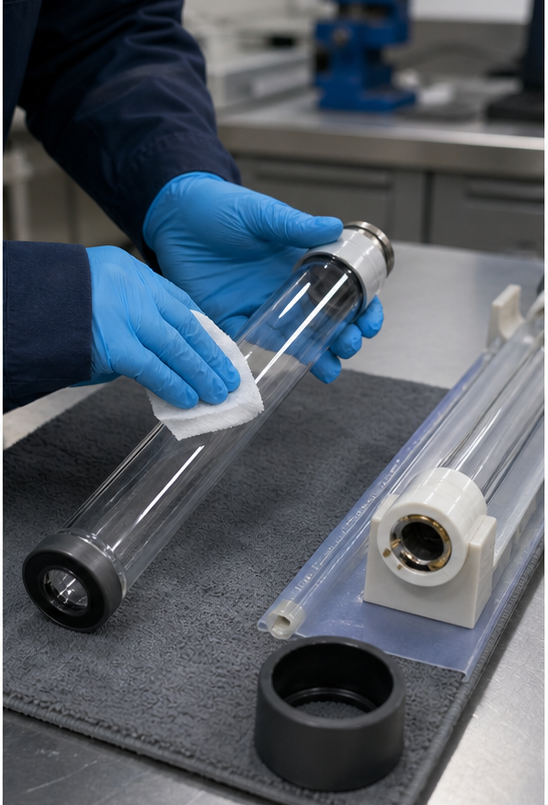
Dust, mineral scale, fingerprints, condensate and biofilm can reduce UV transmission without making a lamp look failed. Inspect sleeves, reflectors, sensor windows, filters and airflow paths at the manual’s interval. Use only compatible cleaning agents and lint-free materials; aggressive abrasives can scratch quartz or coatings. Handle a lamp by approved areas with clean gloves. Refit components in the correct orientation and replace damaged sleeves, seals or gaskets rather than forcing a leaking assembly together.
Track lamp age and output
A UV lamp can still glow while its germicidal output has fallen below the required value. Use controller hours, validated intensity readings, dose alarms and the replacement interval specified for the actual lamp and operating pattern. Do not substitute a visually similar lamp: wavelength, electrical characteristics, base, length and output can differ. Record baseline readings after cleaning or replacement so future changes can be interpreted. For regulated disinfection, follow the validated operating envelope and compliance procedure.
Inspect supporting components

Ballasts or drivers, fans, filters, wipers, seals, cables, connectors, sensors and alarms all affect performance. Check for overheating, corrosion, moisture, unusual noise, leakage and repeated fault codes. Verify that automatic cleaning works and that the sensor window is itself clean. Keep critical spares as the operational plan requires. Resetting a timer without replacing the lamp or clearing an alarm without a functional check creates a false maintenance record.
Return the unit to service
Reassemble with correct seals and torque, remove tools, restore pressure or airflow gradually, then energize from a protected position. Confirm leak tightness, lamp status, alarms, interlocks, sensor values and any required water-quality or irradiance verification. Log who performed the work, parts and cleaning agents used, readings before and after, waste handling and the next due date. If output does not recover, investigate fouling, lamp aging, sensor calibration, ballast output and process conditions.
Decision table
| Check | Evidence needed | Decision purpose |
|---|---|---|
| Before opening | Power, UV and pressure isolated | Prevent shock, exposure and release |
| Optical path | Sleeve, window and reflector clean | Restore transmission |
| Lamp life | Hours and verified output | Replace before inadequate dose |
| Seals and cooling | No leak, obstruction or overheating | Protect equipment and process |
| Restart | Alarms, interlocks and performance verified | Document safe return to service |
How to use this guide responsibly
This guide explains a decision process, not a substitute for the current product manual, professional diagnosis, engineering approval, medical care, or local legal requirements. Search results often compress a complex decision into a single answer. A safe conclusion needs the exact equipment or symptom, operating context, applicable jurisdiction, and evidence that can be checked. Keep model numbers, photographs, measurements, dates and instructions together so another qualified person can reproduce the decision.
Start with the lowest-risk observation. Do not defeat guards, interlocks, protective devices or warnings to obtain a reading. If the task involves energy, gas, structural loads, moving equipment, impaired vision or public safety, stop when conditions exceed your competence. The correct escalation is part of a successful diagnosis, not a failure to finish the job.
Evidence and documentation checklist
- Exact product, vehicle, appliance or system identity, including model and year where relevant
- Current manufacturer instructions and configuration-specific drawings
- Observed symptom or required outcome written in measurable terms
- Operating conditions, changes, previous work and environmental factors
- Applicable safety, electrical, structural, medical or road-use requirements
- Measurements recorded with instrument, units, test point and system state
- Decision, responsible person, corrective action and final verification
Do not convert a marketing phrase into a technical claim. Ratings only apply to the configuration and conditions stated by the issuer. When evidence conflicts, use the more conservative safe state while obtaining clarification from the manufacturer, authority or qualified professional.
Common mistakes to avoid
- Buying or acting from a keyword, photograph or marketplace title without identifying the exact system
- Changing several variables at once and losing the ability to identify the cause
- Using a measurement without units, load condition, reference point or instrument limitations
- Assuming a familiar symptom always has the same cause
- Bypassing protection or increasing a fuse, limit or rating to make a problem disappear
- Copying a competitor’s claim without checking primary documentation
- Treating a temporary improvement as proof that the underlying issue is resolved
Connection to professional area lighting
Keyyou manufactures mobile lighting equipment for temporary outdoor and industrial applications. The subject of this guide may sit outside that product range, so no Keyyou product claim is implied. Readers planning construction, remote-site or emergency illumination can review the portable tower lighting guide, the jobsite lighting planning guide, and the light tower inspection checklist. Those resources address large-area mobile lighting rather than the specialized device discussed here.
Authoritative references
Video explanation
The following video is included as a visual introduction. Verify every action against the exact product instructions and the safety boundaries in this article.

Watch UV Lights Explained on YouTube (MEP Academy).
Frequently asked questions
How often should a UV lamp be cleaned?
There is no universal interval. Water quality, dust, airflow, operating conditions and the manufacturer’s instructions determine it; trend readings and inspect at the specified schedule.
Does a glowing UV lamp still disinfect?
Not necessarily. Visible glow does not prove adequate UV-C output or dose. Use the system’s validated monitoring method.
Can I touch a UV lamp with bare hands?
Follow the manual; clean gloves are commonly required because oils can contaminate quartz and the lamp is fragile.
Can a UV lamp go in household trash?
Some UV lamps contain mercury or require special handling. Follow the lamp documentation and local hazardous-waste or recycling rules.
Final takeaway
The final decision should account for first identify the uv system and control energy, radiation and pressure. Verify the exact product or situation, follow the controlling instructions, document the evidence, and escalate any condition that exceeds the limits described in this guide.


