
When Are Fire-Rated Recessed Lights Required? A Compliance Guide
A practical guide to start with the ceiling assembly, what fire-rated downlight means, and ic, airtight, and fire ratings differ, with decision checks, sources, and FAQs.
Fire-rated recessed lights—or an approved tested protection system—are required when cutting the light opening would otherwise compromise a fire-resistance-rated ceiling or floor-ceiling assembly and the applicable code, listing or authority requires the penetration to maintain that rating. They are not automatically required in every ceiling, and an IC or airtight rating is not the same as a fire-resistance rating. Identify the rated assembly, required duration, luminaire and tested detail with the designer and authority before installation.
Start with the ceiling assembly

A ceiling may be ordinary construction, part of a rated floor-ceiling system, a corridor separation, dwelling-unit separation, garage interface or another protected assembly. The rating belongs to the complete tested construction: joists, layers, fasteners, insulation, resilient channels and penetrations. Cutting an opening can alter its performance. Review approved plans, assembly numbers and fire strategy; visual appearance of plasterboard cannot establish whether a rating exists.
What fire-rated downlight means
The term generally indicates that a luminaire or protective cover has been tested in specified ceiling constructions for stated time and installation conditions. Approval may depend on hole size, board type and layers, joist material and spacing, insulation, clearances and orientation. A product marketed as fire rated is not universal across every assembly. Obtain the test or certification scope and match the exact model and construction.
IC, airtight, and fire ratings differ
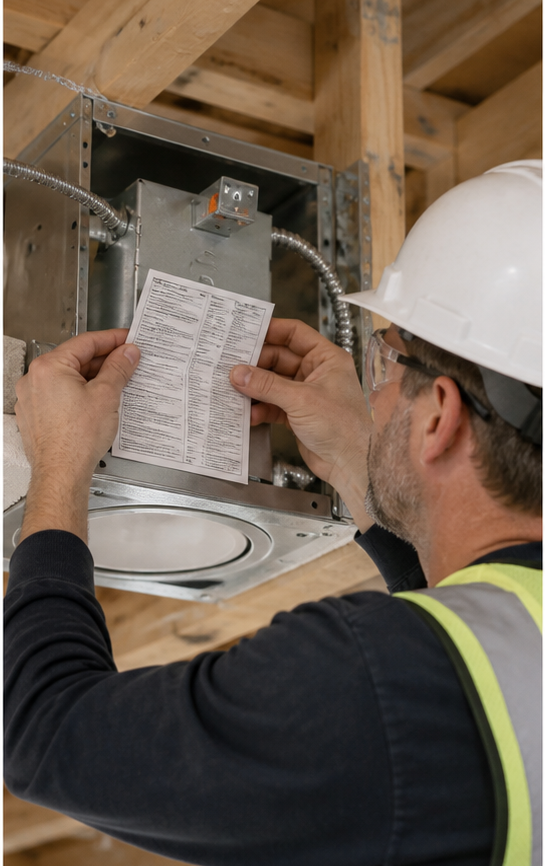
IC addresses permitted contact with thermal insulation under stated conditions. Airtight or air-leakage performance addresses air movement. Damp or wet ratings address moisture. Fire-resistance performance concerns the assembly’s ability to resist fire for a period. One mark does not imply the others. Energy codes may require airtightness while building codes separately protect a rated floor. Document every applicable property rather than choosing one label as a shortcut.
Protection options
Depending on jurisdiction and tested designs, compliance may use a listed fire-rated luminaire, a tested enclosure or hood, a site-built protection detail included in an approved assembly, or relocation to avoid the penetration. Mixing a generic hood with any downlight is not automatically acceptable. Clearances, ventilation and driver temperature must still follow instructions. The design professional and authority having jurisdiction should approve the exact combination before work is concealed.
Installation quality controls
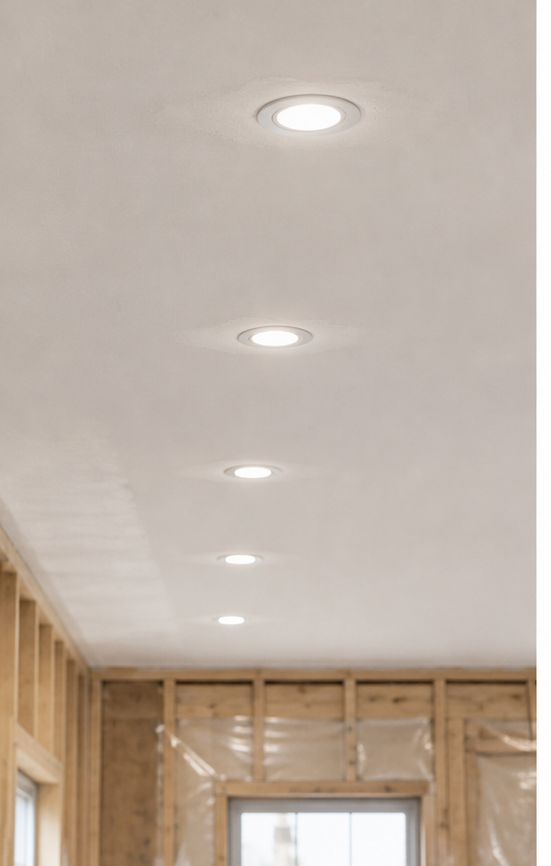
Mark fixture centers against structural and service drawings, cut only the permitted opening, protect required board layers and avoid unapproved notching. Install the luminaire or enclosure with specified fasteners, seals and clearances. Do not cover equipment with insulation unless allowed. Coordinate cables and junction boxes without adding unprotected penetrations. Photograph each installation before closing the ceiling and retain labels and model records for inspection.
Inspection and future changes
The inspector may need assembly documentation, product certification, installation instructions and access before concealment. Commission lighting and emergency functions separately from fire compliance. Later lamp, trim, driver or luminaire replacements must preserve the approved arrangement. Water damage, ceiling repairs or new services can also compromise protection. When documentation is missing, do not infer compliance from a similar product; obtain professional evaluation or restore an approved assembly.
Decision table
| Check | Evidence needed | Decision purpose |
|---|---|---|
| Rated ceiling/floor assembly | Approved assembly and required duration | Determine whether protection is needed |
| Luminaire certification | Exact model and compatible construction | Verify tested scope |
| Opening/detail | Hole size, layers, enclosure and clearances | Preserve assembly performance |
| Other ratings | IC, airtight, damp/wet | Do not confuse with fire rating |
| Approval record | Plans, instructions, photos and inspection | Support future maintenance |
How to use this guide responsibly
This guide explains a decision process, not a substitute for the current product manual, professional diagnosis, engineering approval, medical care, or local legal requirements. Search results often compress a complex decision into a single answer. A safe conclusion needs the exact equipment or symptom, operating context, applicable jurisdiction, and evidence that can be checked. Keep model numbers, photographs, measurements, dates and instructions together so another qualified person can reproduce the decision.
Start with the lowest-risk observation. Do not defeat guards, interlocks, protective devices or warnings to obtain a reading. If the task involves energy, gas, structural loads, moving equipment, impaired vision or public safety, stop when conditions exceed your competence. The correct escalation is part of a successful diagnosis, not a failure to finish the job.
Evidence and documentation checklist
- Exact product, vehicle, appliance or system identity, including model and year where relevant
- Current manufacturer instructions and configuration-specific drawings
- Observed symptom or required outcome written in measurable terms
- Operating conditions, changes, previous work and environmental factors
- Applicable safety, electrical, structural, medical or road-use requirements
- Measurements recorded with instrument, units, test point and system state
- Decision, responsible person, corrective action and final verification
Do not convert a marketing phrase into a technical claim. Ratings only apply to the configuration and conditions stated by the issuer. When evidence conflicts, use the more conservative safe state while obtaining clarification from the manufacturer, authority or qualified professional.
Common mistakes to avoid
- Buying or acting from a keyword, photograph or marketplace title without identifying the exact system
- Changing several variables at once and losing the ability to identify the cause
- Using a measurement without units, load condition, reference point or instrument limitations
- Assuming a familiar symptom always has the same cause
- Bypassing protection or increasing a fuse, limit or rating to make a problem disappear
- Copying a competitor’s claim without checking primary documentation
- Treating a temporary improvement as proof that the underlying issue is resolved
Connection to professional area lighting
Keyyou manufactures mobile lighting equipment for temporary outdoor and industrial applications. The subject of this guide may sit outside that product range, so no Keyyou product claim is implied. Readers planning construction, remote-site or emergency illumination can review the portable tower lighting guide, the jobsite lighting planning guide, and the light tower inspection checklist. Those resources address large-area mobile lighting rather than the specialized device discussed here.
Authoritative references
Video explanation
The following video is included as a visual introduction. Verify every action against the exact product instructions and the safety boundaries in this article.

Watch One-Hour Fire Rating for Recessed Lighting Explained on YouTube (Tenmat USA).
Frequently asked questions
Are fire-rated recessed lights required in every home?
No. The need depends on the rated assemblies and local requirements in the specific building.
Is an IC-rated light fire rated?
No. IC addresses insulation contact; it does not by itself maintain a fire-resistance-rated assembly.
Can I put a fire hood over any downlight?
Only when the hood, luminaire and ceiling combination is documented and accepted for the application.
Do LED recessed lights need fire protection?
Light-source technology does not remove the penetration. The rated assembly and tested detail determine the requirement.
Final takeaway
The final decision should account for start with the ceiling assembly and what fire-rated downlight means. Verify the exact product or situation, follow the controlling instructions, document the evidence, and escalate any condition that exceeds the limits described in this guide.