
Portable Lights for a Football Field: Planning Temporary Training Illumination
Plan portable football-field lighting around the activity, field zones, measurement grid, glare, spill light, power, placement, stability, and verification.
Portable lights for a football field should be selected from a lighting plan, not from wattage or lumen totals. Define whether the field supports informal drills, organized practice, competition, spectators or video; divide the playing area and sidelines into measurement zones; then ask suppliers for a layout based on complete fixture photometry. Position towers outside play and run-off areas, control glare and spill light, verify ground and wind limits, and measure the result after setup. Temporary equipment can solve seasonal or shared-field needs, but it still requires professional design and site-specific approval.
Start with the football activity, not the light tower
A small youth practice, full-pitch team training and a filmed match create different visual tasks. Players need to track a fast ball, see body movement and judge distance. Coaches may need wider observation, while spectators and cameras add vertical-illumination and glare considerations. Record field dimensions, marked practice zones, goals, team areas, access routes, nearby homes or roads, operating hours and the authority responsible for approval.
Do not copy a single illuminance value from an online listing. Applicable criteria depend on the sport, level of play, governing body, jurisdiction and project agreement. The Illuminating Engineering Society’s sports-lighting practice specifically distinguishes competition levels and design concerns. A qualified lighting designer should establish the target and calculation method.
Translate the field into measurable zones
Create a scaled plan showing touchlines, goal lines, center line, penalty areas, sidelines, technical areas, spectator positions, entrances, parking, roads, residences and existing lighting. Mark proposed tower positions and the measurement grid. If only half the field is used for drills, state that explicitly; do not present a half-field layout as full-pitch coverage.
Measurements should use the plane, grid and calculation conventions required by the project. Record average illumination, minimum points, uniformity, vertical light where relevant and observations of glare. A bright central patch can produce a high average while leaving corners, goalmouths or transition areas difficult to see.
Portable football-field lighting decision table
| Decision | Project input | Evidence before approval |
|---|---|---|
| Activity level | Drills, practice, match, spectators, recording | Applicable owner, league and lighting criteria |
| Coverage | Full field or defined training zones | Scaled photometric layout and measurement grid |
| Quality | Uniformity, glare, vertical visibility, shadows | Complete-fixture photometric file and aiming schedule |
| Placement | Run-off, access, slopes, traffic and ball impact | Site drawing with setbacks and protection |
| Power | Grid, battery, hybrid or engine; session duration | Load, runtime, recharge/fuel and sound assumptions |
| Operations | Setup frequency, crew, storage and weather | Manual, wind limits, inspection and emergency plan |
Why lumens and watts cannot predict field performance
Lumens describe total light leaving a source under stated conditions; they do not show where that light lands. Watts describe electrical input, not visibility. Fixture optics, mounting height, tilt, aiming direction, depreciation, obstructions and background brightness determine the distribution. Compare complete luminaire photometric files rather than LED-chip claims or nominal floodlight wattage.
Ask the supplier to identify calculation assumptions, light-loss factor, mast height, tower coordinates, fixture orientation and aiming points. If the delivered fixture or optic differs, repeat the calculation. A generic rendering without coordinates or calculation data is not an acceptance document.
Tower quantity and placement
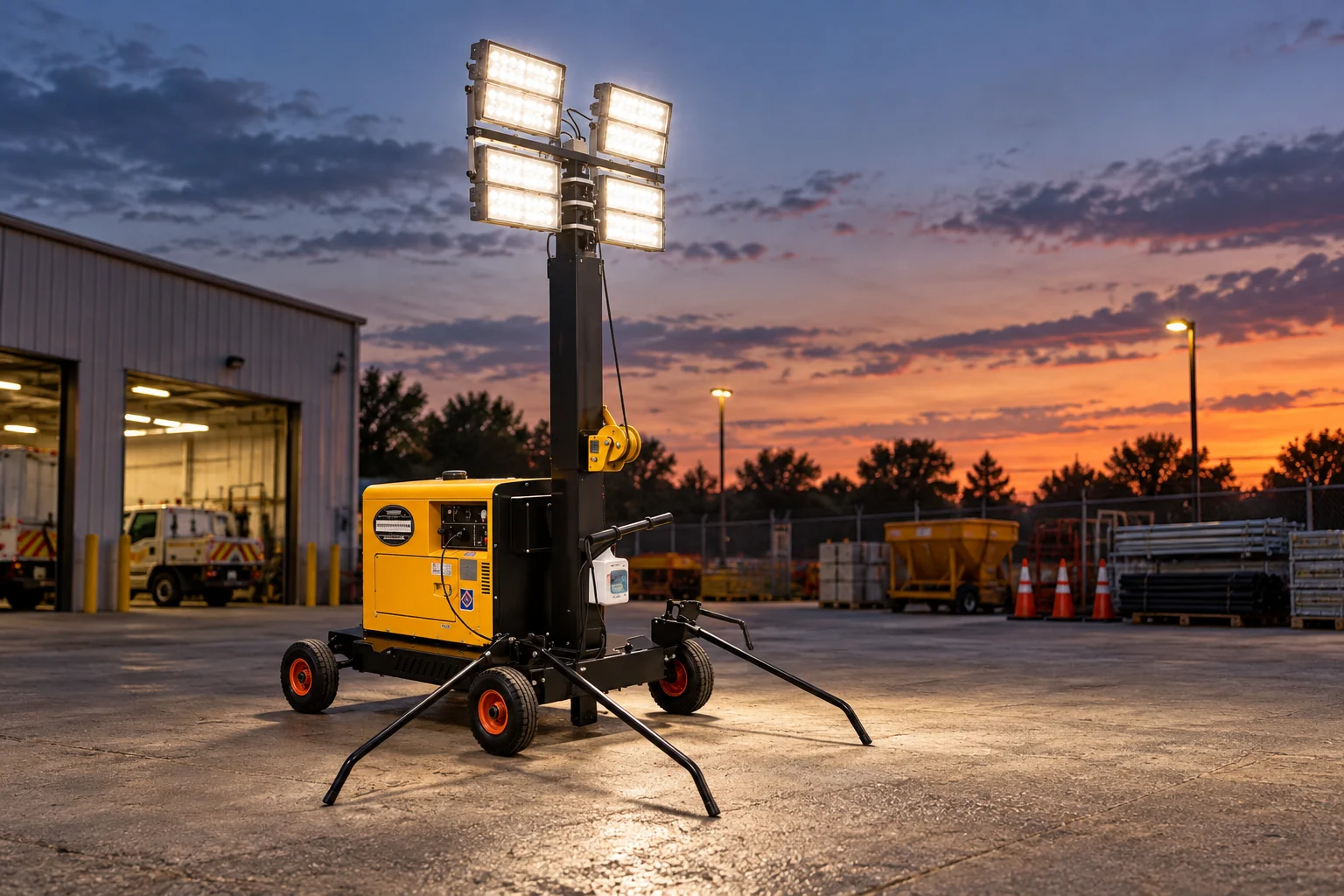
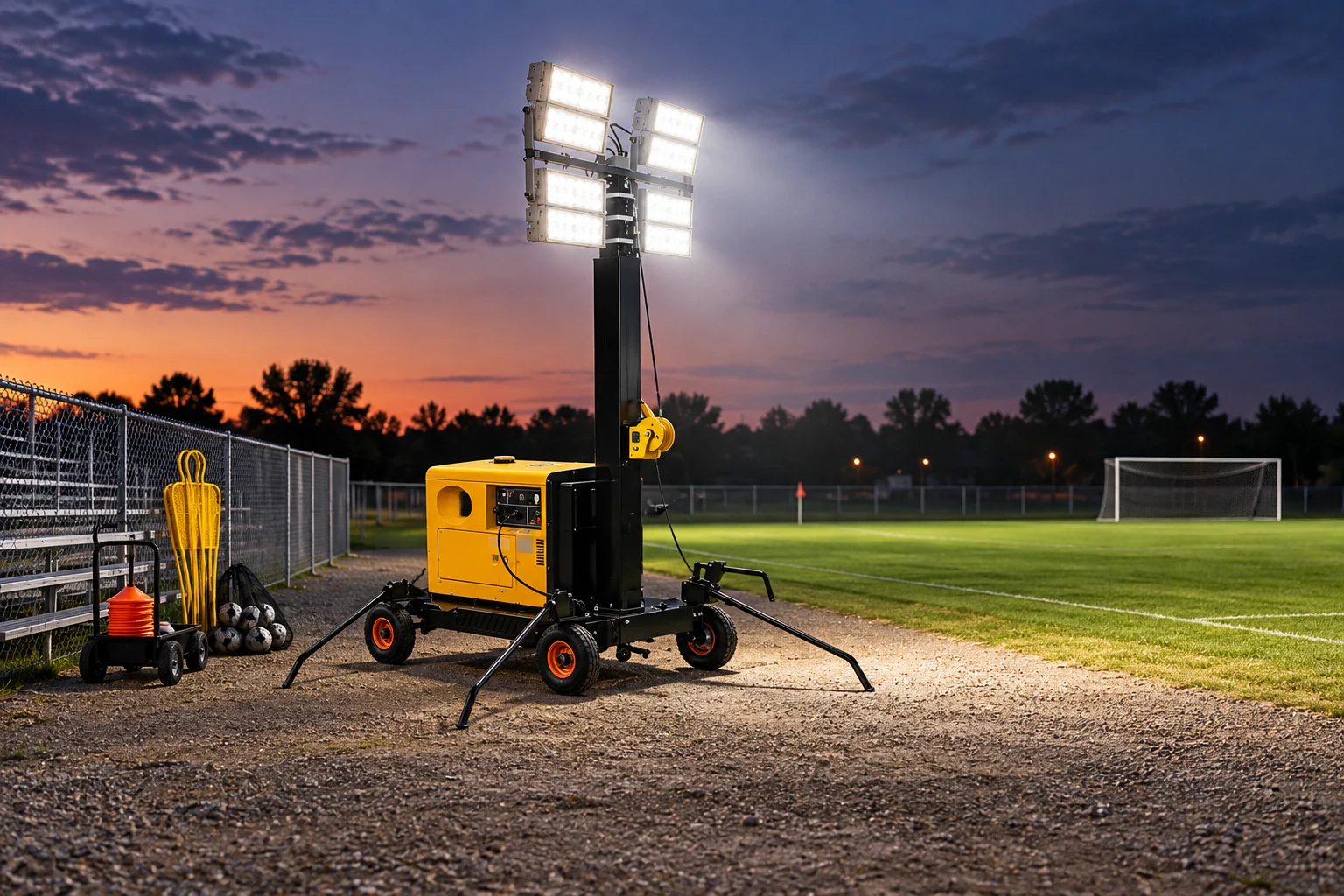
Multiple moderate positions often control shadows and uniformity better than one extremely bright location, but quantity must come from the layout. Arrange towers so players are not forced to look directly into intense sources during common lines of play. Consider goalkeepers, high balls, corner activity and movement in both directions. Check views from homes, roads and spectator areas.
Keep towers outside designated playing and run-off zones. Protect them from players, balls, maintenance vehicles and public access without creating new collision hazards. Maintain emergency routes. Account for the deployed footprint, stabilizers and mast fall zone—not only transport dimensions.
Control glare, spill light and sky glow
Glare is not solved by looking only at horizontal readings. Walk the likely viewing directions at player eye level and assess direct view of the luminaires against the night background. Poorly aimed high-output fixtures can reduce visibility by veiling contrast. Use suitable optics, careful aiming, shields where approved and only the output needed for the task.
Measure near property boundaries and road approaches when these are sensitive. The U.S. Department of Energy’s responsible outdoor-lighting guidance emphasizes eliminating unnecessary light, uplight and excessive output while controlling spectrum. Local permits or curfews may add stricter requirements.
Choose a power architecture around the session
Grid-fed portable systems avoid on-site combustion but need protected distribution and a verified supply. Battery towers can reduce local noise and exhaust, yet runtime depends on actual load, usable battery capacity, temperature, aging and charge state. Solar-assisted equipment requires a multi-day energy balance; a panel rating does not guarantee that a depleted battery will recover before the next session. Engine-driven towers support long duty cycles but add fuel, sound, emissions and maintenance.
Write a realistic operating profile: setup time, warm-up, full-output hours, dimmed periods, teardown, number of consecutive evenings and available charging window. Request runtime evidence at the proposed lighting mode. For battery planning, see the mobile solar light tower battery-capacity guide.
Setup, wind and electrical safety
A competent crew should inspect ground bearing, slope, drainage, overhead lines and weather before deployment. Level and stabilize the base according to the current manufacturer manual. Aim fixtures before raising the mast where practical. Establish an exclusion zone around moving mast sections and stabilizers. Never exceed documented wind limits or improvise ballast.
Route cables away from players, spectators and vehicles. Where crossings cannot be avoided, use an engineered protection method appropriate to the load and environment. Electrical equipment, connectors and distribution must be suitable for wet outdoor conditions and protected under applicable rules. Stop operation for instability, damaged cables, water ingress, abnormal sound, exhaust concerns or a lighting failure that compromises safe play.
Commission the layout on the real field
- Confirm towers, fixtures, optics, heights and aiming match the approved plan.
- Allow lamps and electronics to reach a stable operating condition.
- Measure every required grid point with a suitable, calibrated meter.
- Record average, minimum and uniformity using the agreed method.
- Walk player, goalkeeper, coach, spectator and road viewpoints for glare.
- Correct aiming methodically, then document final settings and readings.
Recheck after relocation, mast-height changes, fixture replacement, severe weather or a different training layout. Portable does not mean unrepeatable: numbered tower positions and saved aiming settings improve consistency.
Procurement information to send suppliers
- Scaled field and site drawing with north direction and sensitive boundaries
- Activity level, governing criteria and required measurement method
- Operating schedule, seasons, weather and noise restrictions
- Available power, towing limits, storage access and setup crew
- Required photometric files, manuals, compliance documents and training
- Acceptance measurement, defect correction and support expectations
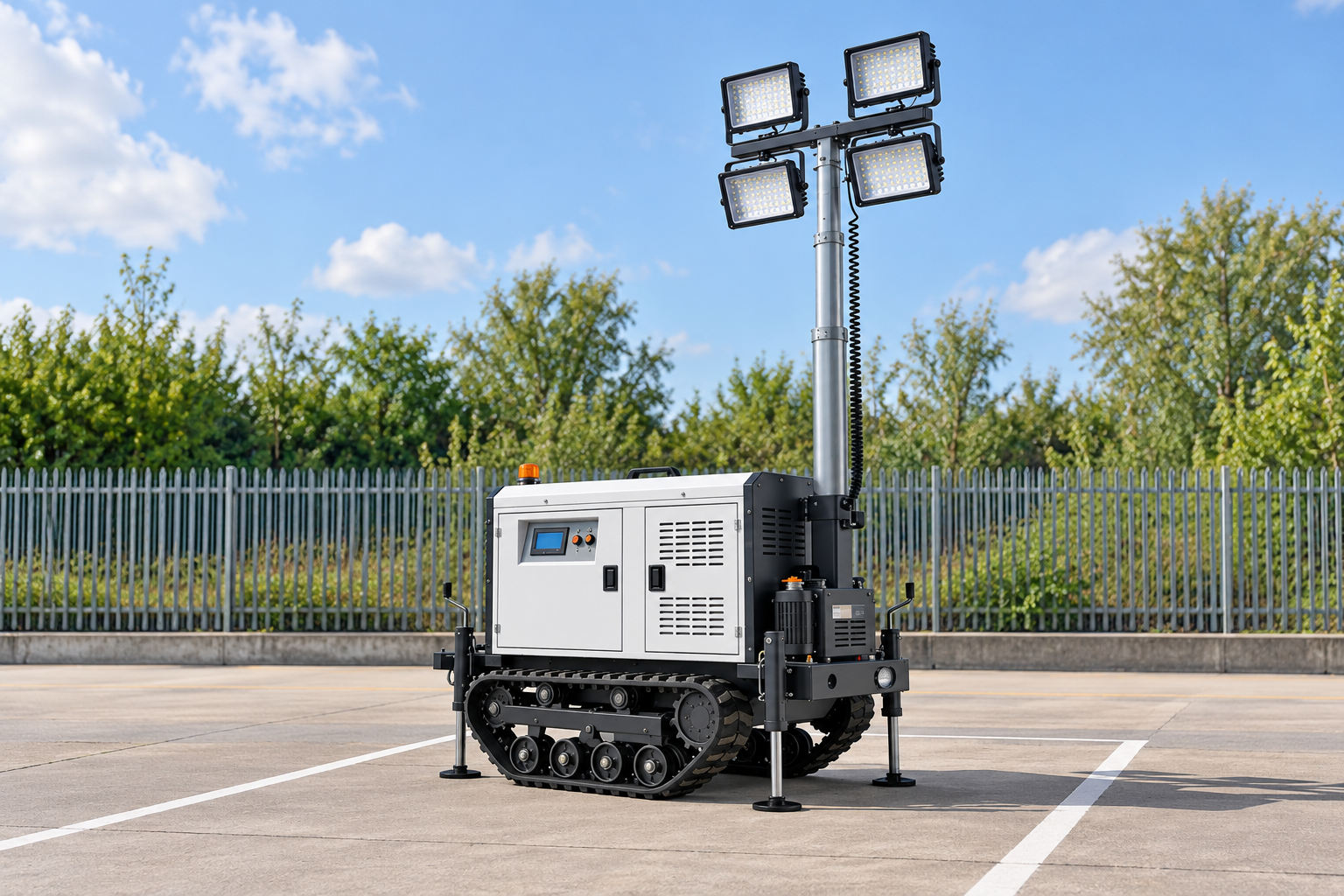
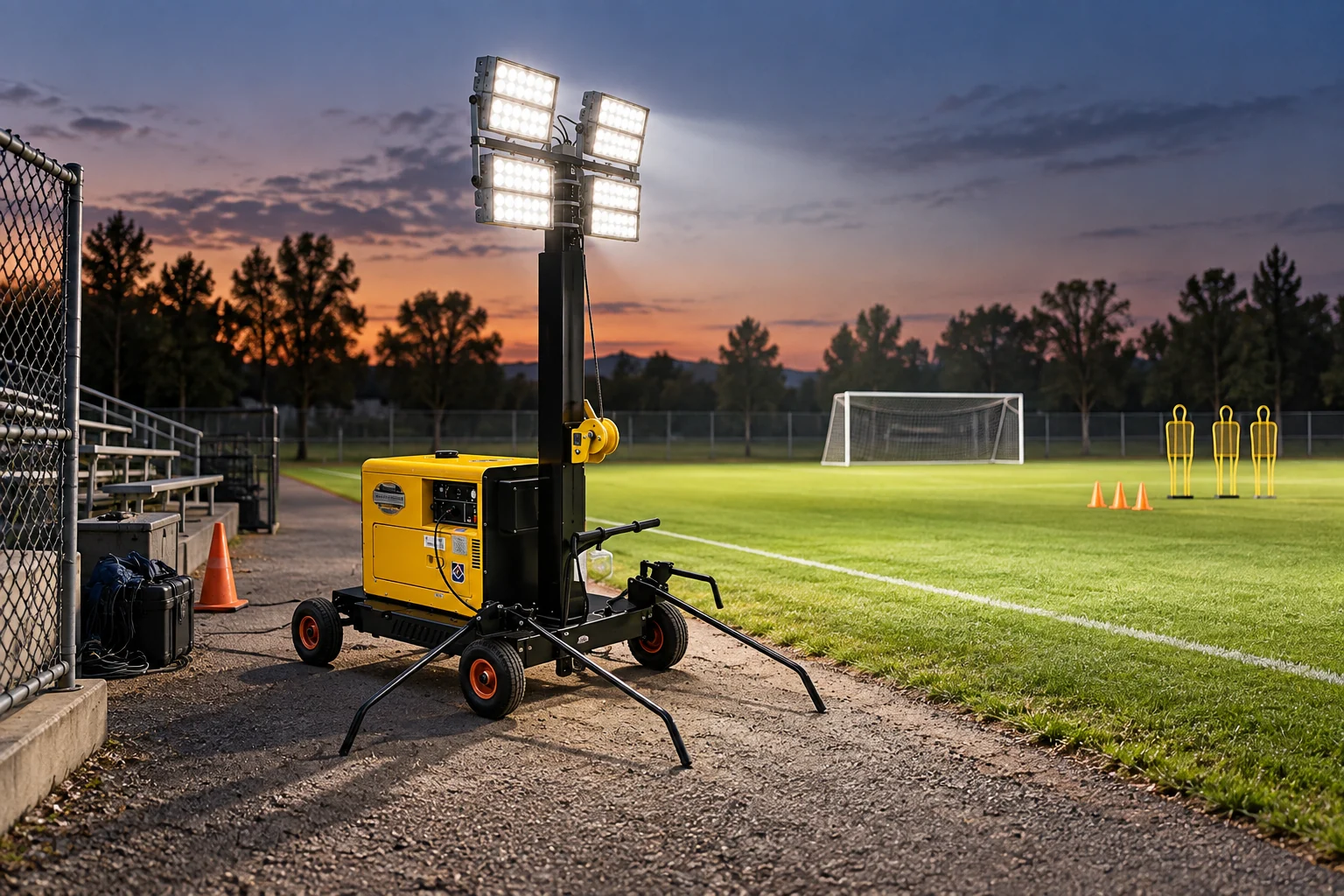
Keyyou’s mobile lifting lighting towers and trailer-style light towers can be compared against this project brief. Selection still depends on a configuration-specific layout and the site authority’s approval.
Related guides
- Portable tower light types and setup
- Sports-lighting project cost drivers
- Pre-use light tower inspection checklist
Authoritative references
- Illuminating Engineering Society sports and recreational lighting committee
- U.S. Department of Energy research on glare
- U.S. Department of Energy responsible outdoor-lighting principles
Video: understanding outdoor LED glare
This U.S. Department of Energy video explains why source position, luminance and the surrounding night background affect discomfort glare.

Frequently asked questions
How many portable lights does a football field need?
There is no reliable universal count. Field size, activity, optics, mast height, positions, aiming and required uniformity must be tested in a photometric layout.
Can portable lights be used for official matches?
Only if the governing body, venue owner and authorities accept the temporary design and verified performance for that competition level.
Are lumens enough to compare sports light towers?
No. Compare complete-fixture photometry, layout results, glare, uniformity, mounting height, power and operating conditions.
Where should portable towers be placed?
Outside playing and run-off areas, on stable ground, with safe clearances, protected access and aiming established by the approved site plan.
Plan for spectators, neighbors and changing field use
A temporary layout that works for a closed practice can fail when parents stand along a touchline, vehicles arrive behind a tower or another team rotates the drill direction. Include these foreseeable conditions in the site walk. Define where spectators may stand, how equipment is barricaded, where cables or refueling activities occur and who can stop play if a tower moves or a light fails.
Keep a simple setup record for each session: tower positions, mast heights, aiming references, start and stop times, weather, defects and corrective actions. Review complaints about glare or spill against the recorded layout instead of making random adjustments. When the field changes, repeat the relevant measurements. This turns portable lighting from an improvised arrangement into a controlled operating process.
Final takeaway
Portable lights can make an existing football field usable for evening training without permanent construction, but only a measured layout can show whether visibility is adequate. Define the activity and zones, design with complete photometric data, control glare and spill, deploy equipment safely, and accept the installation from field measurements rather than headline output.