
Light Tower Telematics: Fleet Data, Alerts, and Handover Checks
Evaluate light tower telematics using signal definitions, timestamps, communication gaps, alert ownership, access controls, exports, and fleet handover evidence.
Light tower telematics is the collection and delivery of equipment information to people who manage a lighting fleet. Depending on the installed and supported system, that information may include location, operating hours, fuel level, faults, or communication status. Start by defining the decisions the data must support, then verify each signal, its source, its timestamp, and the action assigned to it. Do not assume that a tower includes tracking, remote starting, or a cloud subscription because a similar model advertises those features. A useful system connects trustworthy information to a clear maintenance or dispatch decision.
Define the fleet problem before choosing a dashboard
List the questions that cause calls, delays, or unnecessary visits today. A dispatcher may need to find an idle asset, a maintenance planner may need an accurate service-hour reading, and a supervisor may need to know whether a remote unit has stopped reporting. These are different requirements. A location map alone will not explain why a lamp is off, and an engine-hour counter will not prove that the work area is adequately illuminated. Give every requested field an identified user and purpose.
Describe the decision in practical terms. For example, a maintenance planner may want a review list before the next shift rather than a continuous stream of raw readings. Ask how the team will respond when the information is absent or uncertain. If the answer is still a site visit, specify what data will make that visit better prepared. Avoid paying for fields that nobody uses while leaving the team without the timestamp or equipment identity needed to interpret the important ones.
Distinguish monitoring from remote control
A monitoring system reports information. A control system can issue commands that change operation. Some products combine them, but capability in one area does not prove capability in the other. Request an explicit statement of which commands, if any, are supported on the offered tower. Include local authorization, operating-mode restrictions, and the manufacturer’s conditions. A remote indicator that an engine is running is not evidence that somebody can safely start it from a phone.
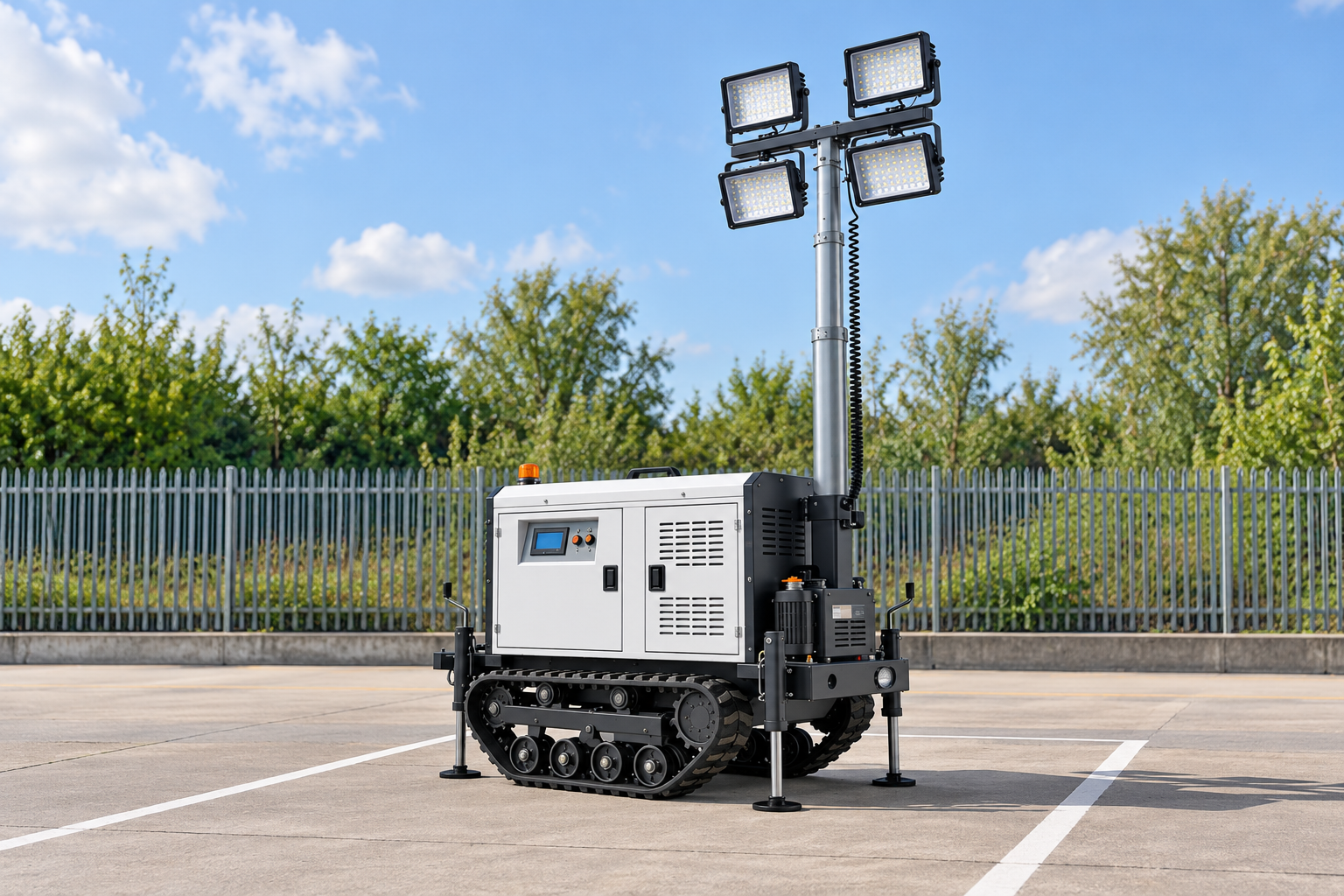
Keep the initial fleet data project within its approved scope. Adding a remote-start function later requires a separate equipment and site review, including how people near the machine are protected and how local procedures take priority. Do not improvise control wiring or bypass an interlock to make a dashboard demonstration work. The illustrated crawler tower represents the physical equipment category only. No connected hardware, remote command capability, subscription, or installed sensor is claimed by the illustration.
Create a data dictionary for each supported signal
For each field, record the source, unit, meaning, update behavior, and known limitations. Engine hours, lamp hours, and powered-on controller hours may count different events. If maintenance depends on engine hours, substituting the wrong counter can move a service decision. Ask how the counter behaves after a controller replacement or a reset. Keep the source field alongside any derived total so that a maintenance planner can investigate a surprising value.
Fuel information also needs context. A reported percentage may depend on the sensor, tank geometry, equipment position, and filtering. Ask the supplier how the value should be interpreted and which conditions affect it. Do not convert an undocumented percentage into an exact remaining-runtime promise. For battery-powered equipment, distinguish a reported state of charge from verified usable energy for the planned shift. The data dictionary should expose these limits so the interface does not turn an estimate into a fact.
Choose information that leads to an action
| Information | Useful decision | Acceptance question |
|---|---|---|
| Asset identity and location | Dispatch the correct unit and plan access | Does the record identify this asset rather than a nearby gateway? |
| Relevant operating-hour counter | Review service needs | Does its counting rule match the required maintenance basis? |
| Fuel or battery indication | Plan inspection or replenishment | What measurement, estimate, and operating conditions underlie the value? |
| Fault event with timestamp | Prepare a qualified technician’s response | Is the event current, cleared, repeated, or merely historical? |
| Last successful communication | Recognize stale information | Does the interface clearly distinguish offline from healthy operation? |
| User and change records | Trace configuration decisions | Can authorized staff see who changed an alert or permission? |
This table is an original qualitative planning tool. It defines questions to resolve with the supplier, not features present on every tower. Security guidance from NIST supports the separate discussion of connected-device risk below; it does not certify the offered equipment or validate individual telemetry readings.
Treat a timestamp as part of the reading
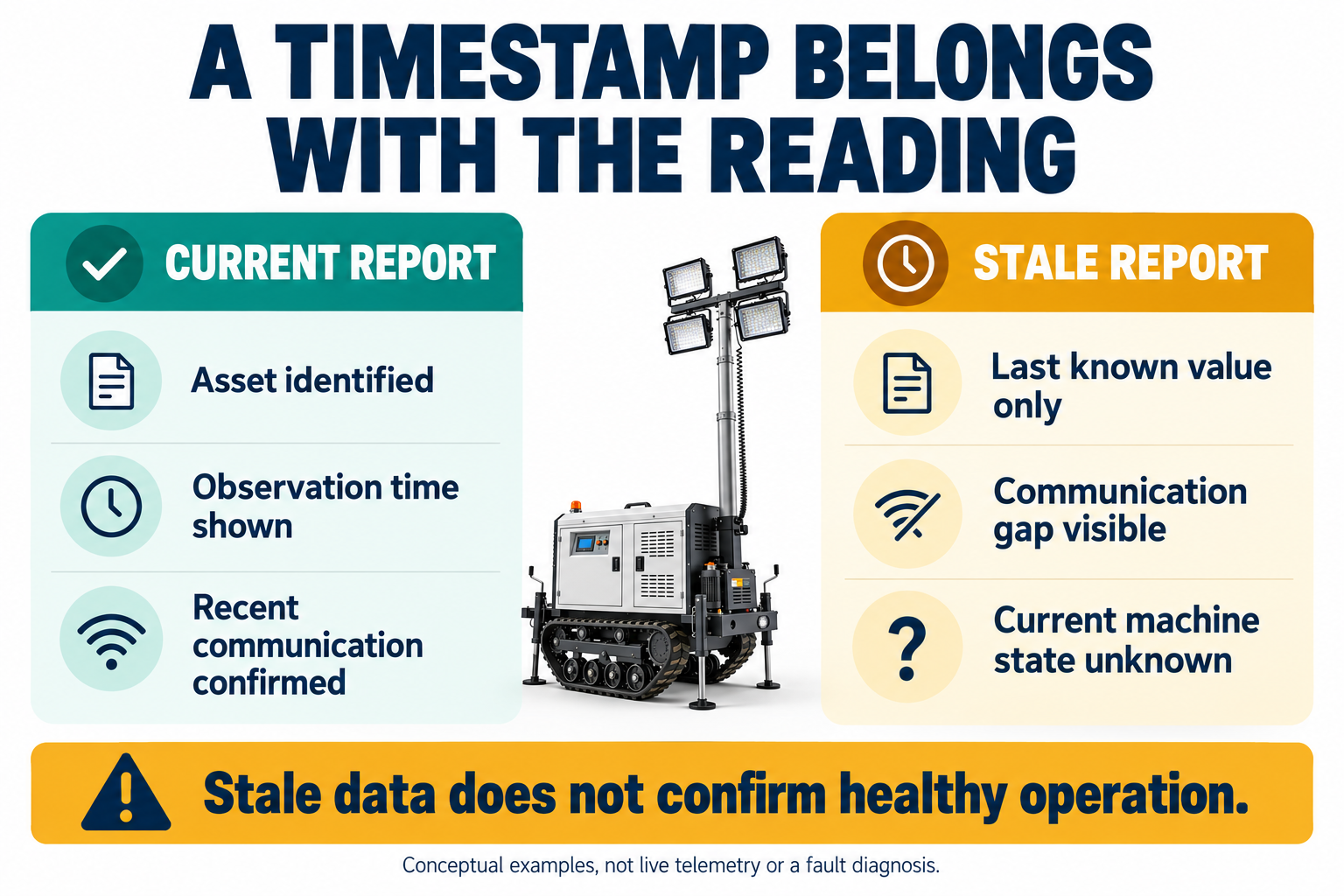
Diagram explained: A current report identifies the asset, shows when it was observed, and confirms recent communication. A stale report contains only last-known information and a visible communication gap; the present machine state remains unknown. Old data do not confirm healthy operation.
A value without its time can mislead a fleet team. Show when the equipment observed an event, when the platform received it, and which time zone the operator is viewing where those distinctions matter. A delayed message should not appear to describe the machine’s present state. If the device clock can drift or reset, ask how that condition is detected. The dashboard should communicate uncertainty clearly enough for an operator to avoid acting on an old snapshot.
Agree how queued records behave after a network outage. The device may store some information for later transmission, or it may lose the interval entirely. Neither behavior should be guessed from a general statement such as real-time tracking. Test a permitted communication interruption with the supplier’s approved method and inspect the recovered history. Record whether the gap is visible, whether events retain their original times, and whether duplicate messages appear. Keep this test distinct from testing the tower’s lighting performance.
Build alerts around responsibility and response
An alert is useful when someone owns the decision it prompts. Define the condition, recipient, working hours, acknowledgement rule, escalation route, and closure record. A low-fuel advisory may belong to a logistics planner, while an equipment fault may need a qualified technician. Do not send every message to every person and assume the fleet is now managed. Excessive notifications can obscure the event that requires attention before a remote shift starts.
Separate an abnormal measurement from missing communication. If the unit stops reporting, the system may not know whether it is running, parked, disconnected, or outside coverage. Display that uncertainty instead of showing the last healthy state indefinitely. Agree when a manual confirmation is required. For remote sites, a dispatch plan may need an independent communication route. Telemetry can improve situational awareness, but it cannot guarantee that a local worker has seen an alert or that lighting remains suitable for the task.
Review connectivity and power demand at the actual site
Ask which network technologies, service arrangements, and geographic coverage apply to the offered package. Verify the intended deployment region rather than assuming that a demonstration near the supplier’s office represents a mine, rural road, or screened industrial yard. Clarify roaming, subscription renewal, account ownership, and any dependence on a particular platform. An otherwise functional tower may remain fully usable locally while a disconnected data service provides no current fleet information.
Include the connected equipment in the approved power and installation review. A monitoring accessory may have its own supply requirements, protective arrangements, and effect on standby demand. Obtain the manufacturer’s installation instructions and identify who is authorized to install it. Do not attach an improvised antenna or gateway to a moving mast. Keep cable routing and external mounting within the equipment’s approved configuration. A purchasing checklist should include the physical installation, not merely access to a web account.
Protect access and plan the connected-device lifecycle
NIST’s operational-technology and IoT guidance provides a framework for identifying connected-system risks and managing access over time. Apply that framework with the equipment supplier and the organisation responsible for the fleet network. Establish who creates users, changes permissions, handles updates, reviews records, and removes access when a person leaves. Avoid shared credentials where individual accountability is required. The specific safeguards should follow the system’s capabilities and the organisation’s assessed risk.
Ask how updates are delivered and supported, how an unsuccessful update is handled, and what happens when the service reaches end of support. Document the contact and recovery procedure before a remote deployment. Keep operational continuity in view: a security change should be reviewed for its effect on monitoring and approved local operation. This guide is a procurement and acceptance framework, not a complete cybersecurity design. Have the relevant specialists evaluate the actual device, platform, network, and command capability.
Test the evidence chain during handover
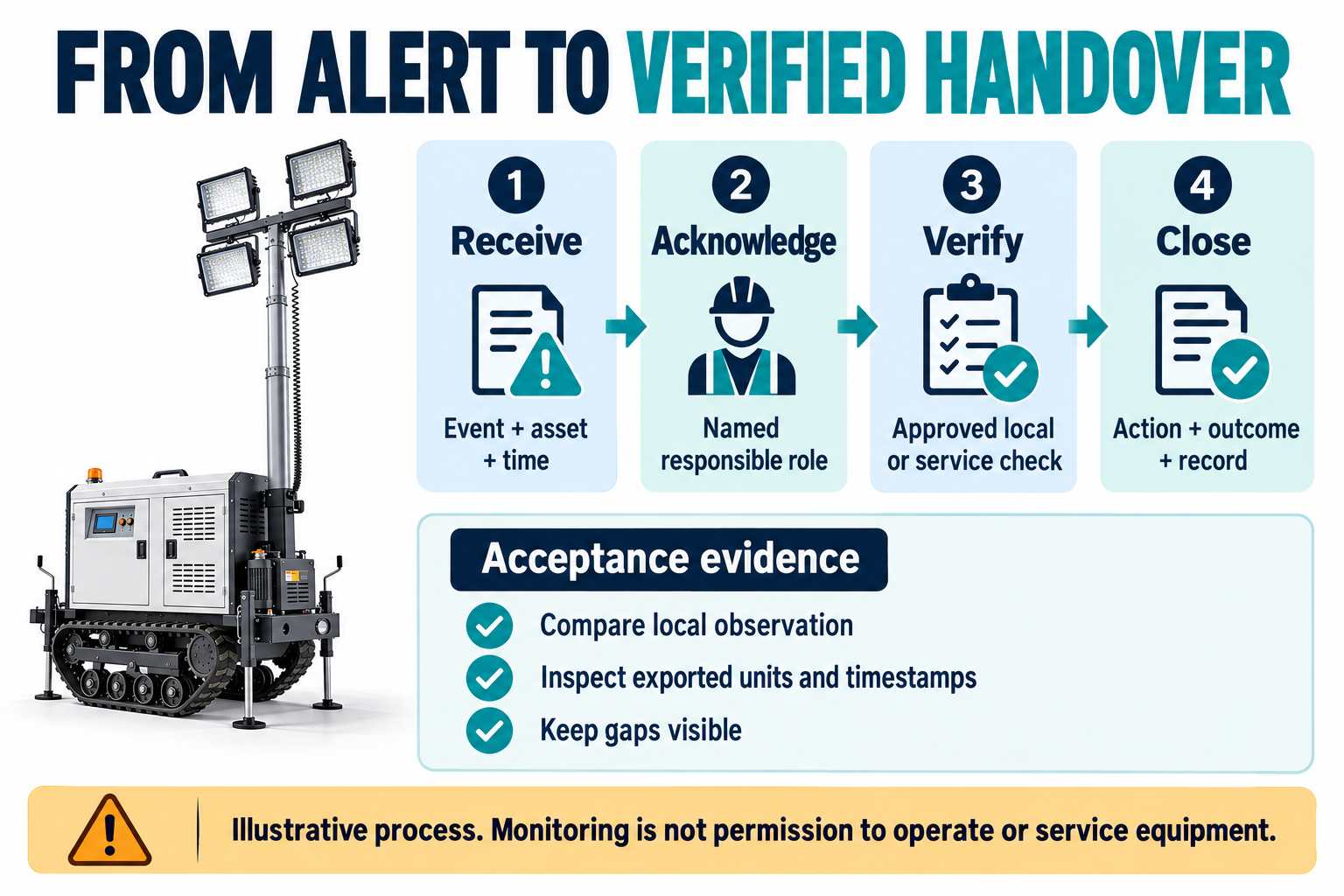
Diagram explained: Receive the event with asset and time, assign acknowledgement to a named role, verify it through the approved local or service process, then record the action and outcome. Compare local observations, inspect export units and timestamps, and preserve visible gaps. Monitoring does not authorize operation or servicing.
Use one identified asset for a controlled acceptance exercise. Confirm its serial or asset number in the platform, compare the reported fields with the manufacturer’s permitted local observations, and record the differences. Demonstrate the agreed alert and its acknowledgement using a safe approved method. Do not create a genuine hazardous fault or run equipment outside its limits merely to test a notification. A supplier may provide a simulation or test facility that demonstrates the messaging path without that risk.
Check the export as well as the dashboard. Verify that the exported record includes the asset identifier, units, timestamps, event meaning, and communication gaps needed by the fleet team. Review what a replacement controller or gateway does to historical continuity. A display that looks correct on the day of delivery may still be difficult to audit months later. Keep the acceptance record with the equipment configuration, subscription details, user responsibilities, and support information so the next team can repeat the essential checks.
Evaluate fleet value using records from real use
After deployment, compare the system with the decisions it was purchased to support. Review whether dispatchers can locate assets, maintenance staff can trust the relevant counters, and service visits arrive with useful fault information. Record the cases in which data were stale, ambiguous, or unavailable. Those observations can improve alert rules, training, and connectivity arrangements. Avoid claiming reduced downtime or cost savings from the mere presence of a connected dashboard.
If the business case uses monetary savings, state the baseline, comparison period, operating differences, and evidence for each avoided activity. Separate a prevented unnecessary visit from a visit that was only rescheduled. Keep lighting performance and machine availability as their own measures. The strongest inquiry therefore asks for a documented data service with clear limits and a repeatable handover test. It does not ask suppliers to promise every fleet benefit from an unspecified tracking accessory or a generic remote-monitoring label.
Equipment and complementary planning
Confirm the offered configuration on the Keyyou product page. Use the mobile light tower guide for the wider equipment framework. Complement this assessment with light tower maintenance and light tower lighting controls.
Further learning: security of connected equipment
NIST presents an educational discussion of connected-device cybersecurity. It supports the access and lifecycle review of a telemetry service, not a claim that the illustrated tower includes connectivity or that NIST approves a product.
Watch What is the Internet of Things (IoT) and how can we secure it?.
Frequently asked questions
Does a telematics dashboard mean that remote start is supported?
No. Monitoring and control are different capabilities. Obtain a separate statement of supported commands, operating permissions, and manufacturer conditions for the exact configuration.
What should the interface show when communication is lost?
It should make the age and uncertainty of the available information clear. Agree on stale-data indication, escalation, and any required local confirmation with the supplier and fleet team.
Can location and runtime data alone prove fuel savings?
No. A savings claim requires an explicit baseline, comparable operating conditions, and evidence of the activities or costs actually avoided.
Sources and scope
The linked official resources provide educational background and relevant safety or connected-system context. They do not certify this machine, define its configuration, or replace the supplier documentation and the applicable site assessment.