
What does low-sunlight planning actually decide?
Solar light tower low sunlight performance depends on the energy available at the site, the lighting schedule, and the reserve built into the selected configuration. A team should survey shade and soiling risks, define the night-time load, and confirm the battery and alternate-charging options before it treats a solar unit as an all-night solution.
This guide is for temporary job sites that need an evidence-based planning process rather than a generic runtime promise. For a broader seasonal context, see the site’s winter operation guidance for solar LED light towers.
Part 1. What does low-sunlight planning actually decide?
Low-sunlight planning decides whether the expected solar harvest can support the required lighting period with an acceptable operating reserve. It does not prove that every solar light tower will deliver the same result at every site.
Partial shade is an engineering input, not a small cosmetic issue. The NREL PV Shading Database exists because shading patterns, array layout, and electrical configuration change photovoltaic output in ways that must be evaluated rather than guessed.
For a job site, the practical decision is simple: document the expected conditions before mobilization, then choose a configuration whose published specifications can be checked against those conditions. A suitable plan also records what the team will do if the energy balance becomes negative over several low-sunlight days.
Important: Do not replace a site survey with a catalogue runtime figure. The DOE PV O&M guide treats shade, controller settings, battery condition, and monitoring as operating variables.
Part 2. Which site conditions reduce solar harvest?
Available sunlight changes with season, cloud cover, orientation, temporary obstructions, and the time the equipment arrives on site. A tower placed beside a container, scaffold, tree line, or stockpile can experience a different daily solar profile from the open area shown in a preliminary layout.
Dust, leaves, bird debris, and snow deserve the same attention because they reduce the light reaching the module surface. The IEA PVPS soiling report identifies soiling and snow as yield risks that require site-specific mitigation rather than one universal cleaning rule.
Panel direction and tilt also belong in the deployment check. Atlas Copco’s solar light-tower explainer describes orientation and tilt as significant inputs to solar yield; operators should follow the selected unit’s instructions rather than force a generic setting.
| Site condition | What to inspect | Planning response |
|---|---|---|
| New shade during the day | Containers, cranes, trees, berms, or structures | Record the obstruction window and move the unit if its instructions allow. |
| Persistent dust or debris | Panel surface and nearby dust-generating work | Add inspection and cleaning triggers to the operating plan. |
| Shorter seasonal daylight | Local solar-resource data and operating calendar | Re-check the load and reserve assumptions for that period. |
| Repeated overcast periods | Local weather history and required night hours | Define the allowed reserve draw and fallback decision before deployment. |
Part 3. What should the site survey record before deployment?
Start with the site, not the product label. A short written survey gives the equipment team and supplier the inputs needed to discuss a configuration without inventing a runtime.
Record the energy and exposure inputs
- Location and planned deployment dates.
- Intended lighting hours per night and the number of consecutive operating nights.
- Required lighting areas and any periods when dimming or reduced output would be acceptable.
- Obstructions visible at setup and obstructions expected later in the project.
- Dust, snow, mud, or access conditions that affect panel inspection.
- Whether an alternate charging source is available and any restrictions on its use.
The DOE guidance on PV performance and longevity recommends documenting nominal conditions and using monitoring and diagnostics to identify deviations. For a mobile lighting project, the same principle means preserving the site survey with the operating log.
Check the deployment location physically
A map alone cannot show a new crane, parked plant, or spoil pile that casts a long afternoon shadow. Walk the planned position, identify likely shade paths, and confirm safe access for cleaning and inspections before the mast is raised.
Use a one-page pre-mobilization worksheet
Record the survey in one worksheet that the site team can hand to the supplier and keep with the shift log:
| Worksheet field | What to write down | Why it belongs in the record |
|---|---|---|
| Planned tower position | Mark the intended parking point and safe access route | A drawing makes later changes in layout visible. |
| Shade-path walk | List the time window and source for each likely obstruction | A container, crane, stockpile, or tree line can change exposure during the day. |
| Project dates and weather window | Record the deployment period and expected seasonal conditions | Day length and weather context are inputs, not universal runtime evidence. |
| Night lighting schedule | Note light-on/light-off time, priority zones, and any reducible period | The supplier needs the actual operating pattern rather than “all night.” |
| Panel access and soiling risk | Identify dust-producing work, debris risk, and safe inspection access | The operating team can define condition-based inspection triggers. |
| Reserve and fallback rule | State who decides a reduced schedule and what approved contingency exists | The project avoids an improvised response after a low-energy event. |
For a shift-by-shift follow-up after the survey, use the night-shift operating plan for solar light towers. It turns these site inputs into a normal, reserve, and fallback record without claiming a universal runtime.
| Survey record | Why it changes the decision | Owner |
|---|---|---|
| Daily lighting window | Defines the energy demand to be supported | Site manager |
| Shade and obstruction notes | Identifies avoidable loss of solar exposure | Deployment crew |
| Soiling risk and access | Determines inspection and cleaning triggers | Site team |
| Reserve and fallback requirement | Prevents an unplanned loss of light | Procurement and operations |
Part 4. How do shade, dirt, and snow change the operating plan?
Shade and surface contamination reduce the solar energy arriving at the system, so they should trigger an operating response rather than an assumption that the next day will recover the battery. The selected equipment manual remains the authority for safe cleaning, movement, and electrical work.
The International Electrotechnical Commission’s IEC 62446-2 overview includes maintenance concepts such as module cleaning and vegetation upkeep to support expected performance. Its scope is grid-connected PV systems, but the principle is still useful here: inspect the actual energy-collection surface and correct avoidable obstruction.
Use condition-based checks instead of copying a calendar interval from another project:
- Inspect the array after dust-producing work, snowfall, storms, or a visible output change.
- Remove only the contamination that the manufacturer’s instructions say can be removed safely.
- Record the condition, action, and subsequent energy or voltage observation.
- Escalate damaged glass, loose wiring, abnormal warnings, or repeated low-charge events to qualified service personnel.
This approach also prevents a common mistake: treating a clean-looking panel as proof that the entire site has adequate solar resource. Clean panels improve collection, but they do not create sunlight or remove a long shade period.
Part 5. How should teams match lighting demand to stored energy?
The planning calculation begins with demand: which lights will operate, at what setting, and for how long. Then the team compares that demand with the selected configuration’s approved battery, charge-control, and solar-input specifications under the local site conditions.
Do not use a published battery size from another model, an online calculation, or a forum example as a commitment for a Keyyou unit. The useful question is whether the supplier can document the selected configuration’s usable energy, charging pathway, and operating limits for the stated site survey.
| Decision question | Evidence to request | Risk if skipped |
|---|---|---|
| What is the required nightly lighting schedule? | Shift plan and lighting-area priority | The real load is unknown. |
| What reserve is needed for low-sunlight days? | Project risk decision and approved configuration data | The team has no agreed fallback point. |
| Can non-critical lighting be reduced? | Operating procedure and lighting requirement | Demand cannot be managed during a deficit. |
| Is alternate charging acceptable? | Site power and operating constraints | A fallback may be unavailable when needed. |
The result should be a documented operating boundary: normal operation, a reserve-warning point, and a stop-or-fallback point. That boundary is more useful to a site team than an unsupported claim that a solar tower will always run through every weather pattern.
Part 6. Which configuration questions belong in the RFQ?
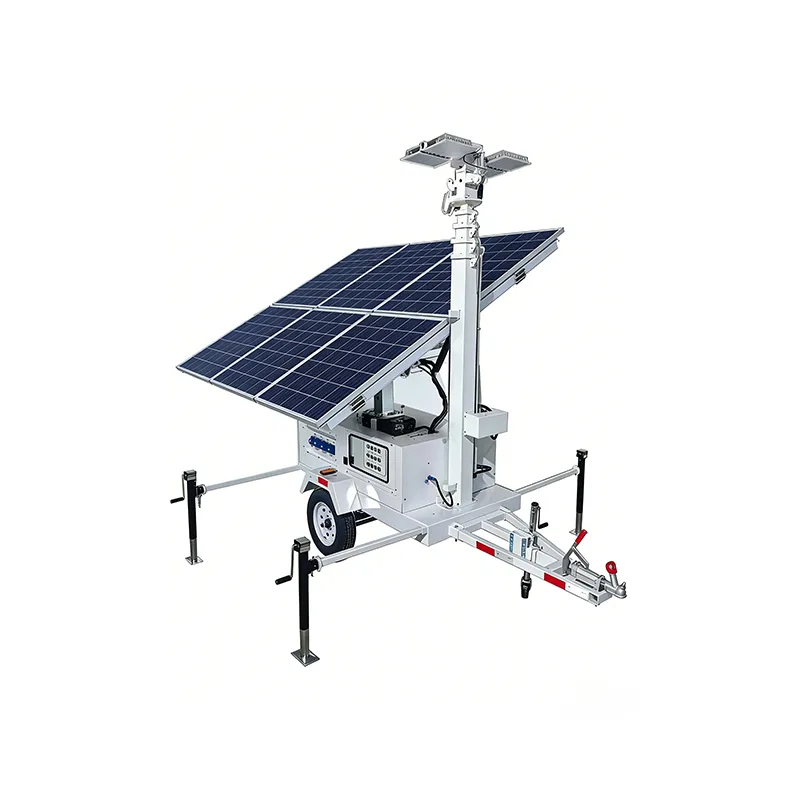
For projects with limited sunlight, an RFQ should ask for configuration evidence rather than only a headline product description. The listed Trailer Model Solar-Powered Mobile Lifting Light Tower describes solar panels, lithium battery storage, smart control, and optional wind input; confirm the exact supplied configuration and its documents before treating any of those features as a project solution.
Buyer should provide
| Buyer input | Why it matters | Common mistake |
|---|---|---|
| Location and project dates | Solar resource and daylight vary by place and season | Naming only the country or saying “winter.” |
| Required lighted hours | Defines the intended demand | Assuming every night has the same operating window. |
| Site shade and dust notes | Identifies avoidable collection losses | Looking only at the setup-day layout. |
| Consecutive low-sunlight tolerance | Defines the reserve and fallback requirement | Leaving reserve expectations unstated. |
| Alternate charging constraints | Tests whether the fallback is practical | Asking about backup after the unit arrives. |
Product recommendation: begin the discussion with the listed trailer solar light-tower configuration only if the supplier can match its approved documents to the recorded site inputs. It is less suitable when the project needs a guaranteed output or runtime that the available model evidence does not support.
Fit Boundary
This planning method is suitable for teams that can survey the location, define their lighting schedule, and accept a documented reserve/fallback process. It is not sufficient for a project that requires an unverified all-weather runtime, has no practical way to inspect the unit, or cannot tolerate an energy shortfall without a separately verified contingency.
Part 7. What should operators monitor after deployment?
After deployment, compare actual behavior with the plan rather than waiting for a complete loss of light. IEC’s PV performance-monitoring overview recognizes monitoring and analysis as core parts of PV performance management.
Keep a concise log of panel condition, visible shade, battery or controller alerts available on the selected unit, operating hours, and any alternate-charging use. The record makes it possible to separate a temporary weather event from a recurring layout, cleaning, wiring, or configuration problem.
Contact qualified service support when there is damaged equipment, exposed or loose electrical wiring, repeated unexplained low-charge warnings, or a condition that the unit manual identifies as unsafe. A site team should not improvise electrical repairs or adjust components outside the manufacturer’s instructions.
To discuss a configuration against a real project, send the site data for configuration review: location, dates, nightly operating hours, lighting priorities, shade/soiling notes, and alternate-charging constraints. You can also review solar and hybrid mobile-lighting options after those inputs are defined.
FAQs
Why does a solar light tower sometimes run for only a short time?
The available stored energy may be lower than the required lighting demand because the site received less usable solar energy, the load was higher than planned, or both. Check the recorded exposure, panel condition, operating hours, and unit alerts before assuming a component failure.
What site data is needed before selecting a solar light tower?
Provide location, project dates, intended lighting hours, lighting priorities, likely shade, soiling access, and the required reserve or fallback process. The supplier then needs to match those inputs to the selected configuration’s approved documentation.
Do clouds stop a solar light tower from charging?
Cloud cover changes the available solar resource; it does not justify a universal runtime claim. Plan for local conditions and consecutive low-sunlight periods instead of assuming a clear-day energy balance.
Does localized shade matter for a solar light tower?
Yes. Localized shade changes photovoltaic performance and should be identified during the site survey. Move or re-orient the unit only when the manufacturer’s instructions and the site’s safety controls allow it.
Is a larger battery reserve enough for low-sunlight sites?
A reserve can be part of the solution, but it must be evaluated together with solar input, load, the number of low-sunlight days to cover, and the selected configuration’s approved limits. Reserve alone cannot correct persistent shade or an undefined lighting schedule.
When should a project consider alternate charging or a hybrid option?
Consider it when the documented site conditions and operating requirement show that solar collection alone may not meet the agreed reserve boundary. Confirm the exact configuration and permitted charging method with the supplier.
What should the site team log after deployment?
Log visible shade, panel condition, operating hours, charge-related alerts, and any alternate-charging use. Those records support an evidence-based escalation if performance differs from the plan.