
Solar Lighting for Military Bases: Resilience and Procurement Guide
Plan solar lighting for military bases by mission, location, energy balance, autonomy, controls, environmental exposure, cybersecurity, logistics, and acceptance testing.
Solar lighting for military bases should be planned as mission-support infrastructure, not purchased as a generic “off-grid” fixture. Define the area and operational consequence of darkness, then size light distribution, battery autonomy and solar recharge for the specific climate and duty cycle. Separate fixed roads and perimeters from rapidly deployable work zones. Require configuration-specific photometry, energy calculations, environmental evidence, control and cybersecurity review, maintainability, spare parts and field acceptance testing. Solar can reduce trenching and support resilience, but it does not remove engineering, security or lifecycle obligations.
Define the mission and consequence of failure
Begin with what people must see and do: pedestrian movement, vehicle circulation, maintenance, access control, staging, parking, temporary construction or emergency response. Identify the hours, seasons, occupancy, blackout tolerance and recovery time. A low-consequence pathway and a critical gate should not share the same autonomy or redundancy assumptions.
Record who owns the requirement, who approves security and electrical interfaces, and which documents control. Avoid publishing sensitive layouts or operational details in ordinary procurement files. This article discusses general planning only; site security, force-protection criteria and classified or controlled information remain with authorized personnel.

Choose fixed, mobile or hybrid architecture
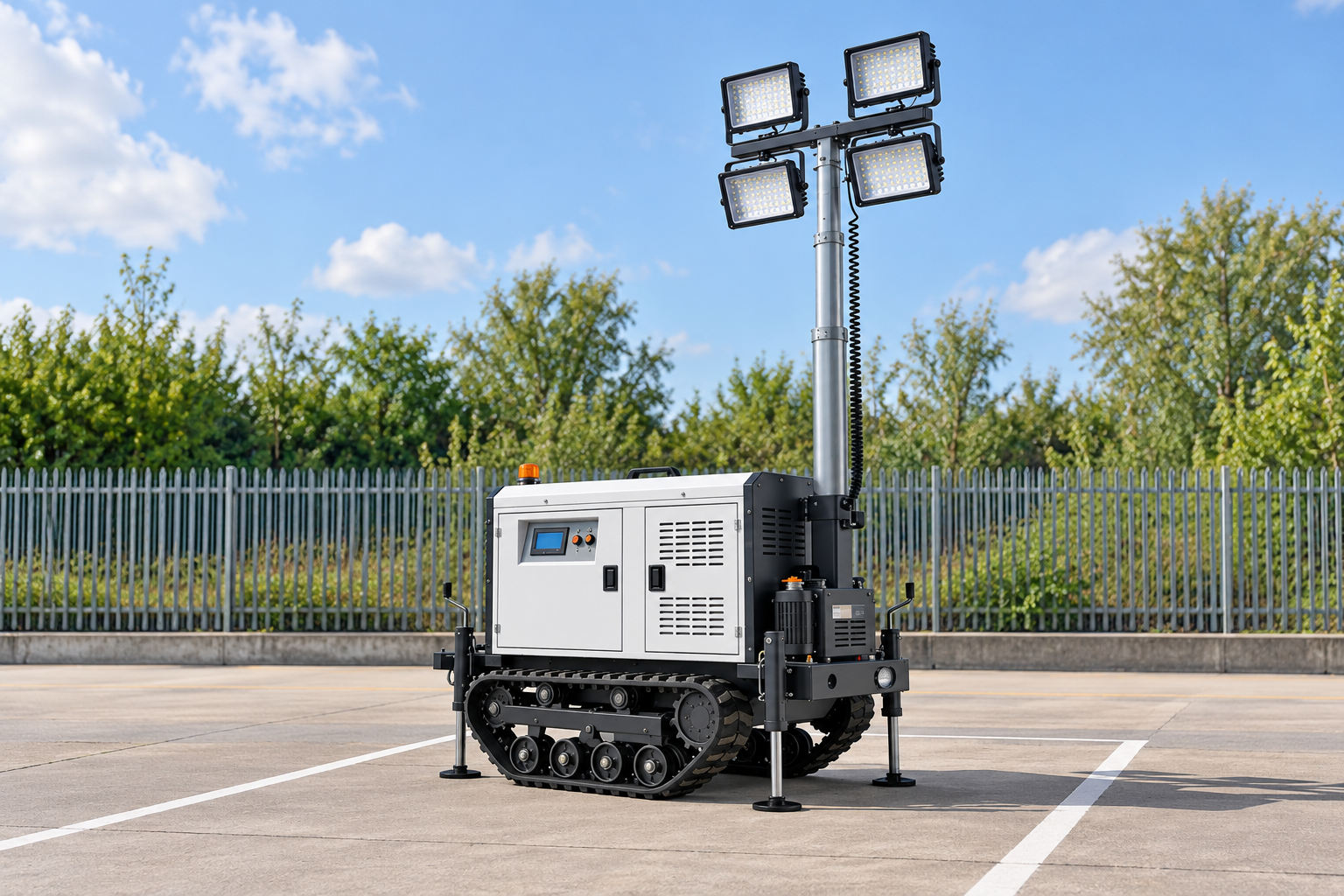
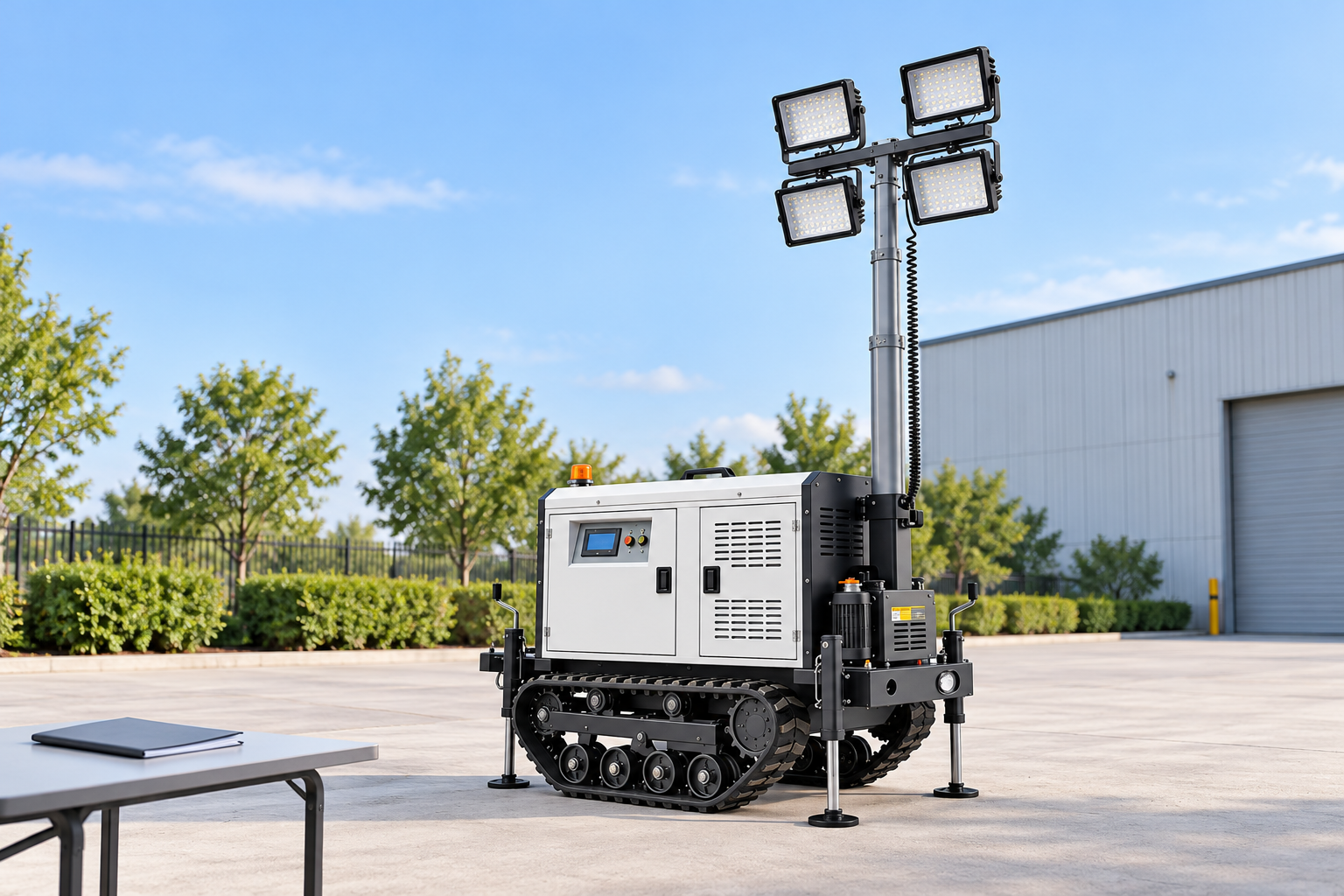
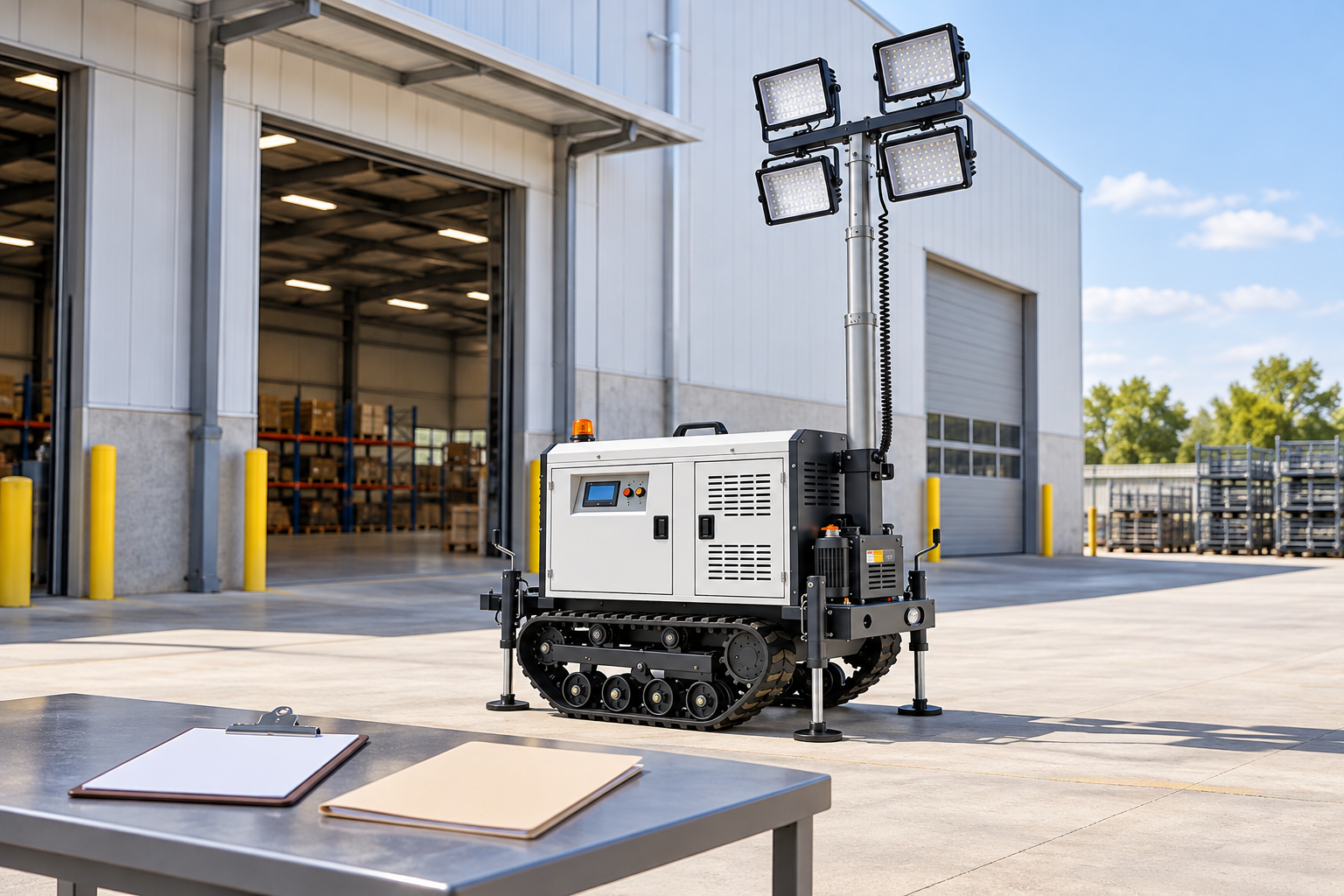
Fixed stand-alone solar poles may suit roads, parking and paths where trenching is difficult. Mobile solar light towers support changing work zones, temporary compounds and maintenance. Trailer or tracked mobility should be selected from terrain, towing, storage and deployment frequency. Hybrid systems can combine solar and batteries with grid or engine backup when the consequence of depleted storage is unacceptable.
Do not mix these architectures in one headline comparison. A fixed pole has different structural, foundation and maintenance needs from a towable tower. A tracked unit may reach rough areas but introduces transport and undercarriage service. Write the operational need first, then evaluate which architecture creates the lowest total mission risk.
Solar base-lighting procurement table
| Decision area | Required project input | Supplier evidence |
|---|---|---|
| Lighting task | Zones, hours, users and failure consequence | Photometric layout and aiming/placement plan |
| Energy | Hourly load, autonomy and climate data | Monthly energy balance with stated losses |
| Environment | Temperature, wind, dust, corrosion and flooding | Configuration-specific ratings and test basis |
| Controls | Operating modes, local/remote access and alerts | Control narrative, permissions and update policy |
| Logistics | Transport, setup, spares and technician access | Manuals, parts list, training and response plan |
| Acceptance | Lighting and runtime success criteria | Factory and site test procedures |
Build a monthly energy balance
Calculate the load from complete luminaires, drivers, controls, communications, heaters, cooling and conversion equipment. Multiply each load by its operating hours and mode. Compare that daily demand with usable battery energy and the solar energy expected under a conservative monthly design condition. Include module orientation, temperature, shading, soiling, wiring, controller and battery losses.
Annual-average sun hours can hide the most difficult season. Use the relevant weather dataset and evaluate consecutive poor-solar days. State whether the system may dim, shorten operating hours, accept backup charging or must sustain full service. The battery-capacity sizing guide explains nominal versus usable kilowatt-hours and autonomy assumptions.
Do not confuse power, energy and autonomy
Energy in kilowatt-hours determines how long a load can operate. Power in kilowatts determines whether the battery and inverter can supply the instantaneous demand. Both must pass. Autonomy describes how long the planned load can run without useful solar input, but its meaning must state the allowed depth of discharge, losses, temperature and end-of-life capacity.
Require a calculation file or clear worksheet rather than an unexplained runtime claim. Test alternate modes, battery aging and low-temperature behavior. If communications or heaters remain active during the day, include them. If a backup generator is proposed, define start logic, fuel management, exhaust controls, maintenance and the state of charge at which it operates.
Photometric performance remains the first output
A large battery cannot compensate for poor light distribution. Establish measurement planes and locations for the task. Require complete-fixture photometric data and a layout showing mounting height, tilt, orientation, obstructions, light-loss assumptions and boundary conditions. Review uniformity, shadows, glare and spill, not only average illuminance.
Security lighting should support observation without creating disabling glare or deep contrast beyond the lit zone. Cameras, if present, create their own spectral, vertical-light and exposure requirements. Coordinate lighting with the approved security design rather than assuming more light always improves detection.

Design for the actual environment
Temperature affects batteries, electronics and available energy. Wind affects deployed masts and solar arrays. Dust and soiling reduce solar collection and can block cooling. Coastal or chemical exposure can accelerate corrosion. Flooding, snow, ice, wildlife and ultraviolet exposure may also control enclosure, materials and maintenance.
Ask which complete configuration was evaluated and under what test method. A component rating does not automatically apply to the assembled tower. Document wind limits, stow conditions, temperature derating, ingress protection, corrosion strategy and inspection intervals. Site procedures must state when equipment is lowered, isolated or removed.
Controls, communications and cybersecurity
Remote status can reduce unnecessary travel, but every radio, modem, cloud service and account creates ownership and security questions. Define whether connectivity is permitted, which network is used, what data leaves the site, who holds administrator rights, how credentials are managed, how software is updated and what happens when the service is unavailable.
A local mode should maintain the agreed safe function when communications fail. Require an inventory of hardware and software, supported versions, vulnerability response, log access and end-of-support policy. These decisions belong to authorized cybersecurity and operational teams; a lighting supplier should not independently connect equipment to a protected network.
Deployment and logistics planning
For mobile towers, verify transport envelope, tie-downs, towing or lifting points, ground pressure, turning space, stabilizer footprint and mast clearances. Build a deployment checklist covering ground, slope, overhead hazards, traffic, weather, aiming, exclusion zones and shutdown. Number units and positions so a tested layout can be repeated.
Plan charging or fuel access, storage, battery transport restrictions, replacement intervals and end-of-life handling. Establish which parts are stocked on site, which require depot work and the response time for critical failures. Standardization may reduce training and spares, but only when one configuration genuinely fits the different missions.
Acceptance testing and records
- Verify delivered bill of materials, software version, labels and documents.
- Inspect structural, electrical, battery, array and mobility systems.
- Confirm controls, permissions, alarms and local fallback behavior.
- Measure lighting at the agreed points and viewpoints.
- Demonstrate the defined operating cycle and energy-accounting method.
- Record deficiencies, corrective actions, final settings and responsible approvals.
A short factory demonstration under ideal sunlight is not a seasonal autonomy test. Use calculation review, factory checks and site observation together. Retain serial-linked reports so later component substitutions do not silently change the accepted design.
Lifecycle cost and supplier questions
Compare civil work, transport, installation, commissioning, energy, batteries, cleaning, inspections, communications, software, spare parts, training, downtime and disposal—not just fixture price. Ask for warranty boundaries between modules, batteries, electronics, structure and third-party communications. Confirm response routes and parts lead times.
Keyyou’s solar-powered mobile lighting towers, crawler-type light towers and energy storage systems can be evaluated against a site-approved requirement. No suitability for a military application should be inferred without project-specific technical, security and compliance review.

Related guides
- Solar light tower supplier evaluation
- Hybrid light tower architecture and selection
- Light tower inspection checklist
Authoritative references
- U.S. Department of Energy solar and storage basics
- Whole Building Design Guide: Department of Defense criteria resources
- CISA cybersecurity guidance resources
- U.S. Army example of solar lighting at an airfield
Video: sizing solar plus battery storage
The National Laboratory of the Rockies’ System Advisor Model team demonstrates how photovoltaic generation and battery storage are sized together. Project criteria still control the final design.

Frequently asked questions
Can solar lighting replace every grid-connected base light?
No. Suitability depends on mission consequence, site energy balance, security, maintainability and approved redundancy.
How many days of battery autonomy are required?
There is no universal value. Set autonomy from climate, operating profile, allowable dimming, backup availability and consequence of failure.
Is a mobile solar tower suitable for perimeter security?
Only after the approved security and lighting design verifies coverage, glare, controls, placement, tamper risk, autonomy and failure response.
Should solar lights connect to a base network?
Only when authorized cybersecurity and operational teams approve the architecture, permissions, data flow, updates and offline behavior.
Control substitutions and configuration changes
Solar lighting performance depends on the interaction of modules, batteries, controllers, luminaires, optics, structure, wiring and software. A component substitution that appears equivalent can alter recharge, thermal behavior, light distribution, communications or service life. Require the supplier to identify proposed substitutions before shipment and repeat the affected engineering and acceptance review.
Maintain a serial-linked configuration record after deployment. When batteries, fixtures, firmware, controllers or solar modules change, record the part, revision, reason, approver and verification result. Update spares and training information at the same time. This discipline is especially important for equipment spread across remote locations, where an undocumented local repair can become the hidden cause of different runtime or control behavior across the fleet.
Final takeaway
A reliable solar-lighting project traces every equipment decision to a defined mission, conservative energy balance, verified light distribution and maintainable support plan. Separate fixed and mobile use cases, protect sensitive information, test the delivered configuration, and retain the records needed to manage changes throughout its service life.