
Wind Solar Light Tower Charge Controller: Compatibility and Acceptance
Check wind solar light tower charge controller compatibility across turbine, solar array, battery, protection, source coordination, and commissioning evidence.
A wind solar light tower charge controller must be specified as part of the complete turbine, photovoltaic array, battery, protection, and lighting system. Begin with the manufacturer’s approved architecture and verify the permitted input ranges, battery charging requirements, source coordination, and fault response. Do not select a controller from panel watts alone or assume that a solar controller can safely handle a wind turbine. This guide helps buyers request evidence and plan acceptance; it does not provide wiring instructions or settings for an unspecified machine. The pictured wind-solar trailer is a product reference, and its internal controller specification must be confirmed separately.
Define what the controller is responsible for
A procurement description should distinguish charging control from lamp switching, battery monitoring, and any wider energy-management function. One enclosure may contain several devices, while another design may combine functions. Ask the supplier for the approved system description and a component schedule. Identify which device regulates each source, which device manages battery limits, and which device makes any load-control decisions. A general label such as hybrid controller does not answer those questions.
Write the operational requirement before comparing quotations. State the lighting duty, expected deployment environment, documented battery configuration, and the available renewable sources. Identify whether the buyer is purchasing a complete factory-integrated tower or reviewing an approved replacement component. Those cases require different evidence. A complete machine should arrive with coordinated documentation; a replacement requires confirmation that the proposed part is compatible with the specific existing equipment and does not invalidate the approved arrangement.
Keep wind and solar input requirements distinct
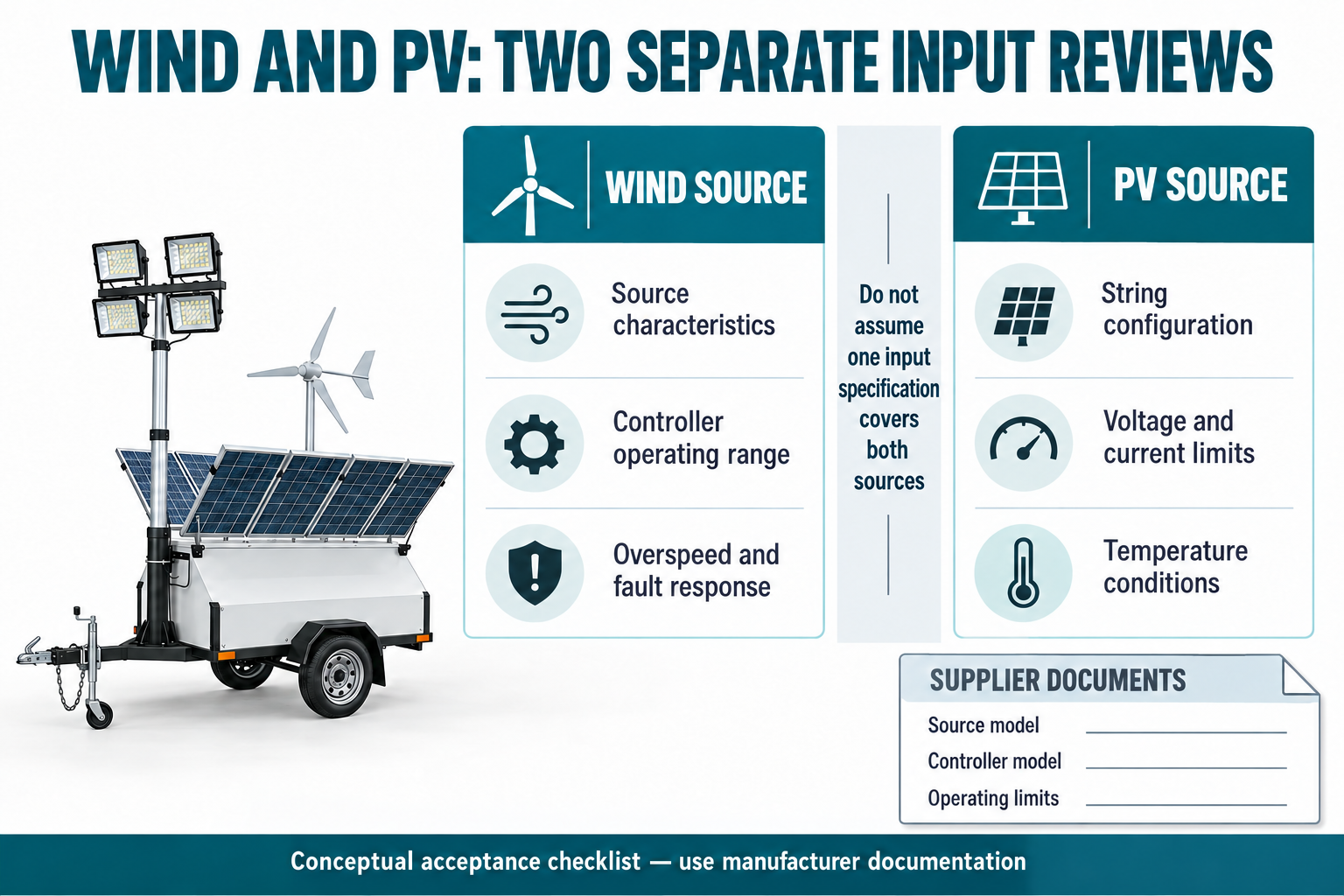
Diagram explained: Wind input review: check source characteristics, controller operating range, and documented overspeed or fault behaviour. PV input review: check the approved string configuration, voltage and current limits, and temperature conditions. Do not assume one input specification covers both sources.
Solar arrays and wind turbines have different electrical and operational characteristics. The Department of Energy’s small-wind guidance describes batteries and charging control as parts of an off-grid system. Its solar-design resources describe the wider components needed around photovoltaic generation. These resources explain why integration matters; they do not approve a universal controller or provide settings for the illustrated trailer. Use the turbine and array manufacturers’ documentation for the actual input requirements.
Ask whether the design uses separate source controllers, a combined unit, or another documented architecture. Where a wind system uses a particular braking, diversion, or load-management arrangement, obtain its specified operating and failure behavior. Do not disconnect a turbine or substitute a solar controller based on an internet diagram. A qualified person must follow the approved isolation and service procedures. The inquiry should reveal these responsibilities without asking an unqualified operator to test potentially hazardous electrical conditions.
Match the battery before discussing settings
Request the battery chemistry, approved configuration, documented operating limits, and charging instructions for the supplied assembly. Identify any required communication between the charger and battery-management system. A nominal voltage match is not enough to demonstrate compatibility. The supplier should explain how the controller respects the battery’s permitted operation and what happens when a required signal is unavailable. Keep those answers connected to the exact battery and controller models, rather than to a generic product family.
Do not publish or copy numerical setpoints without the approved documentation. Temperature, battery condition, current limits, and protection behavior can matter, but the correct values depend on the equipment. If a quotation lists selectable battery profiles, ask who selects and verifies the appropriate profile at commissioning. Record how configuration changes are authorized and retained. The handover should make clear that an operator cannot solve a charging complaint simply by choosing a more permissive profile.
Use a component compatibility checklist
| Interface | Evidence to request | Acceptance question |
|---|---|---|
| Photovoltaic input | Approved array and controller input documentation | Is the offered array configuration within the documented range? |
| Wind input | Turbine-controller compatibility and specified control arrangement | Are the turbine’s permitted operating and fault conditions addressed? |
| Battery connection | Exact battery charging requirements and any communication specification | Does the charging system support this supplied battery configuration? |
| Protection and isolation | Manufacturer’s arrangement and qualified review | Can authorized staff isolate and service the specified system safely? |
| Load coordination | Documented lighting and auxiliary-load behavior | What happens to the lighting when a relevant energy limit is reached? |
| Replacement component | Written approval for the existing machine configuration | Does the replacement preserve the documented system behavior? |
This is an original qualitative review table, not a wiring design or certification checklist. It is intended to organise the supplier’s evidence. The responsible designer and applicable project requirements determine the detailed acceptance method, while the equipment documentation controls configuration and service procedures.
Separate charging capability from available energy
A controller rating does not create sunlight or wind. Even a correctly integrated system may receive insufficient renewable energy at a particular site. Keep the resource assessment and energy budget separate from the compatibility review. The expected lamp demand, operating duration, battery usable energy, and reserve need their own documented basis. A larger controller cannot compensate automatically for shade, an unsuitable turbine location, or a lighting duty that exceeds available supply.
For a planning example, a load of 300 watts operating for eight hours requires 2,400 watt-hours at the load before separately assessed losses and auxiliary demand. This follows E = P × t, using watts and hours; it is arithmetic, not a specification or runtime claim for the pictured equipment. The controller’s input rating should not be entered as though it were continuous generated power. Use verified source and battery information to build the actual energy balance, including the assumptions and uncertainty relevant to the deployment.
Review concurrent sources and limiting conditions
Ask how the approved system behaves when both renewable sources are available, when only one is available, and when the battery reaches a relevant charging limit. The answer may involve separate devices and coordinated protection rather than one central control screen. Request a functional description that connects those conditions to the relevant components. Where the supplier identifies a limit, record what the operator sees and which actions are permitted.
Also ask about the failure of a required sensor or communication path. A system may enter a restricted mode, issue an indication, or require qualified service according to its design. The buyer should not guess that it will continue normal charging. Request the specified behavior and a safe demonstration method. Do not create a real battery fault, overspeed event, or electrical overload to test the brochure. Use manufacturer-approved simulation or commissioning procedures under the required supervision.
Make the site review part of acceptance
The reference product places solar panels and a small wind turbine on a mobile trailer. Its appearance does not establish the renewable yield at a particular site. Review the documented deployment restrictions, mechanical clearances, ground conditions, shading, surrounding obstacles, and the manufacturer’s permitted operating conditions. Keep the electrical compatibility decision separate from the question of whether the location is suitable for the equipment. Both must be addressed before relying on the system for a shift.
Arrange inspection access without opening live equipment or improvising a service platform. Panels, turbine, mast, towbar, and wheels create a physical configuration that must remain consistent with the approved instructions. An attractive sunny location may still interfere with vehicle movement or required clearances. Record the accepted placement and the conditions that trigger another assessment. If the trailer is moved, the original resource and obstruction assumptions may no longer describe the new position.
Verify the installed configuration through records
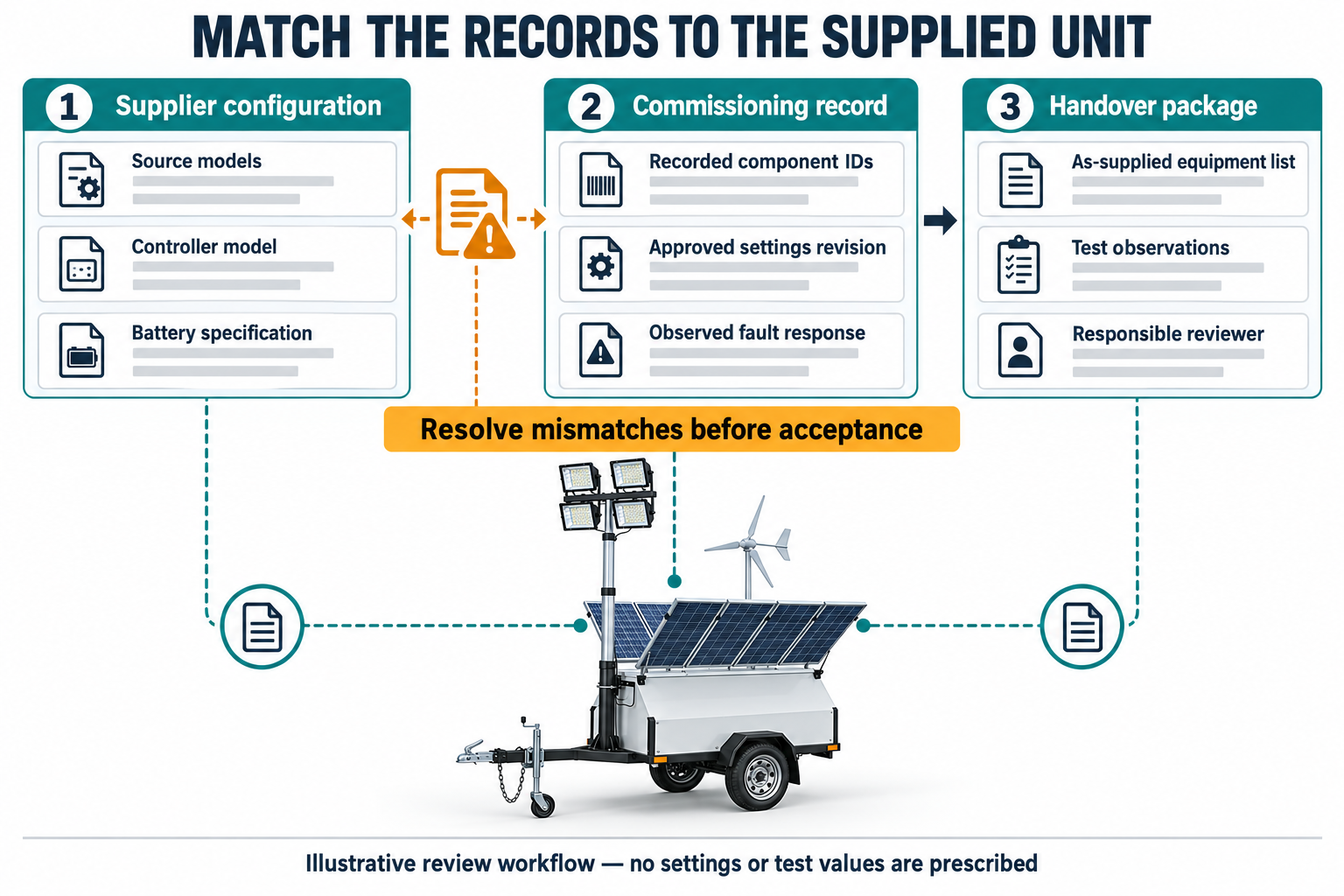
Diagram explained: Compare three records: the supplier configuration, the commissioning record, and the handover package. Cross-check component identity, approved settings revision, and actual observations. Resolve mismatches before acceptance; no values are prescribed.
At delivery, compare the controller and battery identification with the accepted component schedule. Have the authorized commissioning team verify the configuration through the manufacturer’s approved procedure. Retain the configuration record, firmware or revision information where relevant, and the results of the specified checks. A photograph of a closed enclosure can identify the machine but cannot establish its internal settings or electrical compatibility.
Review displayed information against its documented meaning. Charging current, power, battery state, and accumulated energy may represent different measurement points or estimates. Ask which readings are directly measured and which are calculated. Keep units and timestamps with recorded values. A short period of positive charge does not prove that the battery will recover after a full lighting shift. That requires the separately defined duty, resource conditions, and appropriate duration of operational observation.
Investigate poor charging without changing the design
When charging appears low, start with the approved observation and fault-reporting procedure. Record the conditions, the exact indication, the time, and any recent changes. Have qualified staff distinguish resource limitations from configuration, wiring, sensor, or component issues. An absence of strong sunlight and an incompatible replacement part are different problems, even if both appear as a low battery indication at the end of a day.
Do not bypass a protection function, alter a battery profile, or substitute a controller to see whether the number improves. Such changes can obscure the original issue and create new risks. Use the supplier’s service process and preserve the before-and-after records for authorized work. If the original lighting duty is no longer appropriate for the site, reassess the duty and energy provision explicitly. Calling that a controller fault would lead to the wrong corrective action.
Request a complete handover package
Ask the supplier to deliver the component schedule, approved architecture, relevant manuals, configuration record, protection and service information, commissioning results, and limitations. Include the exact spare-part approval process. Clarify the division of responsibility between the tower supplier, battery supplier, controller provider, installer, and site operator. That division matters when a field replacement or software update affects more than one component.
A useful final acceptance record ties each requirement to evidence rather than declaring the system universally efficient or maintenance-free. It identifies what has been demonstrated, what remains dependent on site resources, and which conditions require review. The buyer can then evaluate the charge controller as a coordinated part of the machine while keeping battery reserve, turbine sizing, lamp scheduling, and field energy yield as related but separate engineering decisions.
Equipment and complementary planning
Confirm the offered configuration on the Keyyou product page. Use the mobile light tower guide for the wider equipment framework. Complement this assessment with wind solar light tower turbine sizing and hybrid light tower battery reserve.
Further learning: photovoltaic generation
TED-Ed presents Richard Komp’s educational explanation of how photovoltaic cells convert sunlight into electricity. This supports the distinction between the solar resource and charging-system compatibility. It does not establish a trailer configuration, controller setting, energy yield or runtime.
Watch How do solar panels work? – Richard Komp by TED-Ed.
Frequently asked questions
Can a solar controller be substituted for a wind controller?
Do not assume interchangeability. Obtain written compatibility for the turbine, array, battery, protection, and approved architecture; a qualified person must follow the manufacturer’s procedures.
Does a larger controller guarantee a full battery each day?
No. A controller rating is not renewable energy production. Resource conditions, source configuration, battery limits, losses, and the actual lighting duty need their own documented assessment.
Which charging settings should an operator choose?
Use only the approved configuration for the exact equipment and battery. Settings and changes require the manufacturer’s instructions and authorized commissioning or service.
Sources and scope
The linked official resources provide educational background and relevant safety or connected-system context. They do not certify this machine, define its configuration, or replace the supplier documentation and the applicable site assessment.