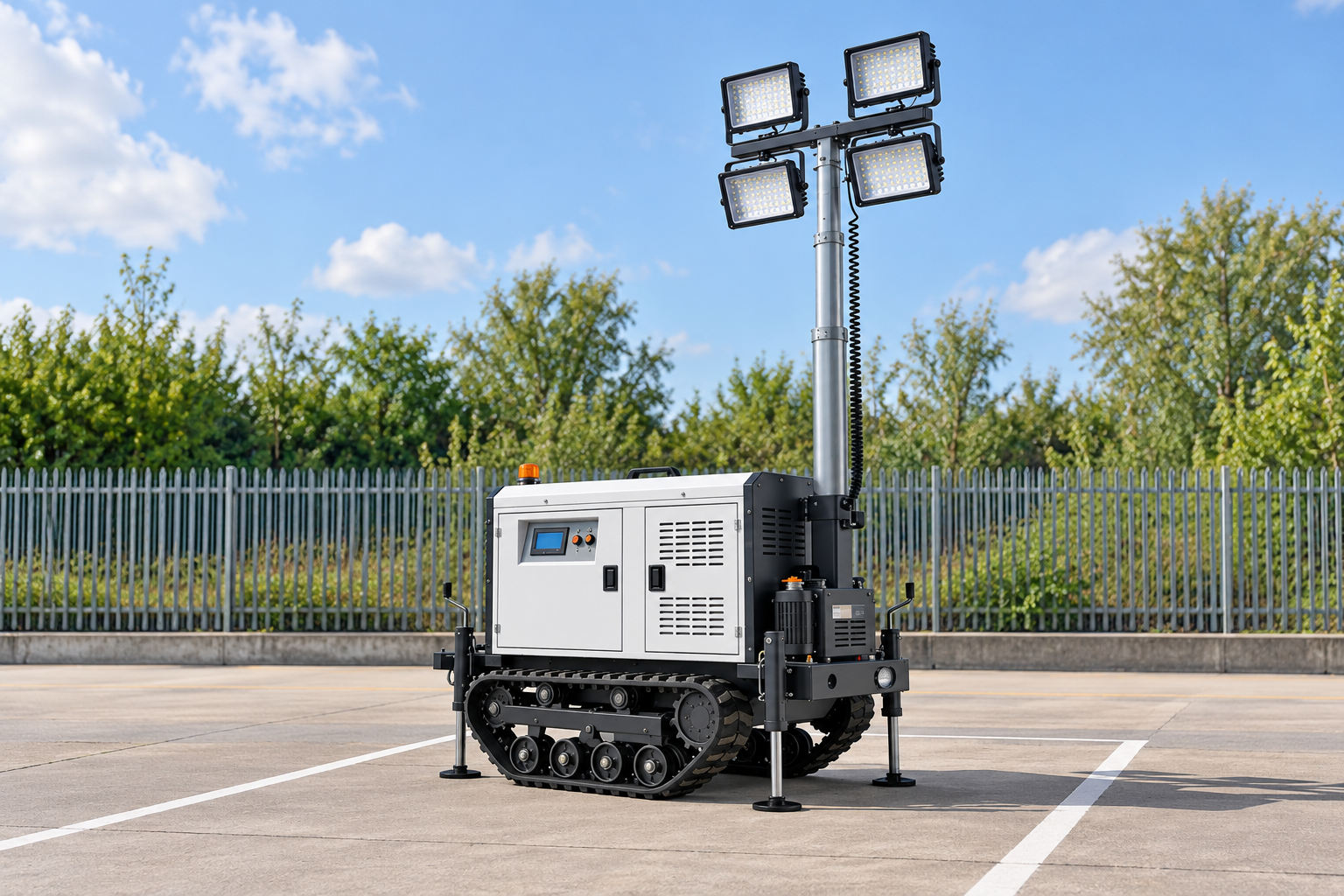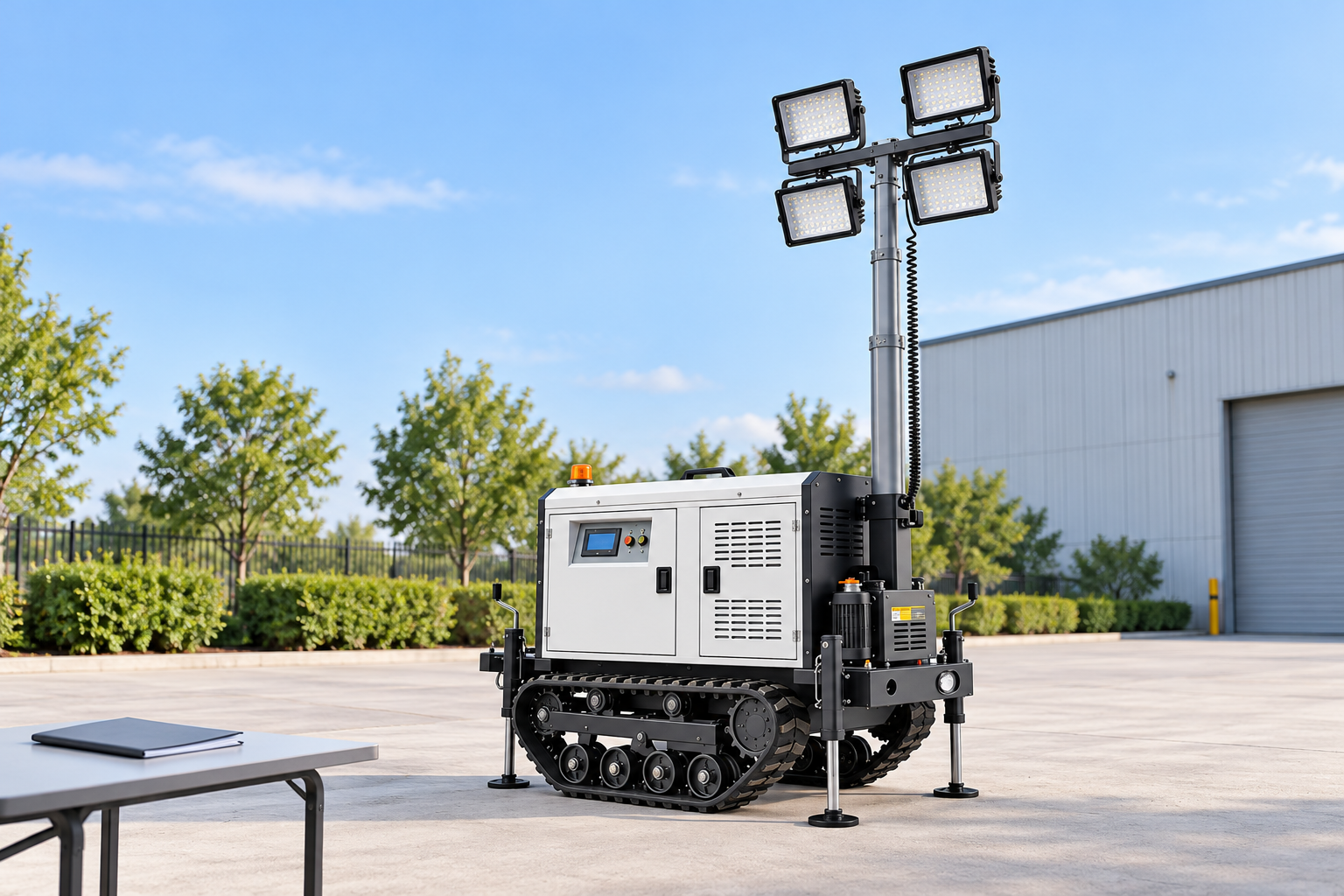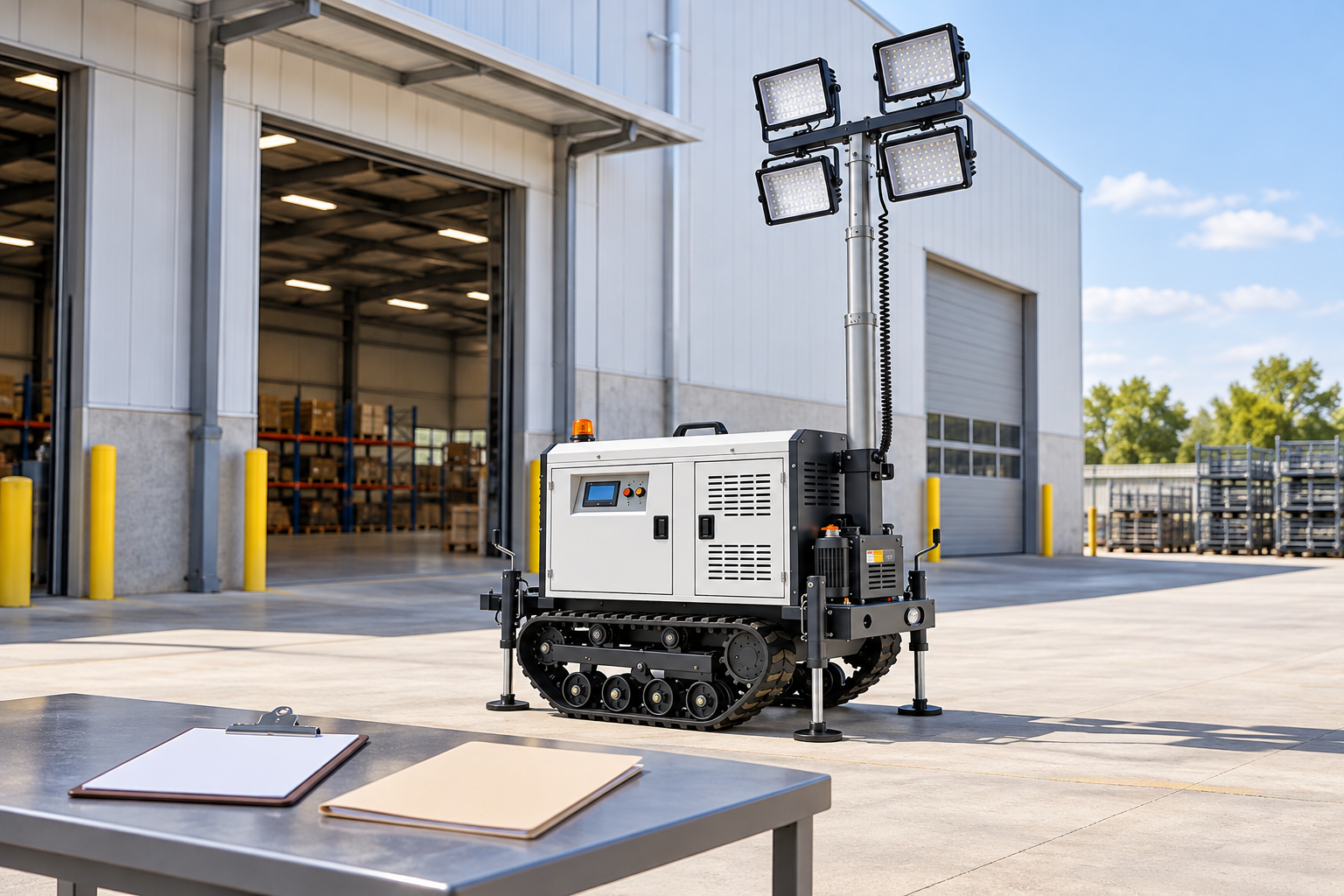

What Should a Trailer Light Tower Setup Checklist Cover On Site?
A trailer light tower setup checklist should confirm a suitable parking position, documented support and stabilisation steps, a clear work zone, visible equipment condition, and an approved handover before normal lighting operation. It covers first deployment after arrival, not road transport, buying selection, or long-term maintenance.

Part 1. What does first-time site setup decide?
First-time site setup decides whether the arrived unit can be positioned and prepared for mast movement under the selected model’s instructions. It does not decide whether the buyer chose the right tower, whether the road move was completed correctly, or what maintenance interval applies later.
| Decision | Belongs in setup checklist | Belongs elsewhere |
|---|---|---|
| Parking position and access | Yes | — |
| Support / stabilisation before mast movement | Yes | — |
| Overhead and side clearance awareness | Yes | — |
| Pre-dispatch tow and transit checks | No | Transport checklist before dispatch |
| Procurement and model selection | No | Trailer-mounted tower selection factors |
| Shade, weather, and operating-hour survey inputs | No | Pre-mobilization site survey worksheet |
| Routine service observations | No | Field maintenance checklist |
Part 2. How should the team define the setup boundary?
Define where transport ends and setup begins. Transport ends when the unit is delivered and the arrival condition is recorded. Setup begins with positioning and ends when the unit is ready for the approved mast-raising and lighting sequence—or when a stop condition requires qualified review.
Keep three roles separate:
- Site team: position the unit, complete visual checks, control the work zone, and record handover.
- Authorized operators: follow only the mast, support, and control steps assigned in the selected manual.
- Qualified service: resolve damaged structure, uncertain support, or any condition the manual treats as unsafe.
Important: Do not raise the mast until the selected unit’s support, leveling, and clearance requirements are confirmed. General industry practice treats stabilization and leveling as prerequisites for mast-type equipment, but exact steps remain model-specific. Source: OSHA rigging-up eTool; Equipment World light-tower safety guidance.
Part 3. What should be checked at the parking position?
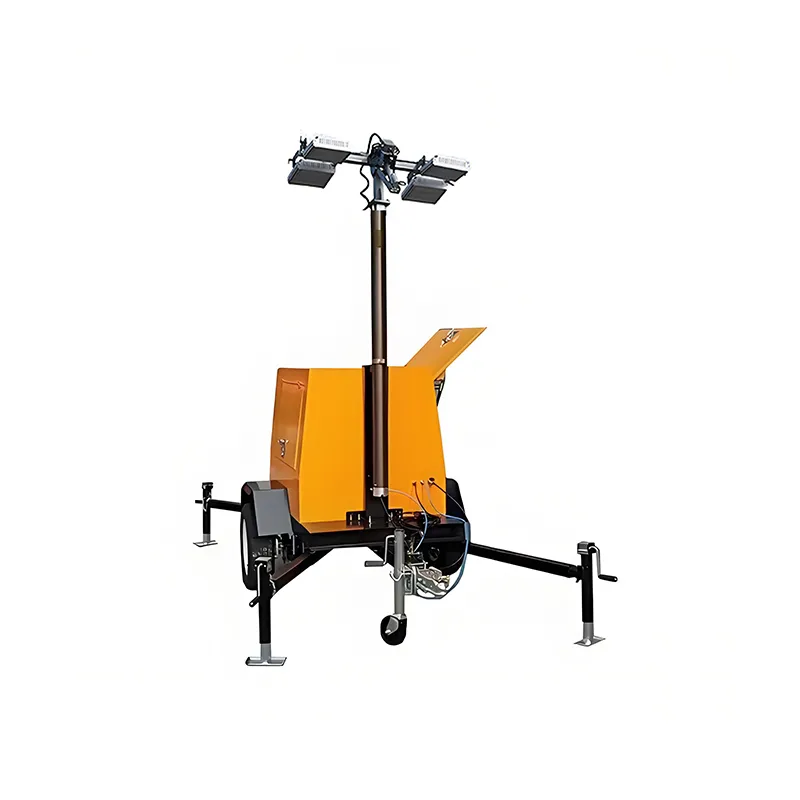
Choose a parking position that the team can access safely, that appears suitable for the planned support method, and that keeps the intended lighting area and travel paths in view. Reconfirm any site-survey notes that affect placement, then verify the ground surface, slope, soft spots, standing water, vehicle traffic, and pedestrian routes around the planned footprint.
| Position check | Observe | Stop condition |
|---|---|---|
| Ground support | Soft ground, voids, debris, standing water, or unstable fill | Position cannot support the documented setup method |
| Slope / level | Obvious tilt that conflicts with the manual’s leveling process | Leveling cannot be completed as required |
| Access | Blocked approach, trapped egress, or conflicting vehicle path | Unit cannot be approached or left safely |
| Overhead and side space | Lines, branches, structures, scaffolds, or crane swing | Clearance for planned mast movement is uncertain |
| Lighting task view | Position cannot serve the intended work area without unsafe placement | Relocate or revise the lighting plan |
A setup checklist records the position decision. It does not create a lux layout, wind rating, or certified placement approval.
Part 4. Which support and visible-condition checks come before mast movement?
Before any mast movement, complete the support and visible-condition checks required by the selected model. Common industry concerns include level trailer condition, outriggers or stabilisers where fitted, locking pins, cable condition, and obvious damage. Import only the sequence from the actual manual.
| Check group | Record | Do not improvise |
|---|---|---|
| Parking brake / chocks / immobilisation | Applied as the manual requires | A generic chock pattern from another trailer |
| Outriggers / stabilisers / supports | Extended or set only as documented | Guessed pad size, torque, or span |
| Level indication | Confirmed by the approved method | “Looks level enough” |
| Visible mast and fixture condition | Damage, loose-looking hardware, abnormal cable routing | Repair or force a damaged pin |
| Doors, covers, and controls | Closed or positioned as required before mast movement | Bypass an interlock or warning |
OSHA vehicle-inspection guidance supports correcting apparent defects before equipment is placed in service. If a visible defect remains open, stop the setup decision.
Part 5. How should the team control the mast-movement work zone?
Control the area around the planned mast path before authorized operators begin mast movement. Keep people, vehicles, and temporary structures outside the exclusion zone defined by the site rules and the equipment instructions. Confirm overhead and side clearance again immediately before movement starts.
Work-zone sequence
- Mark or communicate the exclusion area for the planned mast path.
- Confirm no overhead line, branch, scaffold, or structure intersects the planned movement.
- Keep only authorized operators in the control position.
- Stop if wind, visibility, ground change, or an alarm makes the condition uncertain.
- Record who authorized the move and the time setup was completed or stopped.
Tip: Aerial-lift and mast-type work controls emphasize solid support and work-zone awareness. Use them as hazard prompts, then apply the light-tower manual for the actual sequence. Source: OSHA aerial-lift fact sheet; selected model operator manual.
Part 6. Which configuration questions belong in the RFQ?
Ask for the intended parking surface, expected support method, overhead-obstruction notes, local work controls, arrival condition, required documents, and whether the unit must be relocated during the project. The listed trailer solar light-tower configuration is a starting point for configuration review; it does not prove a setup limit, clearance distance, or certified site suitability.

Product recommendation: use the listed trailer solar light-tower configuration when the project needs a trailer-style solar mobile lifting tower as a document-review starting point. Confirm the supplied version’s setup instructions before assigning a first-deployment procedure. Related constructions are listed under trailer-style mobile light towers.
Fit Boundary
This checklist is suitable for first-deployment readiness after arrival. It is not suitable as a mast-raising training manual, a wind or clearance calculator, a grounding specification, a lighting-layout design, or evidence of a Keyyou site approval. For a configuration discussion, send the site position and model details.
Part 7. When should setup stop?
Stop setup and obtain qualified review when the parking position is unsuitable, support or leveling cannot be completed as documented, a visible defect is unresolved, overhead or side clearance is uncertain, the manual is unavailable, or site work controls are incomplete.
Do not convert an incomplete setup form into “raise carefully.” If the team still needs ongoing observation after the unit is in service, use the maintenance process rather than expanding this first-deployment checklist into a service schedule.
After first deployment is complete, use the light tower pre-operation inspection.
FAQs
Where should a trailer light tower be positioned on a temporary site?
Choose a position with suitable ground support, safe access, and enough clearance for the planned mast path, while still serving the intended work area. Confirm the decision against the selected model’s setup instructions.
Why must a tower be level before the mast is raised?
Leveling and support reduce the risk of unstable mast movement. Use the selected unit’s approved leveling method rather than a visual guess.
What should be checked above a mobile light tower?
Check for lines, branches, structures, scaffolds, crane paths, and any other obstruction that could intersect the planned mast movement.
When should stabilizers or outriggers be used?
Use them only as the selected model’s manual requires for the planned setup. Do not copy pad sizes, spans, or sequences from another trailer.
What should stop a setup before the mast is raised?
Stop for unsuitable ground, incomplete support or leveling, unresolved visible defects, uncertain clearance, missing manuals, or incomplete work-zone controls.
What should be recorded at site handover?
Record unit ID, arrival condition, final parking position, support/level confirmation, clearance notes, open defects, and the person authorizing setup completion or stop.
Is transport part of the setup checklist?
No. Pre-dispatch transit and tow checks belong in the transport checklist. Setup begins after arrival.